Feedback Loops
Three-minute radio loops on the science of scraps, soil and everything in between — 106 episodes and counting.
 Loop106
ACC JAWS
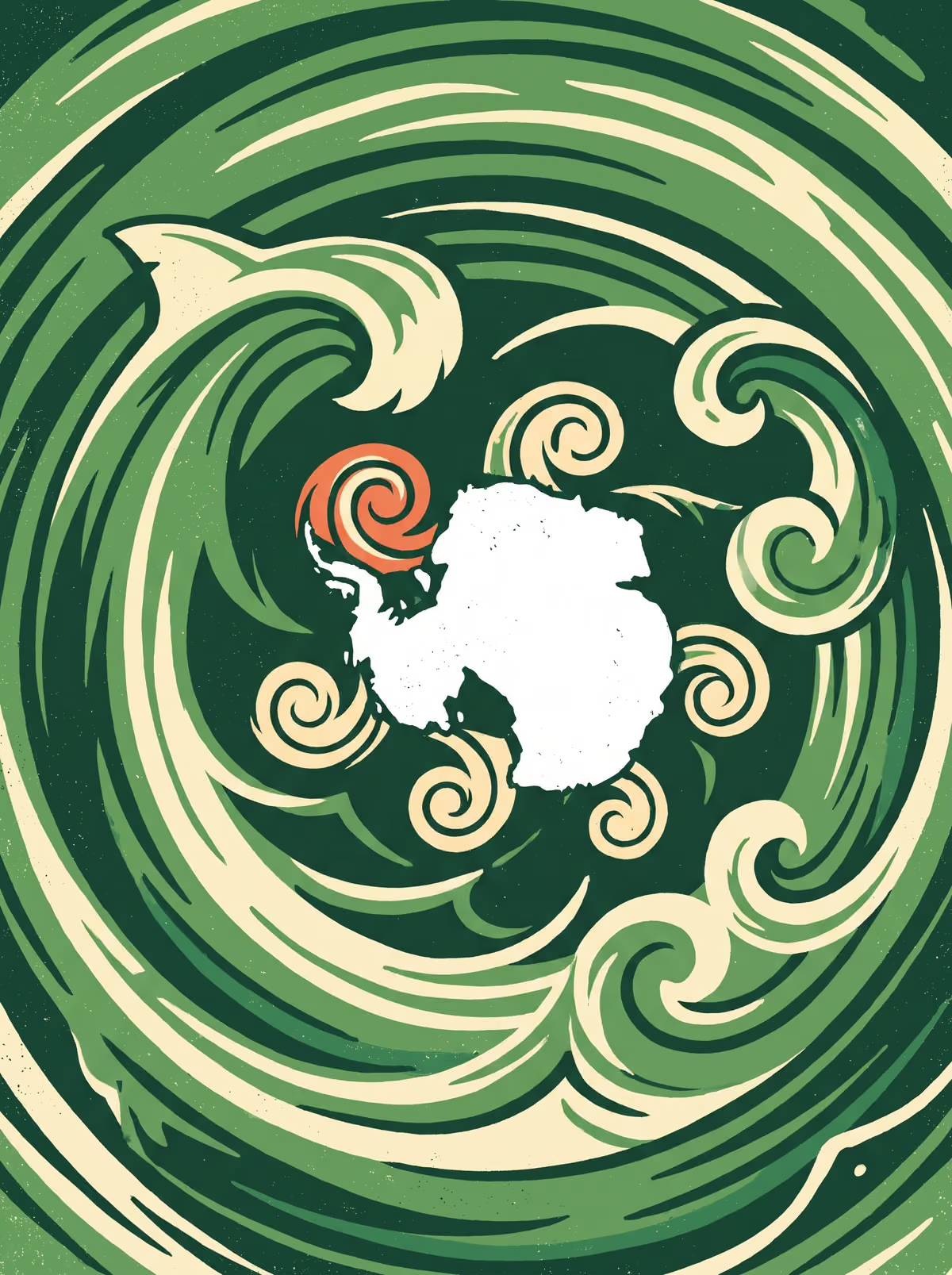
Something bigger than a great white is circling Antarctica. The Antarctic Circumpolar Current - 150 times the flow of every river on Earth - spins off eddies sixty miles wide that batter the ice shelves for a month at a time. Why engineers dream of a 50-by-100-mile underwater net, and what your food scraps have to do with it.
Hi, I'm Jenny Mason, your tour guide to feedback loops, a journey through food waste cycles and the solutions that curb climate change. Something big is swirling around the southern ocean. Bigger than a great white shark. Careful, don't get too close to the Hahahaha! That is the ACCC, Antarctic Circumpolar Current. This current is many hundreds of miles across, and is 150 times larger than the outflow of all the world's rivers combined. Because the southern hemisphere holds more ocean than landmass, the ACCC rockets around like like a formula one car. It's so fast, smaller eddies peel off it and go whipping through the ocean. Often, they slam into Antarctica's ice shelves. With the average eddy measuring over 60 miles across, the impact is huge, and the barrage can span a whole calendar month. The eddies crack and crumble the ice shelves while also generating powerful tides that pry the ice shelf up off the land. Warm water funnels under the ice, which further melts and cracks it. The shelves act like fences that keep the three mile thick glaciers on the continent from slipping off the land and spilling into the sea. Some engineers want to block the ACC eddies using a giant underwater net anchored to the ocean floor. However, building and installing a 50 by 100 mile net is going to take at least 15 years. In the meantime, ordinary households prevent the ACC-celerated global heating, driving polar ice melt when they convert food scraps to compost. Feedback loops is produced in collaboration with Table-to-Farm Compost in KDUR. For more information about curbing food waste, visit table-to-Farmcompost.com.
 Loop105
Ice Got You Babe
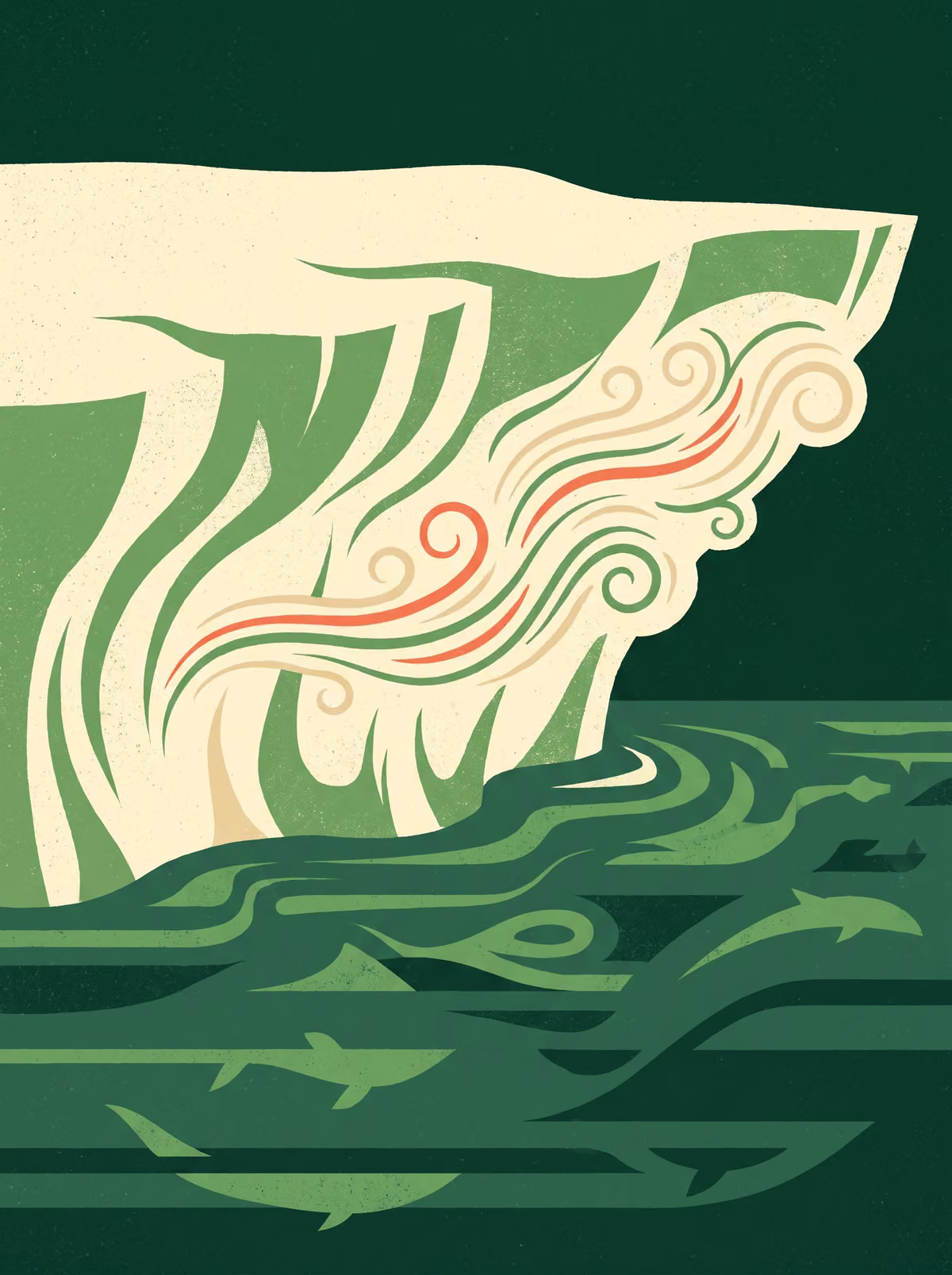
When a submersible robot scanned the underside of Antarctica's ice shelves, scientists expected a smooth plain. They found something groovier - and far less stable. A story about carved ice, warm-water feedback loops, and why groovy and cool do not mix.
Hi, I'm Jenny Mason, your tour guide to feedback loops, a journey through food waste cycles and the solutions that curb climate change. The hippie era gifted society, bell bottoms, psychedelics, civil rights, and sunny and share. We also inherited new expressions like far out, groovy, and cool. Unfortunately for surviving hippies, scientists are finding that groovy and cool don't mix. This discovery was made while using a submersible robot to scan the underbelly of Antarctica's ice shelves. Much to their surprise, researchers found not a flat or gently undulating ice plane, but rather a wildly carved, channeled and chewed underside. Were there monstrous ice-eating termites no one knew about? No, but there were tumbling, rumbling water currents all around the continent. At temperatures slightly warmer than freezing, these swirling waters acted just like termites. The groove suggests that Antarctica's ice shelves are far less stable than previously thought. And to make matters worse, all those grooves and divots act as holding cells for warm water. The longer the warm water stays in contact with the cool ice, the more it melts, making bigger channels and divots to hold even more water. The cycle intensifies itself in a constant feedback loop. The grooveier the ice gets, the less cool it is. So long as more people convert food scraps to compost, we can all chill out because... Babe, ice got you, babe! Feedback Loops is produced in collaboration with Table to Farm Compost in KDUR. For more information about curbing food waste, visit TableToFarmCompost.com
 Loop104
Nail Biter
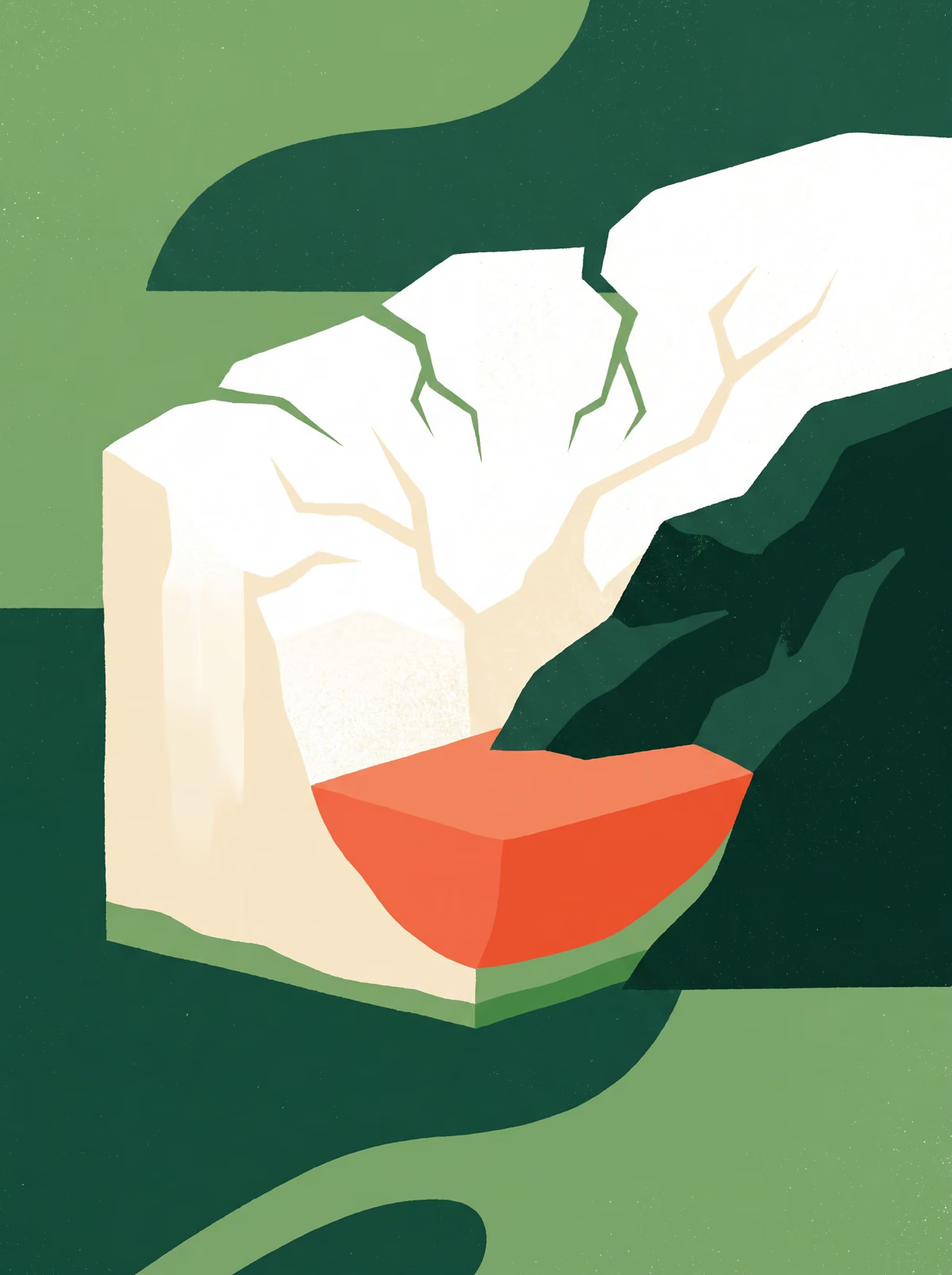
Antarctica's ice sheet has a fingernail, and something is chewing at it. The grounding line - where ice, land and ocean meet - is retreating up to 2,300 feet a year. What happens when warm water gets under the nail.
Hi, I'm Jenny Mason, your tour guide to Feedback Loops, a journey through food waste cycles and the solutions that curb climate change. Look at your fingernails. Go on, it's for science. See where the nail transitions from being firmly attached to the skin to freely extending out into thin air? Antarctica's ice sheet is its fingernail. Currently, climate scientists are obsessed with what's happening under that nail. At the edge or grounding line, where land and ice connect. As the planet heats up, warming sea water accumulates along the grounding line where it chooses at the ice and pushes the line farther back. In 2025, researchers analyzed a quarter-century of polar data and found that the grounding line retreats by 2300 feet per year, which is way faster than they thought. In some places, the grounding line has shifted back some nine miles, and the continent's topography is speeding up the process. From the coastline inland, the land dips down like a bowl due to the weight of all the ice. As warm water breaches the grounding line, it spills down into this bowl and gradually forms a lake. The lake heats and destabilizes all the ice above it, further speeding up the melting process. Imagine something chewing the tissue out from under your nails until finally they pop off. Will Antarctica's ice cap break off and flood the ocean? We might avoid that nail-biter catastrophe if ordinary people convert food scraps to compost. Feedback loops is produced in collaboration with Table-to-Farm Compost in KDUR. For more information about curbing food waste, visit Table-to-FarmCompost.com.
 Loop103
Not So Hot
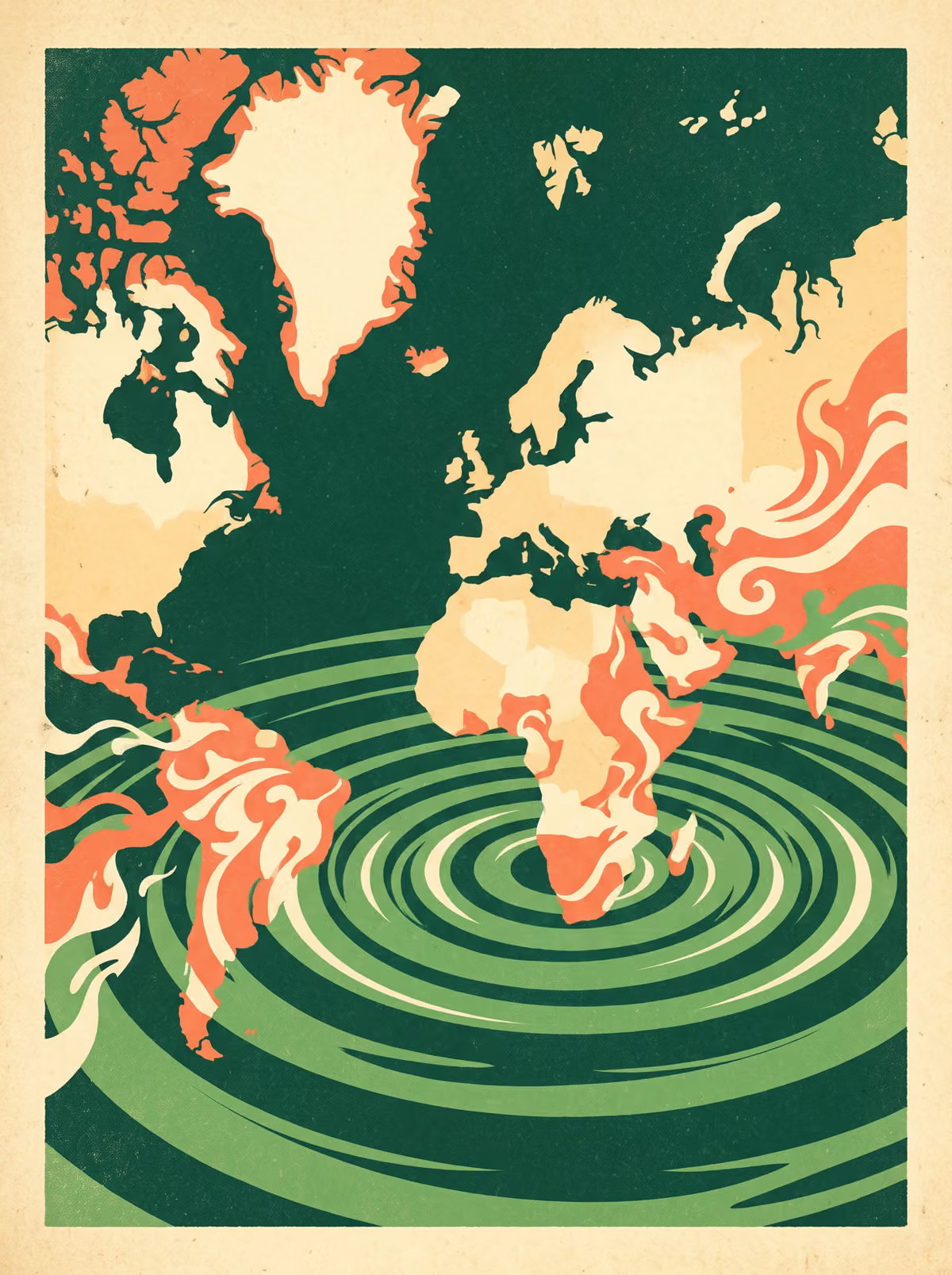
The world map in your head is due for a redraw. Melting even a small fraction of the Antarctic ice sheet would lift the oceans ten feet - enough to erase the Everglades, drown coastlines from Shanghai to New York, and reshape every continent.
Hi, I'm Jenny Mason, your tour guide to feedback loops, a journey through food waste cycles and the solutions that curb climate change. I don't know how you studied for your grade school geography tests, but I relied on memorizing countries and continents by their shape. For example, South America resembles a yam, while Africa is the one that looks like a lung. Italy is a boot, and the waffle cone is India. Unfortunately, the conventional world map image we all carry around in our heads is likely to radically change in the coming years as sea levels rise. One of the biggest drivers of this phenomenon is massive ice melt chipping away at the ice sheets covering Greenland and Antarctica. Actually, melting only a small fraction of the Antarctic ice sheet would be enough to trigger a 10-foot rise in global ocean levels, which is plenty to redraw all the maps. Florida's Everglades, Gone, the Netherlands, submerged along with most of Bangladesh and China's east coast from Shanghai to Beijing. New York, Edinburgh, and Kolkata, all underwater. Scientists have recently uncovered several culprits erasing Antarctic ice and they're all in cahoots, working together like thieves in a museum heist movie. With countless wetland ecosystems and 250 million coastal residents at risk, it's worth getting more acquainted with Antarctica's shape, which I'd describe as not so hot. Good thing ordinary people prevent sea levels rising when they convert food scraps to compost. Feedback loops is produced in collaboration with Table-to-Farm Compost in KDUR. For more information about curbing food waste, visit Table-to-FarmCompost.com.
 Loop102
No Sweat
Antarctica sweats, and that meltwater is its secret armor against the warm sea. But on a hotter planet the sweat is feeding underwater storms that break the armor.
Hi, I'm Jenny Mason, your tour guide to feedback loops, a journey through food waste cycles and the solutions that curb climate change. 17 billion cubic miles. That is how much ice sits atop or around the continent of Antarctica. 90% of all ice on Earth. It piles up anywhere from one to three miles deep. It's sheer weight shoves the continent below sea level, and much of Antarctica's ice extends out over the ocean as massive ice shelves. This ice is too cold to be melted by salty ocean waters, and even though the polar sea is warm enough to melt the shelves, it typically doesn't thanks to a secret weapon. Antarctica sweats. Come spring or summer, natural melting up top drips off the sides of the mighty ice sheet. Just as your sweat cools your skin on a hot day, Antarctica's sweat cools it by buffering it from warm waters. Unfortunately, on an ever-heating planet, Antarctica's sweats a lot more than it used to. That releases a lot more freshwater into the ocean, which disrupts the density levels. The denser saltwater tumbles and tussles with the lighter freshwater. Low pressure and high-pressure cartwheel generating these underwater storms that shatter the freshwater buffer. This breach exposes the ice to the warmer waters, thus triggering more melting. More melting means more freshwater, means bigger water storms, means the cycle repeats. Fortunately, it's no sweat for ordinary people to prevent hotter oceans by converting food waste to compost. Feetback loops is produced in collaboration with Table-to-Farm Compost in KDUR. For more information about curbing food waste, visit Table-to-FarmCompost.com
 Loop101
A-Salt-ing
Why does salt melt ice, and how do the poles stay frozen in a salty sea? The answer is a chaperone story, and the chaperones are losing control.
Hi, I'm Jenny Mason, your tour guide to Feedback Loops, a journey through food waste cycles and the solutions that curb climate change. Have you heard of the South Bend Shovel Slayer? The guy who murdered his whole family and half the people on his block with a snow shovel. Such is the apocryphal horror story Kevin McCallister hears from his brother Buzz in the classic holiday film Home Alone. The killer got away with murder because he mummified his victims in salt that he sprinkled on icy sidewalks every winter. Mummy's or no, have you ever stopped to wonder why salt melts ice? And, if the ocean is full of salt, how is 15% of the sea at the North and South Poles covered in massive ice caps all the time? Well, first salt prevents water molecules from bonding into ice. It's like a chaperone on a romantic date. That is, it sits between the water molecules and stops them from hooking up. But at Earth's poles, temperatures drop so far below freezing that the water molecules snap together, kicking the salt aside. However, interactions between today's hotter atmosphere and warming oceans are shrinking these critical ice stores faster than previously thought. Keep tuning in to hear about the many factors of us salting Antarctica, which holds 90% of all ice and fresh water on the planet.
 Loop100
Old MacDonald
Old MacDonald lost the farm. Since 1948, four million family farms have vanished into a handful of corporate giants, and the soil is keeping score.
Hi, I'm Jenny Mason, your tour guide to feedback loops, a journey through food waste cycles and the solutions that curb climate change. Old MacDonald had a farm. Well, if she had it in the 1900s, she undoubtedly lost it because of mismatched farming techniques that created the dust bowl among the worst man-made ecological disasters. Historians of this era note that farmers were grossly misinformed about the Great Plains growing conditions, which assumed ample rain fell on the plain and watered all those grasses. But in fact, the ecosystem was inherently arid. Native grasses had evolved to survive using deep roots to hold onto moisture and nutrients. The industrialized farms replacing them planted crops with shallow roots. While running the soil conservation service, Dr. Hugh Hammond Bennett worked to instill the earliest regenerative farming practices across the 1940s and 50s. But our modern food belt, farm system, remains endangered. Since 1948, huge corporate farms have swallowed up some 4 million small independent farms. These family farms make up 90% of the food system, which was one goal of the Homestead Act. However, most of these operations are struggling financially as 80% of all grocery store produce comes from a few enormous corporate farms, leaving little to no room on the shelves for family-grown foods. Ordinary people literally transform the food landscape and the planet when they convert food scraps to compost. Feedback loops is produced in collaboration with Table to Farm Compost in KDUR. For more information about curbing food waste, visit TableToFarmCompost.com.
 Loop99
NRCS
As Bennett stalled before Congress, a wall of Great Plains dust rolled over Washington itself. By April, America had a soil conservation service.
Hi, I'm Jenny Mason, your tour guide to feedback loops, a journey through food waste cycles and the solutions that curb climate change. In the spring of 1935, residents of Washington, D.C. were enjoying fine weather. Dr. Hugh Hammond Bennett sat in the Capitol building before a congressional committee. He was going to urge them to create a nationalized soil conservation agency, but at the moment he was stalling. Suddenly, winds kicked up, the sky dimmed. A wall of dust rode out of the Great Plains and slammed into the nation's Capitol. Bennett then launched into his speech as a dusty haze smoked its way through crevices. He told Congress that an area the size of California had been cleared of all topsoil and plant life. The region was reduced to a parched, hard-panned dirt littered with dead cattle. Facing lung infections and financial ruin, 150,000 farmers packed up their families. They surrendered their acres to the rising sand dunes. If lawmakers didn't want America to become the next Saharan Desert, they'd need to act swiftly. Remarkably, they did. By April, they passed the act creating the new soil conservation service and installed Bennett at the helm. Today, we know it as the Natural Resources Conservation Service or NRCS, responsible for safeguarding and improving our shared resources. Converting food scraps to compost is a capital way for ordinary people to safeguard the planet's many natural resources. Feedback Loops is produced in collaboration with Table to Farm Compost in KDUR. For more information about curbing food waste, visit tabletofarmcompost.com
 Loop98
Topsoil Erosion
One man surveyed soils on three continents and saw the Dust Bowl coming thirty years early. Nobody listened to Hugh Hammond Bennett, until the sky went dark.
Hi, I'm Jenny Mason, your tour guide to feedback loops, a journey through food waste cycles and the solutions that curb climate change. You knew when a duster was coming because it made your hair tingle. Many dust bowl survivors recall the prickly buzz of static electricity in the air, sometimes hours or days before a storm emerged on the horizon. The storms killed livestock and gnarled crops. They drove millions out of the great plains away from the dire straits and into the status quo poverty of the Great Depression. But there was at least one person who knew this disaster was coming nearly three decades before it struck. Dr. Hugh Hammond Bennett was in North Carolinian Farm Boy, who later pioneered the budding field of soil conservation. In the early 1900s, Bennett surveyed topsoil samples around the U.S., as well as in 80 other countries. Costa Rica, Alaska, Honduras, Cuba, Guatemala, and South Africa and America's Great Plains all shared the same problem, topsoil erosion. Industrialized farming treated the land like, well, like dirt. It drained away all the nutrients, leaving behind dead topsoil that can't support plants. No plants means no roots to hold the soil in place. Bennett tried to warn America's farmers, but they refused to listen. But Bennett did not give up. He could foresee the future and he was going to use it to his advantage. Converting food scraps to compost, Bennett fits everyone as it feeds the soils that feed us and curbs climate change. Feedback loops is produced in collaboration with Table-to-Farm Compost in KDUR. For more information about curbing food waste, visit www.table-to-farmcompost.com
 Loop97
Derecho
Imagine a mountain range sprinting straight at you. Derechos are storms that do not spin, they charge, and a hotter planet is training them to run year-round.
Hi, I'm Jenny Mason, your tour guide to Feedback Loops, a journey through food waste cycles and the solutions that curb climate change. It's one thing to admire, a towering Colorado mountain range, but imagine that mountain range sprinting at you, booming and boiling. This very sight terrified millions of Americans in the 1930s who endeared the Dust Bowl. For a decade, massive storms howled across the great plain states, creating dust storms that towered hundreds of feet high and hundreds of miles across. Surprisingly, we still see these storms today. The scientific name is Derecho, which is the Spanish word for straight ahead. Derechos are a blustery cousin of tornadoes and hurricanes. The only difference being, they do not spin. Instead, they arrow across landscapes. Unleash a Derecho over loose, dry topsoil and you get a massive dust storm or hoboob. The hoboob that you see on social media, ripping across Arizona and New Mexico, are descended from the 1930s black blizzards. Recordkeeping back to 1888 suggests that Derechos are cyclical, recurring every one to four years. But new data indicates that we may be in store for another prolonged Dust Bowl. A hotter planet creates longer-lasting droughts. It also intensifies storms. Instead of being a seasonal, great plains phenomena, Derechos could morph into a year-round monster that reach farther across the entire U.S. Ordinary people counteract this cycle duratially when they convert food scraps to compost. Feedback Loops is produced in collaboration with Table-to-Farm Compost in KDUR. For more information about curbing food waste, visit Table-to-FarmCompost.com.
 Loop96
Dust Bowl
Dust in the bed, the dishes, the teeth. Forty years after America the Beautiful, the homesteaders' plows turned the prairie into a decade of black blizzards.
Hi, I'm Jenny Mason, your tour guide to Feedback Loops, a journey through food waste cycles and the solutions that curb climate change. Dust in the bed, on the dishes and walls and hair and eyes and ears and teeth and throats. This wind-driven dust, fine as the finest flower, penetrates wherever air can go. Avid backpacking Coloradans are likely to assume this passage describes a typical weekend in any Utah desert. However, it actually comes from Caroline Henderson, a 1930s Oklahoma homesteader. Henderson lived through the massive environmental catastrophe known as the Dust Bowl. In this decade-long disaster, extreme windstorms sparked black blizzards or dusters, extreme wind and dust storms that turned the day dark as midnight, and that scraped paint off cars and homes. The nation was reaping what it sowed after destroying the entire grassland ecosystem, less than 40 years after Catherine Lee Bates paid poetic tribute to America's amber waves of grain. The homestead Act of 1862 granted 160 acres out west to anyone over age 20 with $34 to spare. Women, immigrants, and former slaves leapt at the chance to make a fortune by turning grassland to crop land. About 4 million people infiltrated 30 states in about 120 years, but the homesteaders quickly discovered that the grasslands were about as arid as a desert. Crops failed and conditions worsened when a drought persisted through the 1930s. Converting food scraps into compost is one meaningful way to prevent future mass acres of mass acres. Feedback Loops is produced in collaboration with Table-to-Farm Compost in KDUR. For more information about curbing food waste, visit Table-to-FarmCompost.com
 Loop95
Dishwater Skies
In 2022 the skies over Nebraska turned dishwater brown as a wall of dust scraped off drought-dried farmland. The ghost of the Dust Bowl is stirring again.
Hi, I'm Jenny Mason, your tour guide to feedback loops, a journey through food waste cycles and the solutions that curb climate change. On May 13, 2022, blue skies across Nebraska and Montana turned dirty, dishwater brown. Winds whipped to speeds of 107 miles per hour, drivers on the highways pulled over to watch a wall of clouds crawl from one horizon to the other. Too late, they realized those clouds were made of pure dust scraped off drought-dried farmlands. 2022 was already found to be the driest year on record in the Great Plains. Most crop yields were down anywhere from one third to one half less than normal. The massive dust storms scuttling across the middle of America that day was both a ghost from the past and a harbinger of the future. Massive dust storms struck the nation throughout the 1930s under similar drought conditions. Strangely, even though lawmakers altered farming practices and enacted soil conservation efforts, we have still managed to recreate the circumstances that nearly obliterated our national food production. But the problem is also global. The United Nations estimates global crops will shrink by a third over the next two decades thanks to intensifying droughts and floods tied to carbon climate pollution. Luckily, ordinary people turning food scraps to compost create a plant superfood that restores the soil and curbs climate change. And they're doing it dust in time. Feedback Loops is produced in collaboration with Table to Farm Compost in KDUR. For more information about curbing food waste, visit TableToFarmCompost.com.
 Loop94
BEEleaguered
One square meter of prairie can hold more species than a patch of rainforest, and its wild bees are the most endangered pollinators on the continent.
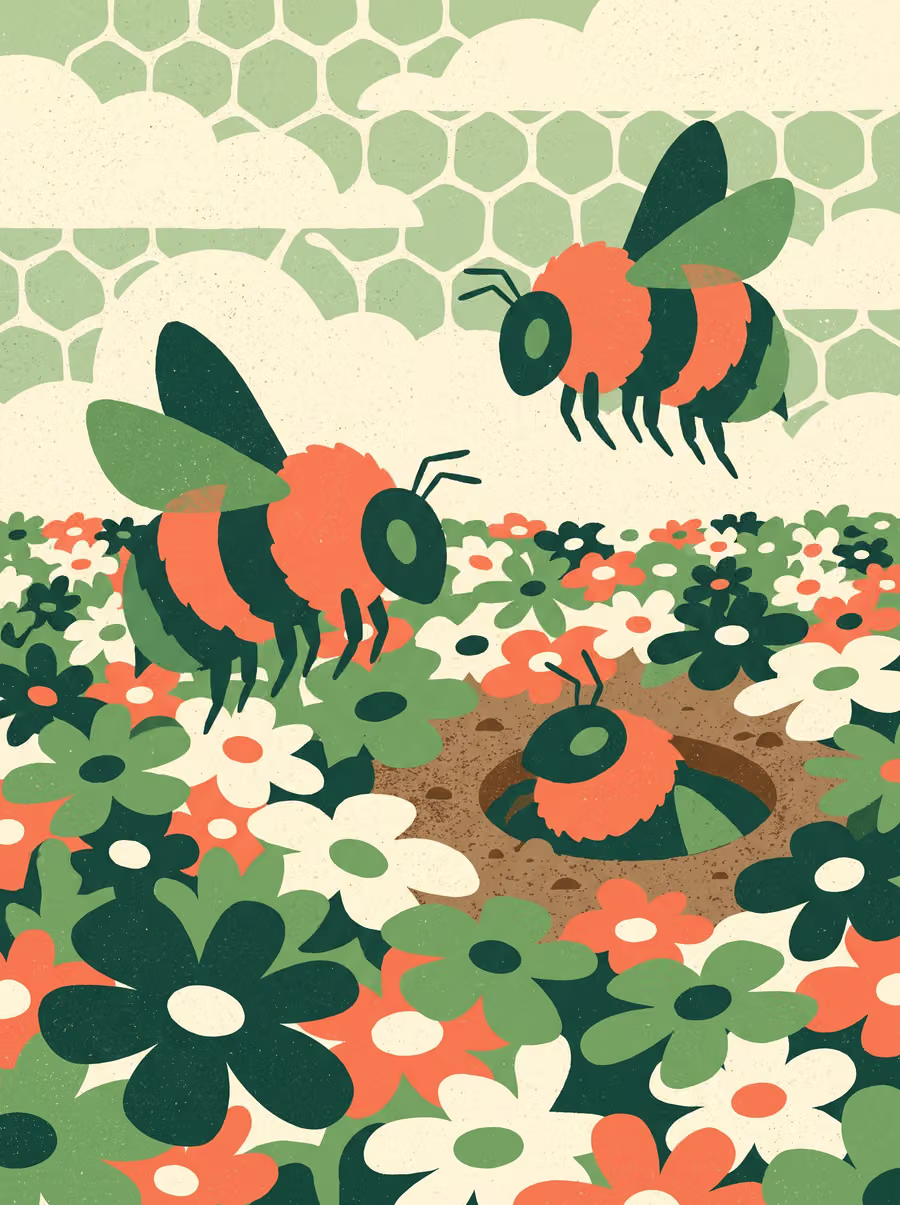
Hi, I'm Jenny Mason, your tour guide to feedback loops, a journey through food waste cycles and the solutions that curb climate change. One square meter of healthy, intact grassland can contain more species of plants and animals than a square meter of tropical rainforest. Although the millions of plains bison no longer roam this home, foxes, ferrets, coyotes, hawks, prairie dogs, hundreds of bird species and other critters still do. Prairies are also crammed with thousands of plant species, including over 350 distinct varieties of wildflowers, which rely on pollinators like flies, bees, beetles, butterflies, hummingbirds, and bats. But with grasslands disappearing, pollinator populations are in sharp decline. A 2025 study published in the proceedings of the National Academy of Sciences undertook the largest assessment of pollinator populations across the U.S. and Canada, and found that wild bees, like bumblebees, leafcutter, and digger bees, are the most endangered or bee-leagured. Bees emerged 130 million years ago soon after Earth's first flowers bloomed. Of the 4,000 wild bee species in the U.S., most rely on grasslands for survival. Not only do bees pollinate grassland flowers, they dig nests in the soil, which helps aerate it, which helps hold moisture and enables root systems to flourish. When ordinary people turn food scraps to compost, they help stabilize the climate patterns bees rely on for survival. Maybe composting can become a basic survival instinct. Feedback Loops is produced in collaboration with Table-to-Farm Compost in KDUR. For more information about curbing food waste, visit Table-to-FarmCompost.com.
 Loop93
Meadowlarks
One acre of grassland stores as much carbon as a blue whale weighs, and the birds that keep it alive have lost 40% of their numbers. The prairie's most famous singer is going quiet.
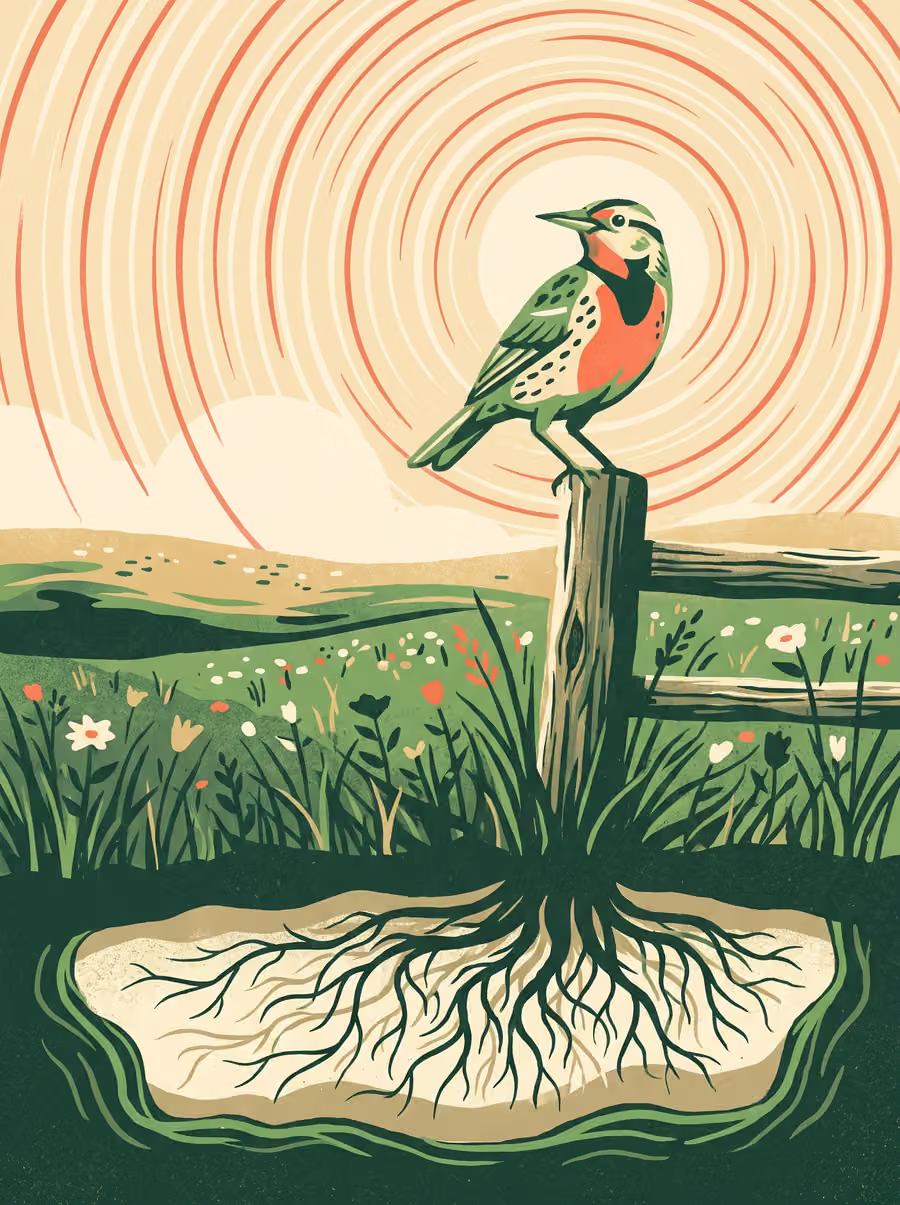
Hi, I'm Jenny Mason, your tour guide to feedback loops, a journey through food waste cycles and the solutions that curb climate change. The Western Meadowlark is an iconic prairie singer, perhaps even more famous than Martina McBride. Unfortunately, for future generations, archival recordings may be the only way to hear this famous bird song, because its populations are in decline. In fact, grassland bird species are in a tailspin, having lost over 40% of their populations since the 1970s. Within the grassland ecosystem, birds do more than chirp. They disperseeds, which help grasses and wildflowers spread. These plants are crucial defense against catastrophic planetary heating. They store gobs of carbon in their leaves and stems. They store even more carbon underground, invest route networks that can reach up to 15 feet deep. As a result, one acre of grassland stores 40 to 120 tons of carbon. That's about the weight of a blue whale. When prairie soil is churned and tilled, either for agriculture or to make way for housing developments, all that carbon is released into the atmosphere, where it traps more heat. Currently, we're losing 1 million acres of grassland per year, which is the same rate of loss as the Amazonian rainforest. That's a hard fact to swallow, because where Robin are future survival, but ordinary communities sequester climate-recking carbon by converting their food scraps to compost. Feedback Loops is produced in collaboration with Table to Farm Compost in KDUR. For more information about curbing food waste, visit TableToFarmCompost.com and visit Table ToFarmCompost.com
 Loop92
Roadtrip
Before settlement, a 500-million-acre sea of grass ran from Canada to Mexico, so tall that explorers stood on their horses to see over it. One sixth of the continent, gone to the plow.
Hi, I'm Jenny Mason, your tour guide to feedback loops, a journey through food waste cycles and the solutions that curb climate change. The summer road trip that inspired Catherine Lee Bates to write her poem America the Beautiful in 1893 revealed the national natural splendors from sea to shining sea. The amber waves of grain across the Great Plains prairies wowed her, even though they were a fraction of their old size. Prior to European colonization and settlement across North America, a 500 million acre sea of tall and short grass prairie stretched over 100 miles east to west and over 2,000 miles from Canada to Mexico. To see over the grasses early explorers had to stand atop their horses. But beginning in the 1800s, farmers converted the fertile prairies into crop lands. Those crops would go on to feed much of the world's human and livestock populations, but unfortunately they replaced some 300 million acres of grassland or one-sixth of the entire continent. Grassland biomes recharge groundwater reserves, they filter pollution from the air and they help slow down climate change by storing carbon deep underground. With over 60% of all earth's grasslands erased, scientists are urging all nations to fiercely preserve any and all remaining amber waves of grain. Hope is not beyond our grasp. Because ordinary communities sequester carbon and feed the soils that feed us when they convert their food scraps to compost. Feedback loops is produced in collaboration with Table-to-Farm Compost in KDUR. For more information about curbing food waste, visit Table-to-FarmCompost.com
 Loop91
In the Weeds
America the Beautiful was written gazing over prairies we have since erased, 99% of them. The story of our grasslands starts in the weeds.
Hi, I'm Jenny Mason, your tour guide to Feedback Loops, a journey through food waste cycles and the solutions that curb climate change. Oh beautiful for spacious skies, for amber waves of grain, for purple mountain majesties, above the fruited plain. Odds are good, you recognize these lines from the poem and song, America the Beautiful, aka our other National Anthem. Professor and writer Catherine Lee Bates penned the poem in 1893 while on a classic summer road trip. She had just written a mule to the top of Pike's Peak in Colorado and was gazing out over the prairies of Kansas when she jotted those lines in her journal. But Bates and the majority of her fellow Americans had no clue that the great planes were already under significant threat. With the United States celebrating its semi-Quincentennial this summer, that is its half of 500 years anniversary, now seems like the perfect moment to acknowledge this young nation's achievements, and also its blunders. From an environmental perspective, erasing 99% of our vital grassland biome is a colossal blunder, in upcoming installments we'll get into the weeds about how grasslands curb planetary heating, how they protect communities from drought, and prevent the collapse of global food chains. No doubt, we would have treated the prairies differently if only weed known the facts. Luckily ordinary people regenerate soil nutrients needed to restore grasslands by simply converting their food scraps to compost. Feedback Loops is produced in collaboration with Table to Farm Compost in KDR. For more information about curbing food waste, visit TableToFarmCompost.com.
 Loop90
Plastic Bath
French scientists give plastic a ten-hour enzyme bath and it dissolves back into good-as-new building blocks. A bottle in, a bottle out.
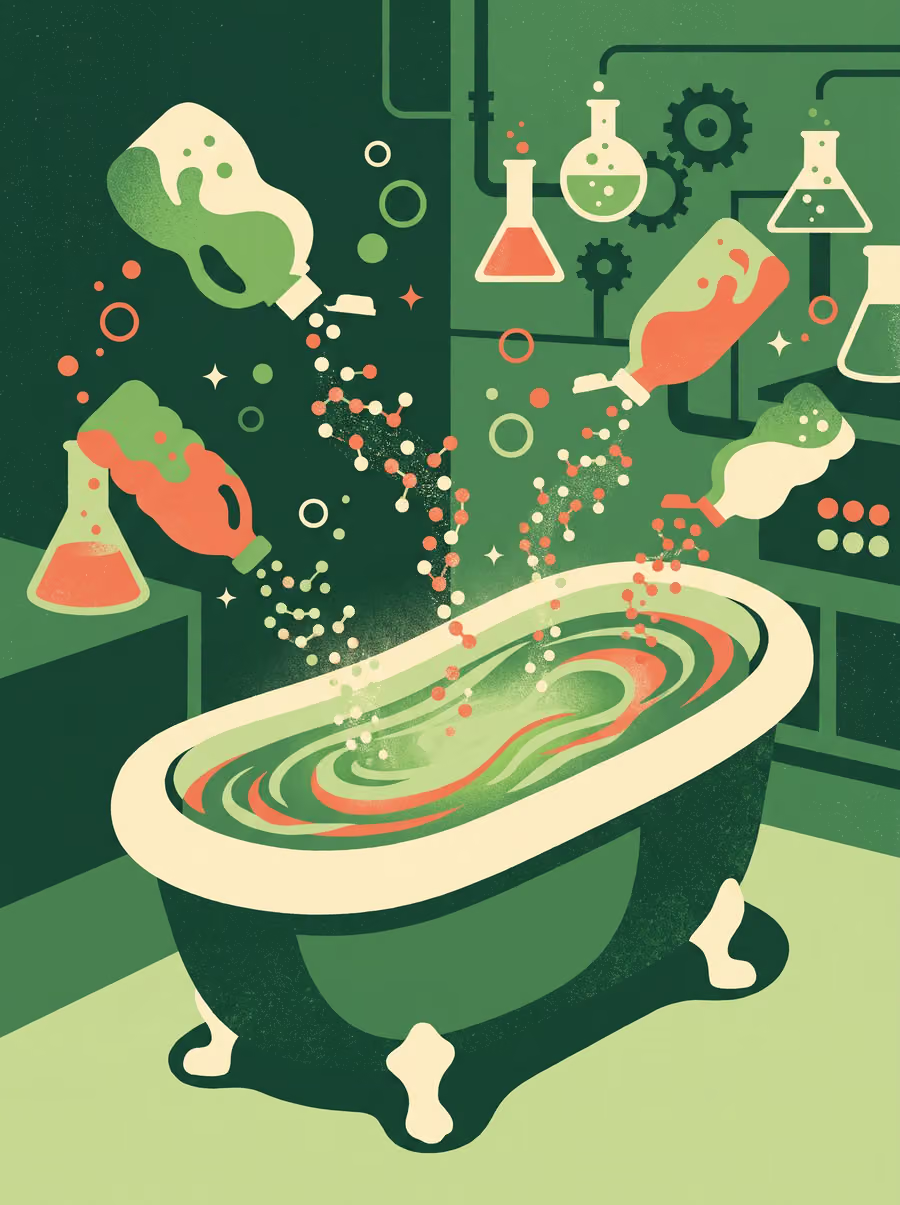
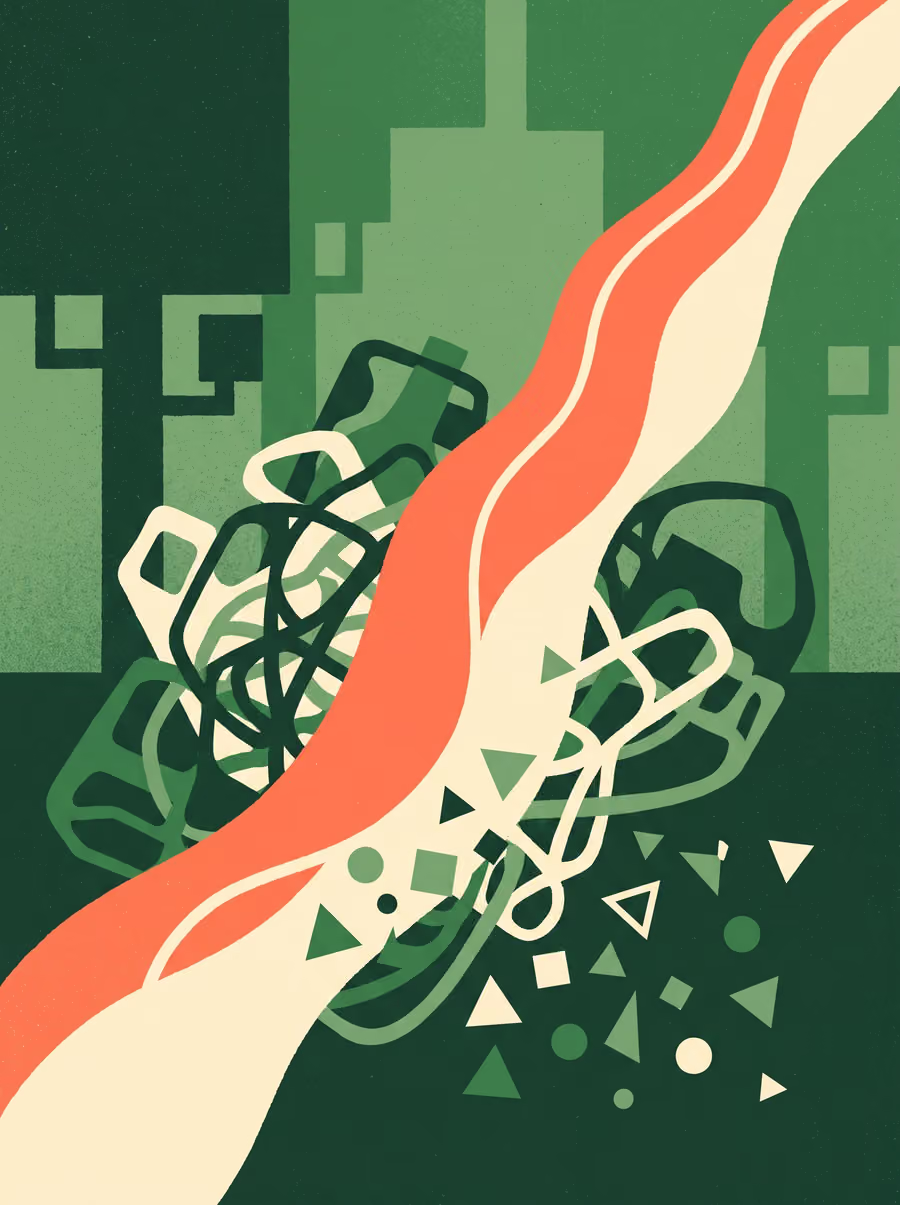
Hi, I'm Jenny Mason, your tour guide to feedback loops, a journey through food waste cycles and the solutions that curb climate change. How do you unwind after a rough day? Sip a glass of wine, veg out while streaming your favorite show? Maybe you slide into a hot bath and dissolve away your stress. Scientists in France are using this very method to dissolve away the world's plastic pollution problem. They submerge all sorts of plastics into a warm water bath full of enzymes or complex proteins. Over 10 hours, the enzymes break apart the polymer chains, leaving behind the building blocks of PET plastics in good as new condition. The warm bath even breaks down plastics in waterproof clothing, synthetic fabrics, and heavily dyed polyesters. 90% of plastic ingredients emerge fresh as daisies. Their company, Carbios, aims to create an entirely closed-loop system where a bottle in equals a bottle out. No need for mixing recycled plastic pellets with virgin plastics. Currently, Carbios is constructing a facility large enough to process 50,000 tons of fabric or 300 million t-shirts annually, and they're already licensing their technique internationally to the UK, Turkey, and China. Just when you think the world is doomed, humanity rallies with some planet-saving breakthrough, like plastic reincarnation or composting, and suddenly there's socation to celebrate. Feedback loops is produced in collaboration with Table to Farm Compost in KDUR. For more information about curbing food waste, visit TableToFarmCompost.com
 Loop89
Plasma Torch
Korean engineers crack unrecyclable plastic in a tenth of a second using hydrogen plasma hot as an aurora. The catch: the torch itself burns a fortune in fuel.
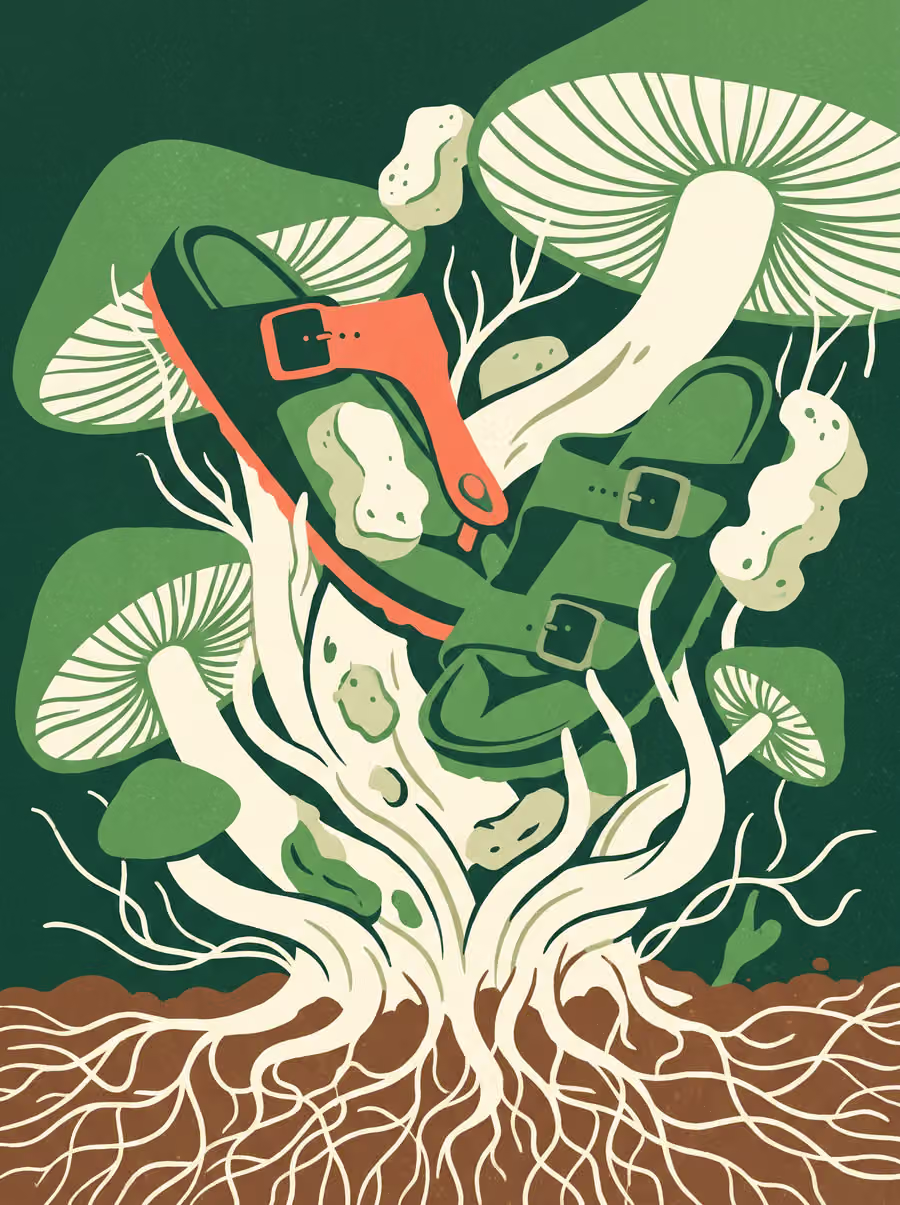
Hi, I'm Jenny Mason, your tour guide to feedback loops, a journey through food waste cycles, and the solutions that curb climate change. If you've witnessed one of the many recent northern lights displays spilling all the way to the southern states, you have the sun's heartburn to think. Essentially, every 11 years, the sun gets some nuclear indigestion and burps out a lot more solar flares and gases. When the ejected particles hit our atmosphere, they ignite into neon rainbow ribbon sheets of ionized plasma gas that we call aurora. A team of South Korean engineers is harnessing their own kind of aurora to recycle the once-impossible to recycle plastic resins. First, they create plasma by heating hydrogen to between 1800 and 3600 degrees Fahrenheit. Then, they feed in the super robust resins. You'd think they'd char like steaks cooked with a jet engine, but they don't. The high-intensity hydrogen cracks the polymer chains into their root ingredients of ethylene and benzene, all in one-tenth of a second. These base products are almost as clean and pure as virgin plastic, so they fetch a high price on the manufacturing market. But before we applaud and aurora, the plasma torch has not been tested outside of the laboratory, and you can't isolate or heat hydrogen without burning a ton of fossil fuels. So this technology has a long way to go, before it becomes as good a pollution solution as, say, composting food scraps. Feedback loops is produced in collaboration with Table-to-Farm Compost in KDUR. For more information about curbing food waste, visit Table-to-FarmCompost.com
 Loop88
Shroom Improvement
Flip flops from algae, styrofoam from mushroom roots, and both compost in your backyard in 45 days. Plastic's replacements are growing.
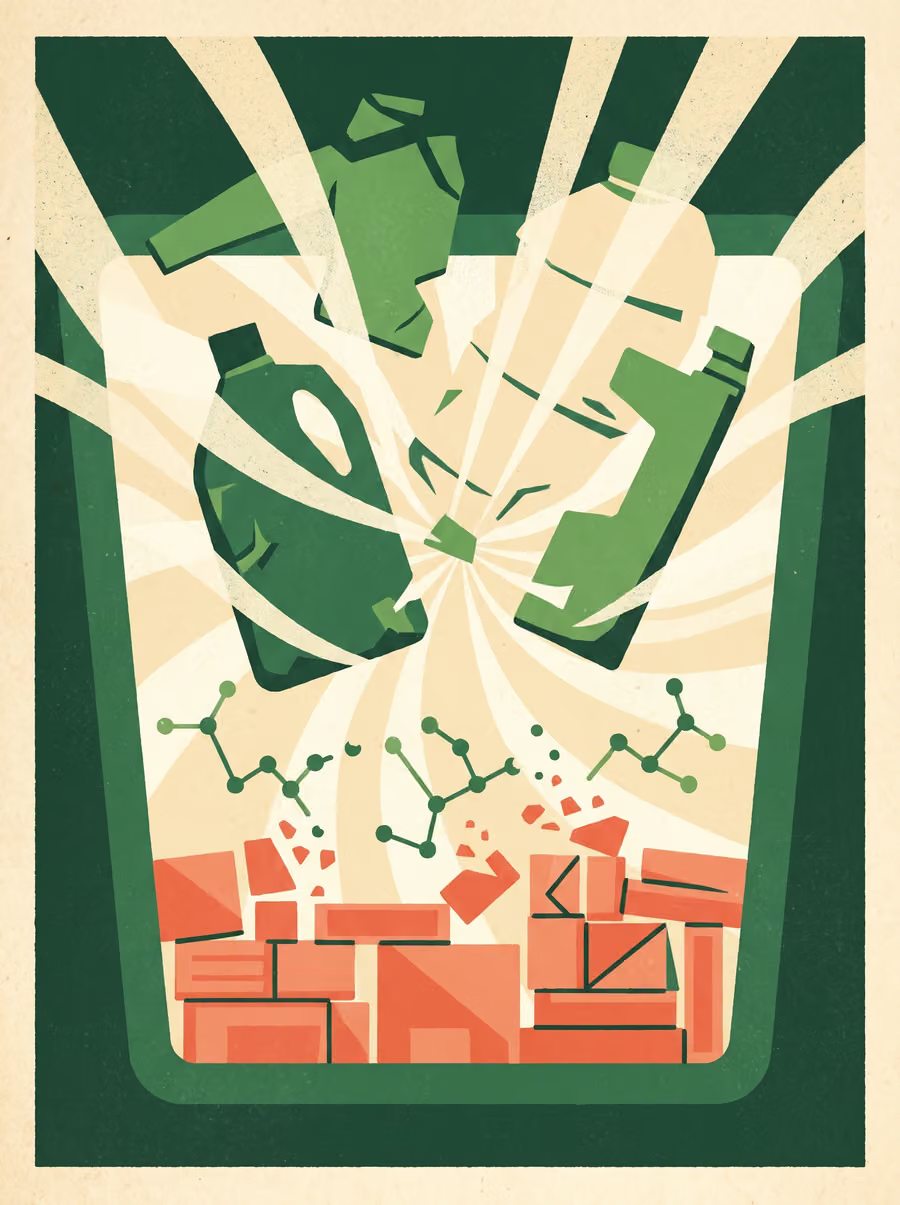
Hi, I'm Jenny Mason, your tour guide to feedback loops, a journey through food waste cycles, and the solutions that curb climate change. Okay, dear listeners, I can't put this off any longer. It's time we had the talk. Oh, not about the birds and the bees, but about Polly Oliphins. Yes, I know that sounds like a niche punk folk sea shanty band. Please welcome to the stage Polly and the Oliphins. But the term actually refers to plastic resin types 2, 4 and 5, the ones that make clean film, toys, detergent bottles, carpet, food containers, and more. These are also the plastics most commonly sidelined for incineration or landfills, because they're either too expensive or impossible to recycle. Currently, humans produce about 220 million tons of Polly Oliphins every year, and that figure is expected to quadruple by 2050. Luckily, some companies are creating alternative plastics using plant-based ingredients. Algenesis turns sea algae into footwear like flip flops. Ecovative converts the thready roots of mushrooms or mycelium into styrofoam. Not only does their production emit 90% less CO2, it requires 12% less energy to produce, making it far more sustainable and affordable. Even cooler is that the flip flops and mushroom foam can be composted in your backyard, where they decompose in about 45 days. Whether we're innovating plant plastics or composting food waste, the human endeavor to save the planet still has shroom for improvement. Feedback loops is produced in collaboration with Table-to-Farm Compost in KDUR. For more information about curbing food waste, visit Table-to-FarmCompost.com.
 Loop87
Sort-a Solution
In Japan, badly sorted recycling comes back to your doorstep with a scolding note. A new UV-and-titanium bath might make sorting obsolete altogether.
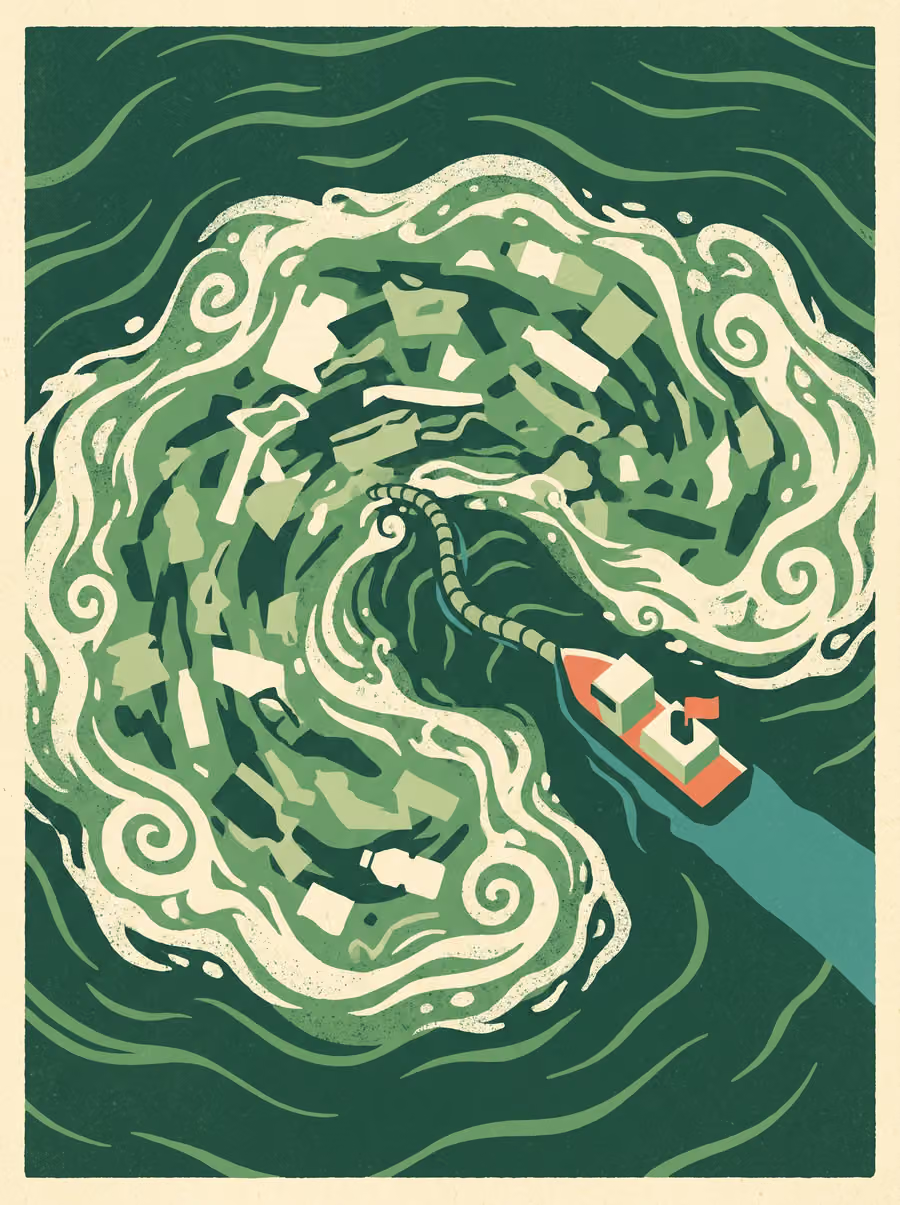
Hi, I'm Jenny Mason, your tour guide to feedback loops, a journey through food waste cycles, and the solutions that curb climate change. A friend who used to live in Japan shocked me. When he said that not only did he have to sort and clean all his recyclables, but also if he didn't do it perfectly, the city would plunk his trash on his doorstep with a scolding note. In the US, most municipalities practice single-stream recycling, meaning we toss all the different materials together because they'll be sorted at a facility, either by people or machines or both. But this process is expensive, and mistakes can be dangerous. For instance, a little contamination from some Type-6 PVC plastic could result in the release of toxic corrosive chlorine gas. A company called DePaulie might have a solution to recycle plastics without any sorting or cleaning. First, unwashed mixed plastics and plastic-based fabrics are shredded. Everything is tossed in an aqueous solution mixed with titanium dioxide and blasted with UV light to crack the once-unbreakable plastic molecular chains. After a 10-minute room temperature soak, the plastic pulp is reduced to its original petroleum-derived building blocks. Any leftover cotton or tougher plastic types are filtered out. DePaulie's methods are low-cost, simple enough to run out of a home kitchen, and cut the carbon footprint of plastic recycling by 65%. They're not just sorta awesome. They're heroes, like the ordinary people who convert food waste to compost. Feedback loops is produced in collaboration with Table-to-Farm Compost in KDUR. For more information about curbing food waste, visit Table-to-FarmCompost.com.
 Loop86
Ocean Plastics
Eight billion tons of plastic and counting, with garbage patches visible from space. One crew is on a mission to clear 90% of it by 2040.
Hi, I'm Jenny Mason, your tour guide to feedback loops, a journey through food waste cycles and the solutions that curb climate change. Humans have produced roughly 8 billion tons of plastics since the material was first invented in the early 1900s. Aliens might suppose we worship plastic for all the ways we incorporated into daily life, stretchy clothes, waterproofing, packaging, casings, films, plastics, prevail. We even carry them in our bodies, either as medical implants or, as forever chemicals or PFAS. These microplastic particles are made of unbreakable toxic molecular chains that do not break down on their own. 85% of the world's plastics get trashed. But a huge portion of that trash washes into the oceans, where it swirls around in gross garbage patches visible from outer space. A company called Ocean Works is on a mission to stop the slop by collecting and recycling all ocean-bound plastic or OBP. That's any plastics found on land or in waterways within 30 miles of a shoreline. Ocean Works recycles types 1 and 2 plastics and sells them on a global market. As of 2024, Ocean Works reclaimed 14 million tons of plastics. In a similar victory, nationwide composting reclaimed over 11 million tons of food waste that same year. Maybe there's still time to convince the aliens we're not plastic parishioners so long as we keep Martian towards the plastics-free future.
 Loop85
Nacho Pollution
Recycling PET plastic works like melting nacho cheese, but each bottle survives only three round trips. Food scraps compost in four weeks; plastic needs 400 years.
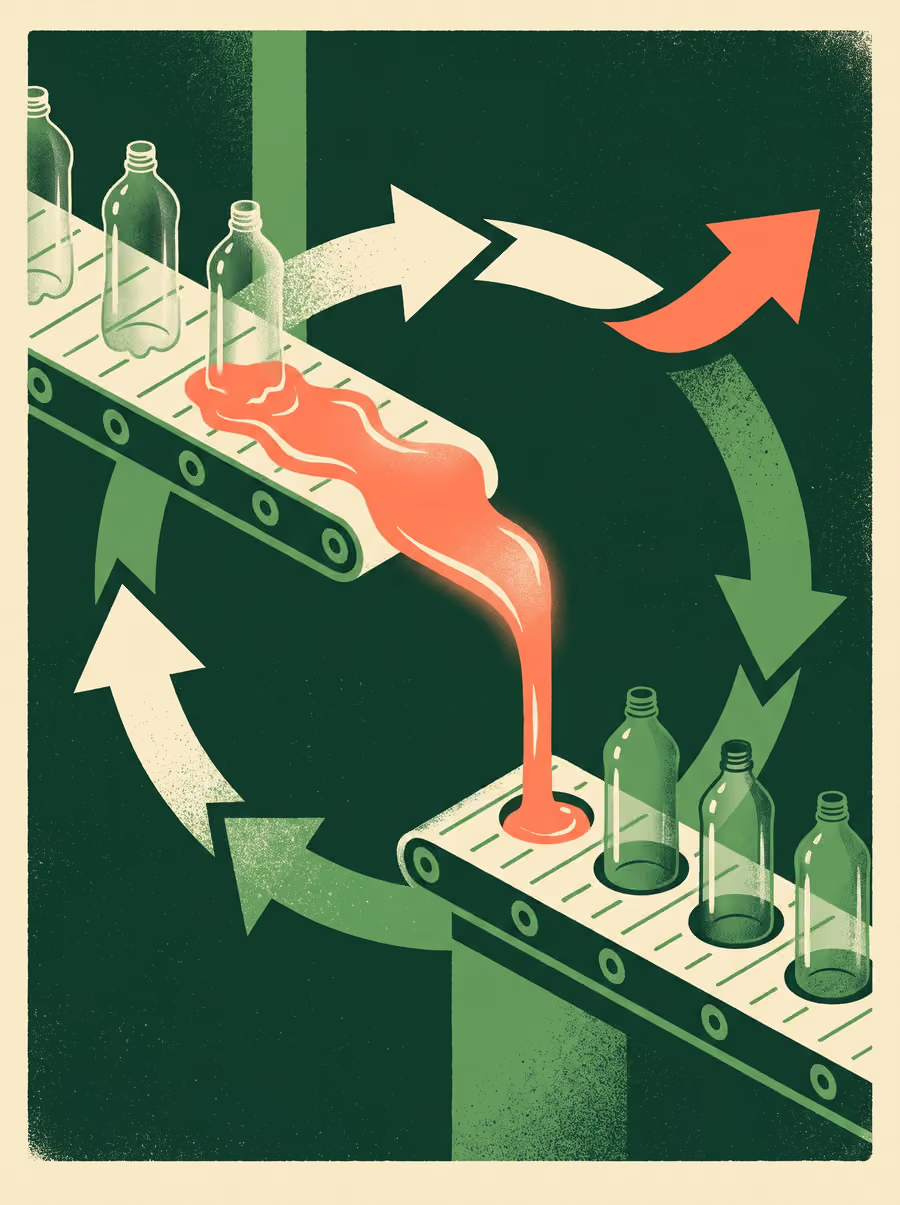
Hi, I'm Jenny Mason, your tour guide to Feedback Loops, a journey through food waste cycles and the solutions that curb climate change. What happens to the plastics you send off for recycling? The answer depends on the type of plastic. In 1988, the plastics industry created a classification system consisting of seven resin types. Type 1 represents PET or polyethylene tariff the late plastic used to make water bottles. Type 2 contains containers like detergent jugs made from HDPE or high-density polyethylene. Then you have the PVC for pipes and the plastic sheets for chip bags and dense polypropylene for making trash bins and their styrofoam. And finally, the Type 7 Superdense resin great for office water cooler jugs. Types 1 and 2 are recyclable. The rest are not. To recycle PET plastics simply shred and melt like nacho cheese. Next, cool the cheese and chip into pellets that manufacturers can mix with new or virgin plastic resin to make new bottles and containers. Mixing reduces the oil drilling needed to make fresh plastic. But PET plastics can only survive three recycles. After that, they're trashed with all other resin types. And unlike food scraps, plastics do not decompose easily. While you can convert food waste to compost in about four weeks, plastics need 400 years or more to break down. Plastics are nacho ordinary pollution problem, but if people are smart enough to master composting to fight climate change, then there's hope we'll conquer this polymer predicament. Feedback loops is produced in collaboration with Table to Farm Compost in KDUR. For more information about curbing food waste, visit TableToFarmCompost.com.
 Loop84
Recycling Saint
You feel saintly every time you toss a bottle in the blue bin. But of seven plastic types, only two are ever recycled, and less than 9% of the world's plastic gets a second life.
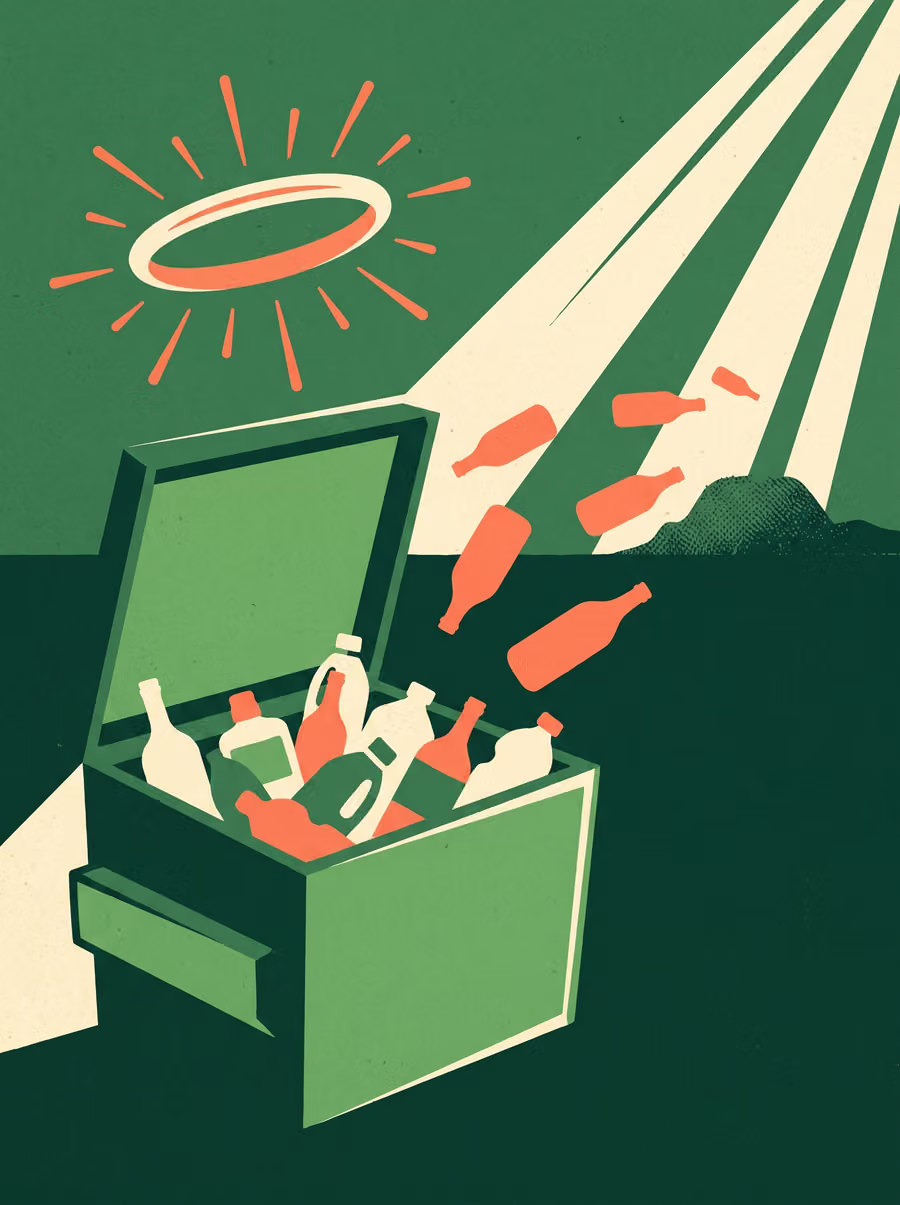
Hi, I'm Jenny Mason, your tour guide to feedback loops, a journey through food waste cycles and the solutions that curb climate change. Do I feel like a saint every time I sideline glass for recycling? Do I polish my saved the planet halo every time I chuck cardboard, aluminum or plastic in a single stream recycle bin? The short answer is yes, but I probably shouldn't because my plastic waste is likely contributing to a global pollution problem. You know that triangle symbol found on the bottom of plastics, the one that contains numbers 1 through 7. Those marks indicate the seven different types of plastic resins. At present only types 1 and 2 resins can be recycled. The other plastics are either incinerated or shipped off to landfills located far away from the United States. Essentially of the 450 million tons of new plastic produced each year, less than 9% gets recycled. Our plastic glut is polluting the ocean and even crumbling into microplastics trickling into the bellies, brains and blood of all living creatures on Earth. Fortunately, new technologies are in the works to recycle the other resins or to create alternative plant-based plastics. Over the next several episodes, we'll unwrap plastics dirty past and hopefully its cleaner future. In the meantime, you can keep your eco-halos shiny by converting your food scraps to compost. Feedback loops is produced in collaboration with Table to Farm Compost in KDUR. For more information about curbing food waste, visit tabletofarmcompost.com
 Loop83
BBNJ
Eighty-one nations just ratified first-ever protections for the two-thirds of the ocean beyond any border. The high seas finally have a bodyguard.
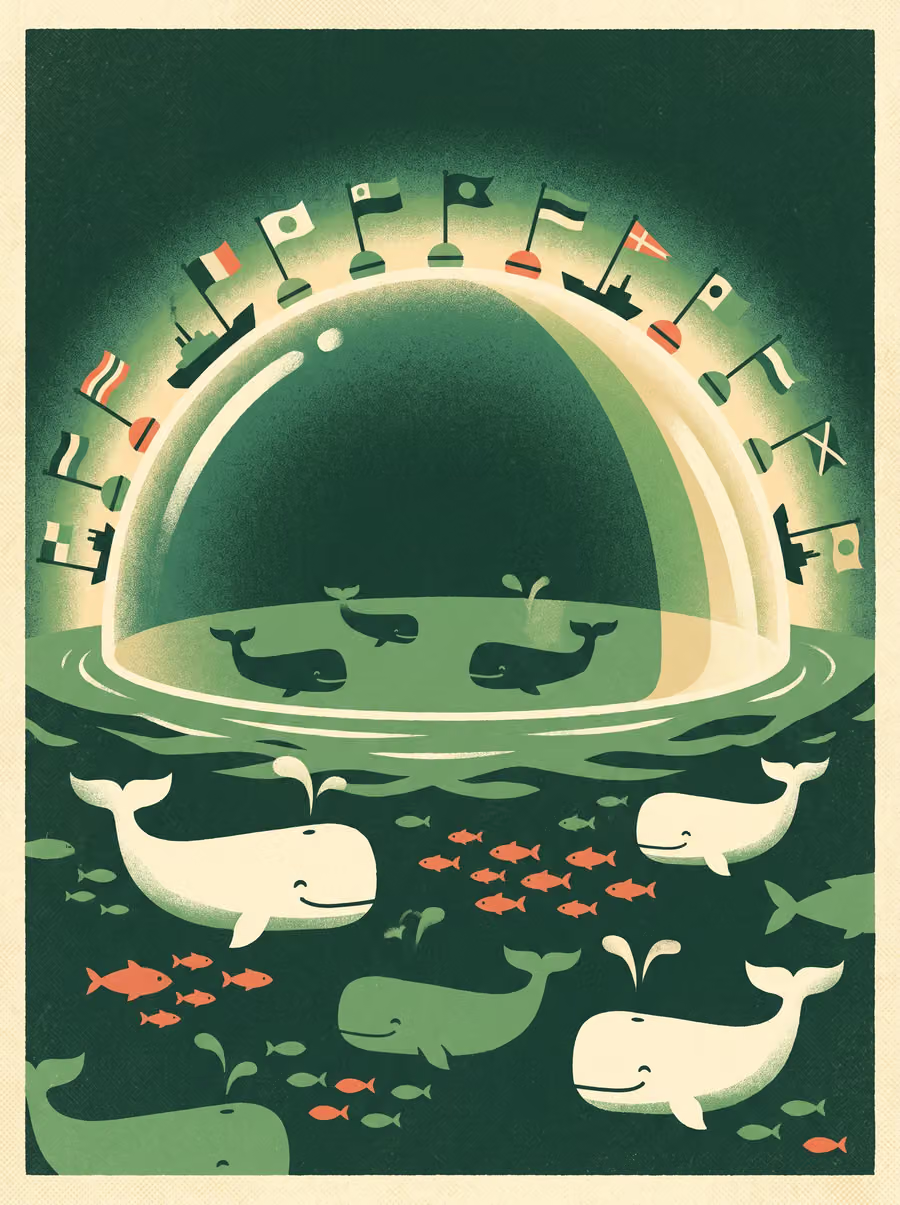
Hi, I'm Jenny Mason, your tour guide to feedback loops, a journey through food waste cycles, and the solutions that curb climate change. What's yummier than a good PB&J? Well, as of January 2026, ocean lovers might say the BB&J tops the podium. The biodiversity beyond national jurisdiction treaty is a first of its kind protection for ocean zones beyond nationally designated waters. The BB&J enables the United Nations to defend two-thirds of Earth's ocean waters from habitat destruction. Plastics pollution, acidification, deoxygenation, and unsustainable resource extraction are just a few of the offenses that can result in legal action or fines for countries or commercial companies. The treaty also mandates that pharmaceutical, cosmetic, and food companies equitably share with all nations any profits made from harnessing the genes of ocean plants, animals, or microbes. And it mandates consultations with indigenous groups and local communities before commercial activities can commence. A whopping 81 nations ratified the treaty, all of them asserting that the ocean belongs to no one and yet benefits everyone. While China, France, Japan, and Brazil are among the international power players backing the treaty, the US, UK, and Russia are noticeably absent from the BB&J sandwich. But before you get to crust fallen, keep in mind ordinary people safeguard ocean wellness every day by simply converting food scraps to compost. Feedback loops is produced in collaboration with Table-to-Farm Compost in KDUR. For more information about curbing food waste, visit Table-to-FarmCompost.com
 Loop82
Hot Water
In 2025 the ocean absorbed 23 zettajoules of heat, twelve Hiroshimas of energy, breaking the record for the ninth straight year.
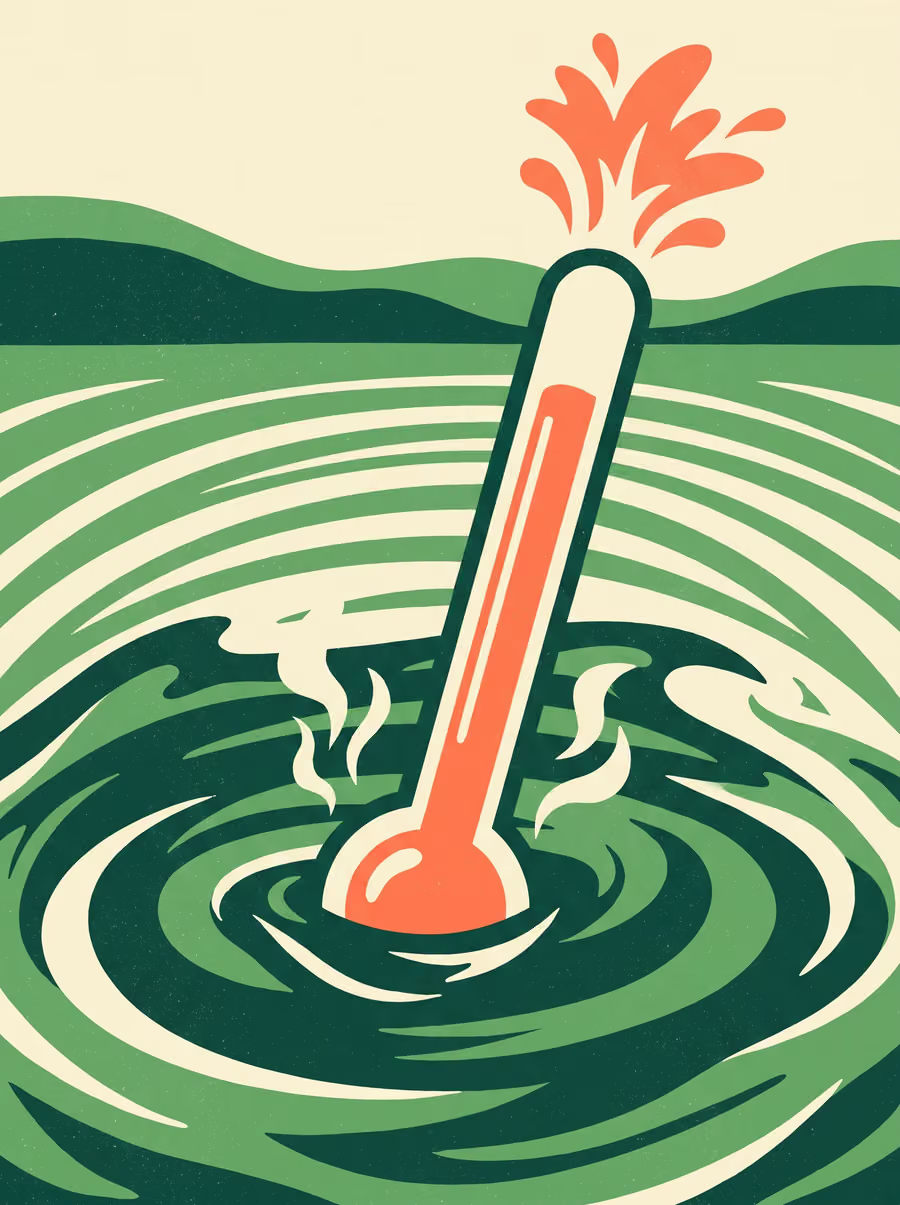
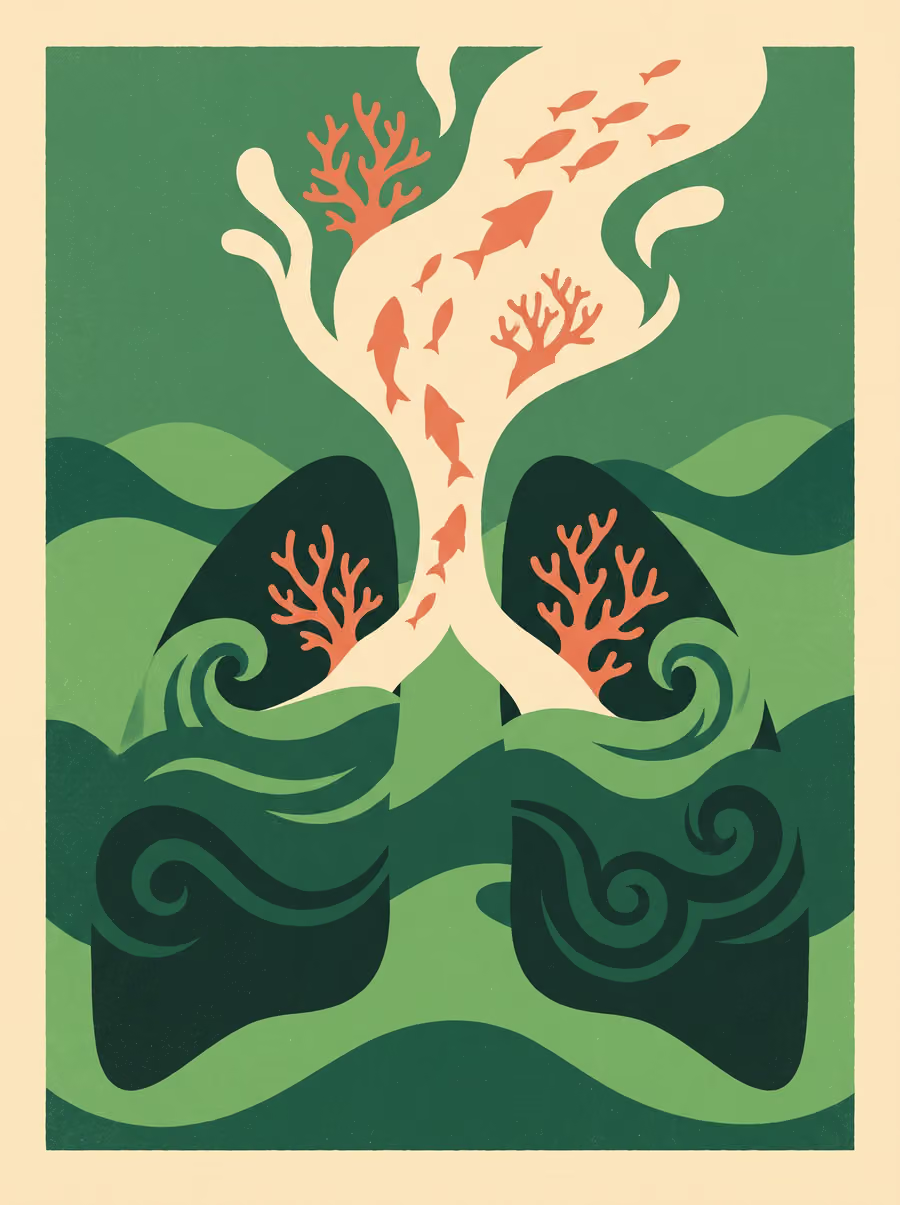
Hi, I'm Jenny Mason, your tour guide to Feedback Loops, a journey through food waste cycles and the solutions that curb climate change. How many Catherine Zeta-Joneses can you fit in the ocean? Only one if she's starring opposite George Clooney or Brad Pitt in Oceans 12. But if it's the actual ocean, then the number is closer to one sex-tellian Zeta-Joneses. Er, wait, what? Oh, my producers are telling me the unit of measurement is actually Zeta-Jewels, not Zeta-Jones. Well, in that case, a single jewel is a measure of energy. Zeta-Jewels are many trillions of jewels, and in 2025 the ocean absorbed 23 Zeta-Jewels of heat energy. According to a report in EOS magazine, that's akin to detonating 12 Hiroshima bombs in the sea. It's not just a lot, it's record-breaking, and the record has been broken nine years in a row, and a nine-year streak is itself record-breaking. A hotter ocean impacts not just the marine life underwater, it throws off global water currents that are nodded to global wind and rain cycles. If the usual rain or snow patterns where you live are out of whack, odds are good it's the result of a hotter ocean. But whereas Zeta-Jones and Zeta-Jewel energy conversion is a one-way road, climate change is not. If the ocean can impact you anywhere on Earth, you can likewise impact it. Converting food waste to compost is a powerful way to curb the emissions overheating the seas. Feedback loops is produced in collaboration with Table-to-Farm Compost in KDUR. For more information about curbing food waste, visit table-to-farmcompost.com
 Loop81
Sea Air
For the first time on record, the ocean's breath hiccuped: the Gulf of Panama's reliable cold upwelling barely showed up in 2025.
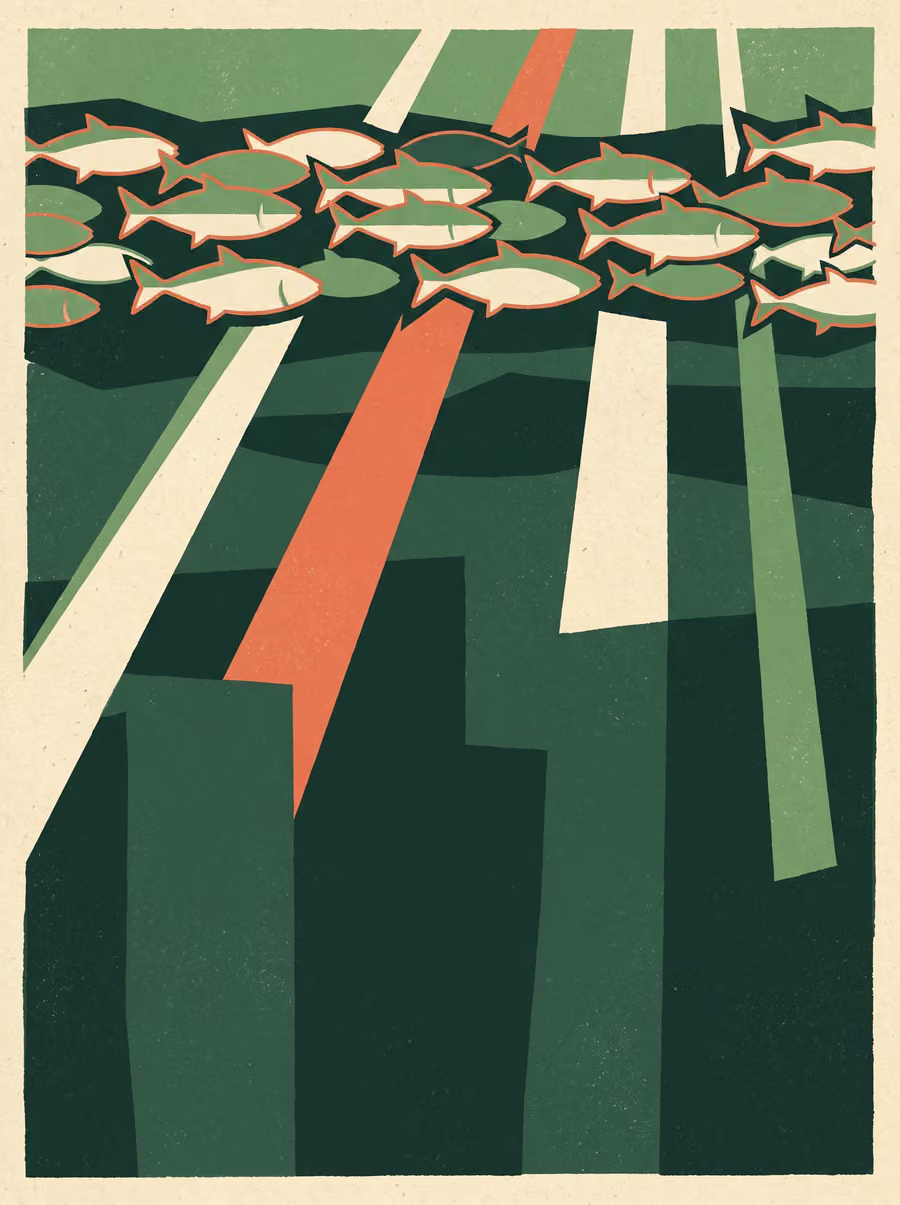
Hi, I'm Jenny Mason, your tour guide to Feedback Loops, a journey through food waste cycles and the solutions that curb climate change. Well, it finally happened. The ocean stopped breathing. Or maybe it just suffered a temporary hiccup? Either scenario has oceanographers deeply worried. Here's the deal. For the first time since records began, the seasonal upwelling of deep, cold ocean waters to the surface in the Gulf of Panama spluttered. This cycle is usually so reliable and so predictable it is referred to as the ocean's breath. Normally in the dry season, powerful winds push surface waters away from the shoreline, creating a vacuum that draws cold waters up. The upwell delivers a fresh wave of nutrients like plankton. The cold waters also act as an air conditioner cooling off coral reefs and coastal communities. But in 2025, something in the reliable cyclical machinery broke. The winds came six weeks late and they didn't howl continuously. The waters made a half-hearted churning attempt for less than two weeks instead of the usual two-month tumble. If the machinery breaks again for several years, coral reefs off the Panamanian coast are likely to bleach and die off. If fish are starved of nutrients, the communities that rely on the fish also starve. By converting food waste to compost, ordinary people keep the oceanic breathing machine running. Put another way, they see the error of their waves. Feedback loops is produced in collaboration with Table to Farm Compost in KDUR. For more information about curbing food waste, visit tabletofarmcompost.com
 Loop80
Murky Waters
The oceans are getting darker. Sunlight's reach has shrunk by fifty meters across an area the size of Africa, squeezing the zone where 90% of marine life lives.
Hi, I'm Jenny Mason, your tour guide to feedback loops, a journey through food waste cycles and the solutions that curb climate change. The world's oceans are getting darker. This might seem impossible when the days are feeling sunnier and hotter, but researchers analyzed measurements of the ocean luminosity or how deeply sunlight penetrates the water and found that from 2003 to 2022, the sunlight's reach shrank by some 50 meters over a total area the size of the African continent. This weaker penetration means that the ocean's photic zone is thinning. 90% of all marine life lives in this zone, relying on either the light of the sun or the moon to survive, eat, and reproduce. Titer quarters in a thinner photic zone means fiercer competition for shrinking resources. But what's making the waters darker? First off, there's more junk washing off the land and into the sea, more sediment and more particulates like microplastics. There's also more bacteria blooming in the ocean. Temperature spikes combined with higher concentrations of fertilizers running off giant agricultural crops lead to enormous, algal blooms. These slimy green carpets act as umbrellas blocking the sun. If phytoplankton are choked off from sunlight, their death unravels the entire ocean food web and pulls the plug on carbon sequestration in the sea. Luckily ordinary people can curb planet heating emissions by converting food waste to compost, which prevents sediment runoff. Essentially composting is a move in the light direction. Feetback loops is produced in collaboration with Table-to-Farm Compost in KDUR. For more information about curbing food waste, visit Table-to-FarmCompost.com
 Loop79
Plankton Pirates
The worst swimmers in the sea produce half the air you breathe. Plankton drift wherever currents take them while quietly running the planet's oxygen supply.
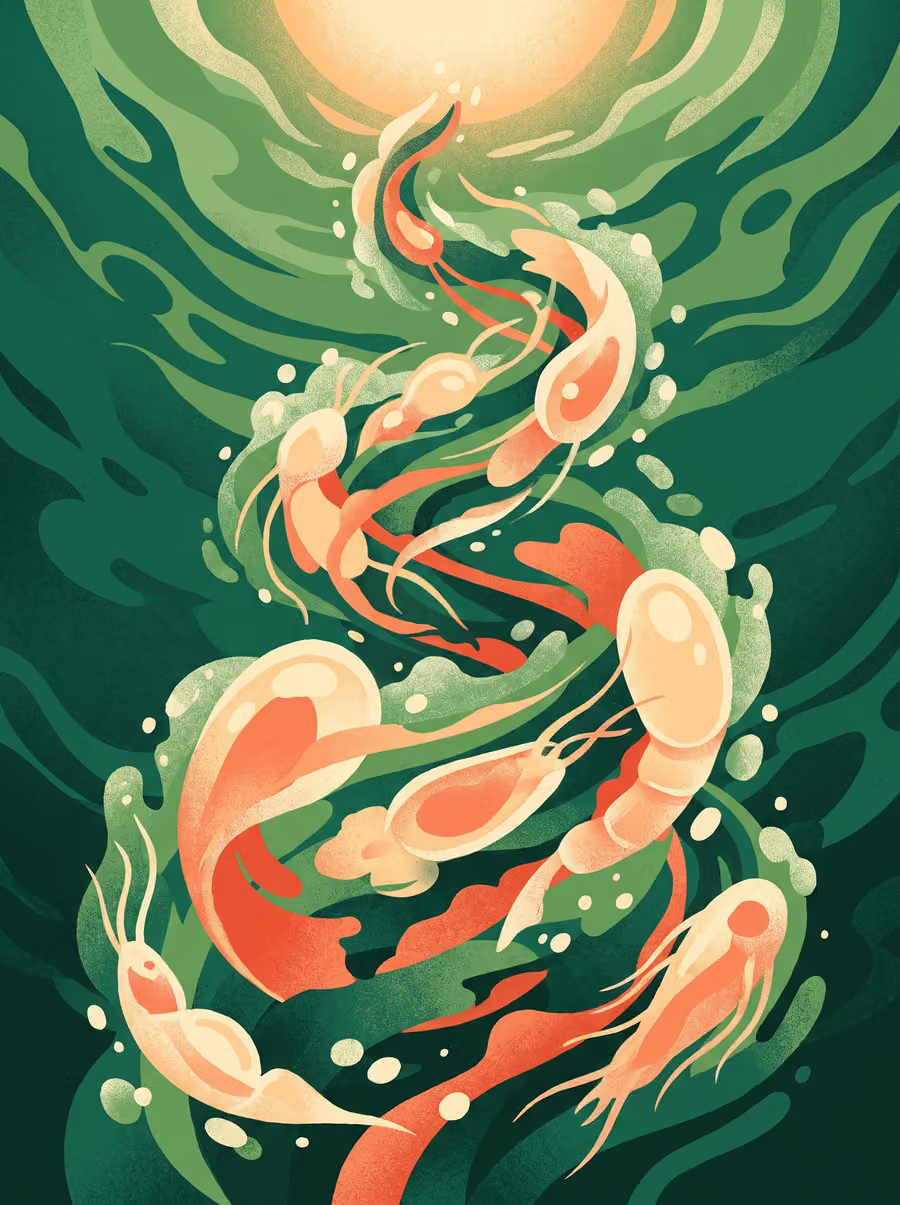
Hi, I'm Jenny Mason, your tour guide to feedback loops, a journey through food waste cycles and the solutions that curb climate change. Recent scientific breakthroughs have now revealed how important plankton are in the fight against climate change. Think of plankton like Captain Jack Sparrow, he is the worst pirate, and they are the worst swimmers. They mostly float along going wherever the current takes them. Some plankton like phyto plankton are plant-based. Others are tiny animals called zoole plankton that eat plant plankton. Everything else in the ocean eats plankton, or everything that eats plankton gets eaten by something else. So plankton formed the entire basis of the vast ocean food web. And just like trees on land, plankton absorb carbon dioxide and emit oxygen. Despite being microscopic, they produce more oxygen than all the trees on earth. 50 percent of all the air on the planet, or half of all the air you'll breathe today, came from phyto plankton. And about 40 percent of all carbon emissions are absorbed by these single-celled critters. When plankton die, much of that carbon sinks to the ocean floor where it is kept sequestered from the atmosphere. Zoole plankton poop piles on even more carbon. But plankton cannot continue to cycle out carbon without our help. Rising ocean temperatures threaten their survival. Our deniery people can help dial down global temperatures by converting food waste to compost. Feedback loops is produced in collaboration with Table-to-Farm Compost in KDUR. For more information about curbing food waste, visit Table-to-Farm compost.com.
 Loop78
Husk House
Rice husks protect grain from water, pests and mold, exactly what we want from our houses. Now a Mississippi mill is pressing them into lumber.
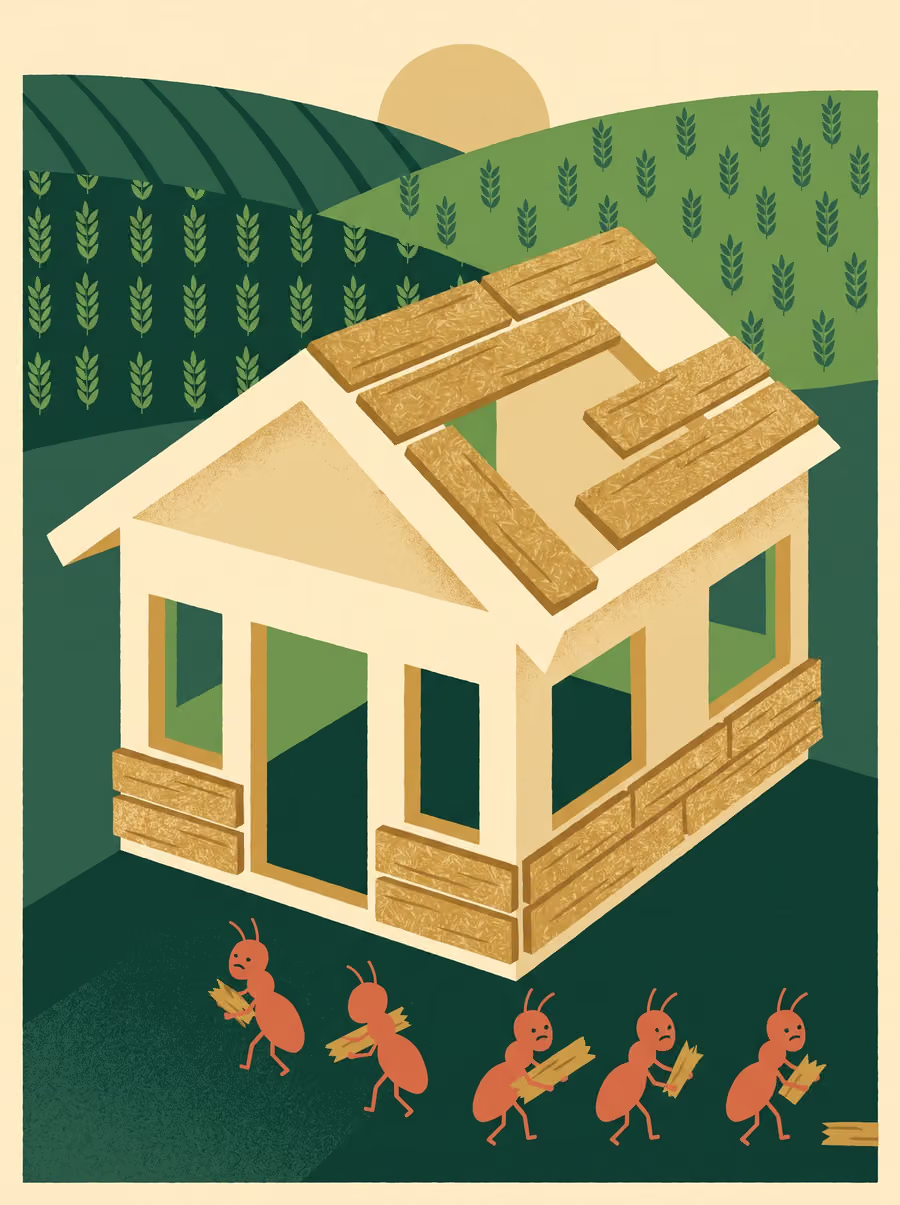
Hi, I'm Jenny Mason, your tour guide to Feedback Loops, a journey through food waste cycles and the solutions that curb climate change. You have a lot more in common with a grain of rice than you may realize. For instance, rice grains develop inside of heavy duty husks that protect the rice grain from water, pests, sunlight, mold, and mildew. Which are the exact same things we want to be protected from? The smart folks running modern mill, a Mississippi-based company, have put two and two together to get acre. That's what they're calling a new building material, fabricated from crushed and compressed rice holes. This wood-like material is not only incredibly strong, it's also waterproof, fire-resistant, and creates a circular economy for agricultural waste. According to reporting from the Weather Channel, the Mississippi Delta produces some 20 billion pounds of exportable rice. Once processed, the rice grains leave behind whole mountains of husks that are normally dumped into landfills where they produce climate buckling gases. Acre comes with a slew of other benefits. For instance, termites have zero cravings for rice husks, and the natural water-resistant qualities of the husks deter mold, mildew, and fungal growth. These are ideal qualities in any home-building materials, but especially so in the humid, southeastern, U.S. Ordinary people also prevent food pollution when they make the ultimate saccharis, rice, by converting food scraps to compost. Feedback loops is produced in collaboration with Table-to-Farm Compost in KDUR. For more information about curbing food waste, visit Table-to-FarmCompost.com
 Loop77
Microplastics
You eat 211,000 microplastic crumbs a year, but green roofs capture up to 97% of the airborne ones. Cities are growing their own filters.
Hi, I'm Jenny Mason, your tour guide to Feedback Loops, a journey through food waste cycles and the solutions that curb climate change. Did you hear that the average person will eat about eight spiders in their sleep every year? Luckily for you, me, and all the spiders out there, this stat is a complete myth. What is not a myth is that the average person will consume 211,000 tiny microplastic crumbs every year. You'll inhale some 68,000 plastic particles daily. We find microplastics in our blood, as well as in the tissues of all other living animals on earth, even the wee amphipods or crap cousins living 36,000 feet deep in the oceans Mariana Trench. Microplastics are linked to a host of health problems, but the good news here is that a study published in the journal Nature found that green roofs or rooftops paved with rich soil and thriving plants capture up to 97% of aerosolized microplastics. In the city of Shanghai, where green roofs comprise some three and a half million square meters, the microplastic capture could reach up to 61 tons per year. While the green roofs were not so great at capturing the fibrous plastics that puff out of our modern stretchy clothes like dog dander, scientists are hopeful that a surge in urban greening could go a long way to trapping some of the world's worst pollutants, kind of like spiders trapping bugs in their webs. Or binary people capture carbon pollution when they convert food scraps to compost. Feedback loops is produced in collaboration with Table-to-Farm Compost in KDR. For more information about curbing food waste, visit Table-to-Farm compost.com.
 Loop76
Grain of Salt
Forever chemicals met their match: a ball mill, some potassium salts, and the indestructible PFAS bond breaks. Take the doom with a grain of salt.
Hi, I'm Jenny Mason, your tour guide to Feedback Loops, a journey through food waste cycles and the solutions that curb climate change. Take it with a grain of salt, or in other words, take nothing too seriously. A coalition of scientists from Oxford and Colorado State University are making this statement about forever chemicals. Per and polyfluoroacal substances or PFAS are not just fancy Latinate labels that make you sound drunk. They are artificial chemical substances used in nonstick cookware, stain and waterproof clothing, food packaging, carpets, and more. At the atomic level, PFAS are virtually indestructible chains of carbon and fluorine. Because they do not break down, PFAS wind up in our drinking water, soils, foods, and even inside our bodies where they've been linked to cancer. The good news is that you can take all this doom and gloom about PFAS with a grain of salt. Literally. Specifically, it has to be potassium phosphate salts. In a paper published in the journal Nature, the scientists supply the following recipe. Simply drop your PFAS and fancy salts into a massive grinder loaded with metal ball bearings and voila, forever bonds break down. Not only that, but you can also recover the freed fluorine, which is a substance needed to make life-saving medicines, but comes from the rare and largely depleted earth element, fluorospar. Ordinary people, assault climate pollution when they convert food waste to compost. Feedback loops is produced in collaboration with Table to Farm Compost in KDUR. For more information about curbing food waste, visit tabletofarmcompost.com
 Loop75
Colorado EPR
Recycling is coming to 700,000 more Colorado homes, and producers, not taxpayers, are footing the bill. The state's recycling rate is set to double.
Hi, I'm Jenny Mason, your tour guide to feedback loops, a journey through food waste cycles and the solutions that curb climate change. Recycling in Colorado is about to expand to more than 700,000 additional households across the state. But all those new bins and expanded hauler fleets are projected to cost an additional 130 to 260 billion dollars according to the Colorado Public Interest Research Group. But the good news is that those costs are not passing on to taxpayers. Instead, producers and manufacturers will put the bill thanks to the state's new extended producer responsibility law. HB-22-1355 took effect January 2026. It mandates that producers pay to recycle or landfill all the packaging used to wrap food, drinks, or other products. For instance, the tube that your toothpaste comes in is assessed a fee, so is the box that tube is packaged in. And if that box is shrink wrapped, there is yet another fee for the producer. These fees go to Colorado's towns and cities where they'll fund community-wide recycling programs. At present, Colorado recycles or compost only 15% of its waste, or less than half the national average, primarily because services are not offered by default. With the EPR now in effect, recycling and composting are set to become as standard as trash pickup. And it's anticipated that Colorado's annual recycling rate will more than double to 720 tons by 2035. This is news so good, it's Therrap Putek. Feedback Loops is produced in collaboration with Table to Farm Compost in KDUR. For more information about curbing food waste, visit Table to Farm Compost.com.
 Loop74
Right to Repair
Four out of five Americans are not legally allowed to fix their own devices. Right-to-repair laws are changing that, state by state.
Hi, I'm Jenny Mason, your tour guide to feedback loops, a journey through food waste cycles and the solutions that curb climate change. You know that moment when you pull your phone from your pocket and we naturally want to fix things when they break, but four out of five Americans are not legally allowed to repair or choose who will repair their devices. Through software locks, only authorized technicians can run digital diagnostic tools or apply repair patches, hardware restrictions legally prohibit replacement parts being sold or bar anyone but the manufacturer from installing new parts. As a result, when a device fails, people are stuck paying high fees, waiting weeks or trashing items that could have been repaired. An annoying inconvenience for some is a devastating setback for others. For instance, electric wheelchair users are left in a lurch when a repair is delayed. Farmers may lose entire harvests when tractors shut down mid-season and they're legally barred from fixing their machines. Right to repair laws aim to restore competition and common sense, making parts, tools and manuals available so people can fix what they own. Since 2025, all 50 states have proposed right to repair laws and in five states, New York, California, Minnesota, Oregon and Colorado, those laws have passed. Exercise your right to repair local ecosystems by converting household food waste to compost. Go ahead, you conduit. Feedback loops is produced in collaboration with Table to Farm Compost in KDUR. For more information about curbing food waste, visit TableToFarmCompost.com
 Loop73
Ocean Cleanup
The Great Pacific Garbage Patch spans two Texases, but one nonprofit is scooping three tons of it an hour, on a mission to clear 90% of ocean trash by 2040.
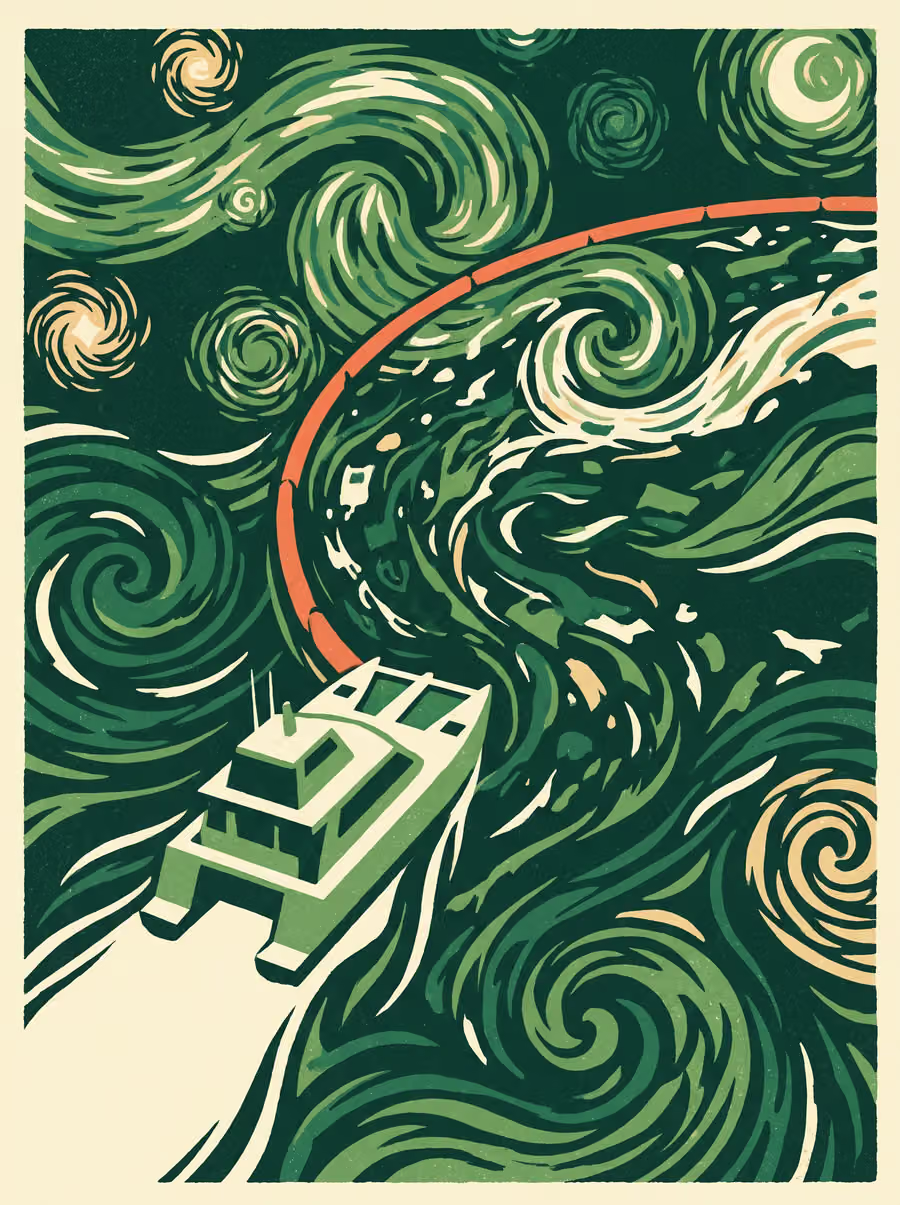
Hi, I'm Jenny Mason, your tour guide to Feedback Loops, a journey through food waste cycles and the solutions that curb climate change. This week, we bring you good news from the world's oceans. From space, ocean currents look a lot like the coiling star swirls in Van Gogh's starry night painting. But these swirls sweep up human trash and form enormous garbage patches in the Indian, Atlantic, and Pacific Oceans. The great Pacific garbage patch is the largest of all, spanning the length of Texas times two. Each garbage patch is not so much an island of trash, but rather a cloudy, mucky soup of chunky, broken plastic waste. Scientists suspect that much of the trash sinks, creating mountain ranges of garbage on the ocean floor, and every year one to two and a half million metric tons of new plastic enters the ocean. Marine animals become entangled in the trash, or they mistake it for food. But there is good news. The non-profit ocean cleanup is on a mission to remove 90% of all ocean trash by 2040. Over the last year, they have successfully gathered some 3.2 tons of trash per hour every day. Lawmakers could help out by passing extended producer responsibility laws, which make manufacturers pay to clean up their plastic waste products. These policies create clean ocean legacies, and ordinary landlubbers help further when they convert household food scraps to compost. Feedback loops is produced in collaboration with Table to Farm Compost in KDUR. For more information about curbing food waste, visit TableToFarmCompost.com
 Loop72
Reef Relief
Coral larvae avoid silent reefs. So scientists played recordings of healthy reef chatter underwater, and the ghost towns filled at twice the rate.
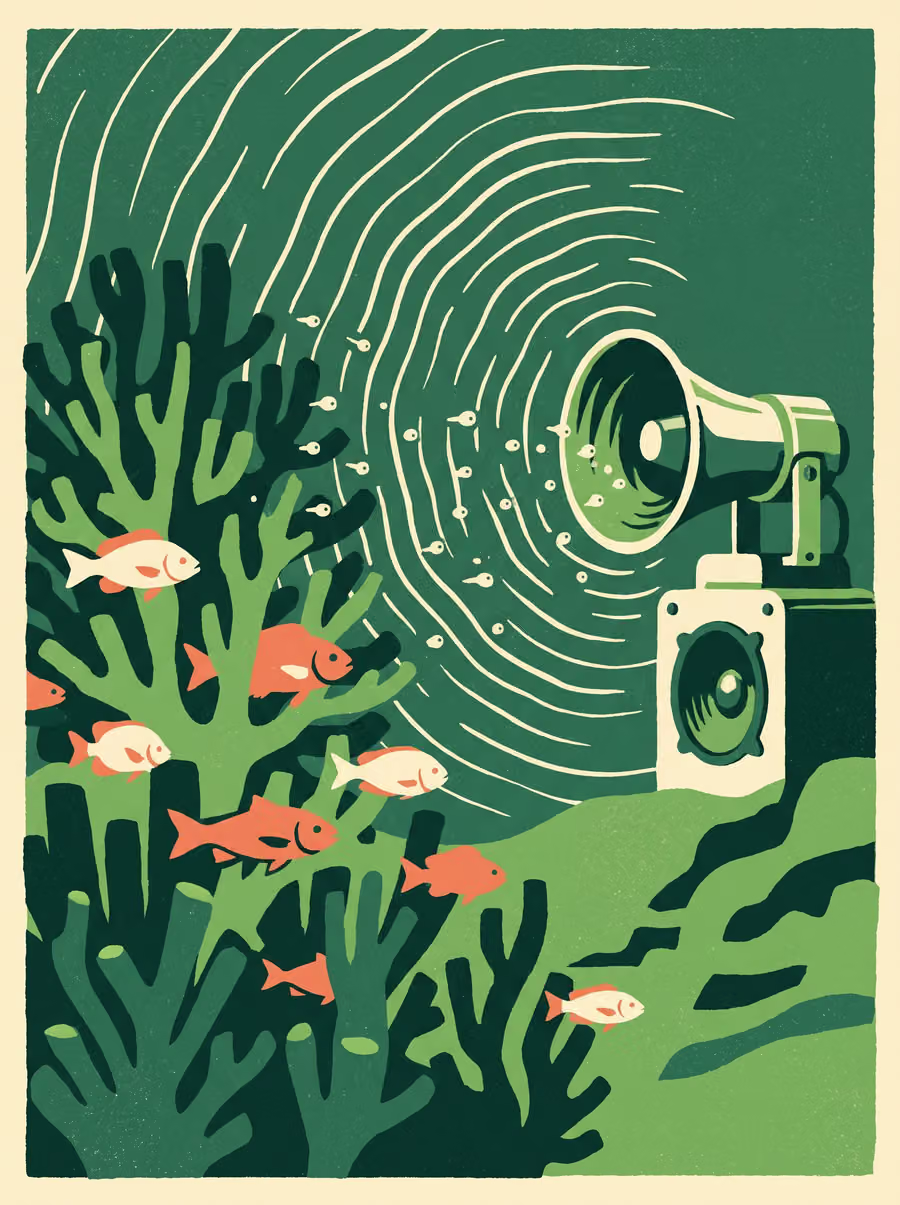
Hi, I'm Jenny Mason, your tour guide to feedback loops, a journey through food waste cycles and the solutions that curb climate change. A healthy coral reef is a rainbow kaleidoscope carpet. Green prickles, pink pom-poms, yellow ruffles, flickering swarms of neon fishes and critters. A healthy reef is also colorful to our ears. There's the bacon sizzle of shrimp chatter and the croaks, purrs and grunts of various fishes. But when a reef is damaged by disease or bleached by excessive heat, the colorful sights and sounds disappear. Any young coral larvae floating around hunting for a permanent home avoid these silent, bone-white ghost towns. Over the last 30 years, a quarter of the planet's coral reefs have been lost, creating an oceanic crisis because reefs support more than a quarter of all marine animals. They supply abundant food and nutrients to sea creatures and people. They also buffer coastlines from destructive waves and storms. Luckily, damaged reefs can be restored if you can get those finicky larvae to resettle. In 2025, scientists sparked resettlement by simply playing the recorded sounds of healthy reefs underwater. When a ghost town sounded like a hot nightclub, larvae quickly rooted in it twice the normal rate. This breakthrough dolphinantly qualifies as good news and so does a rising tide of ordinary people converting food waste to compost. Feedback loops is produced in collaboration with Table-to-Farm Compost in KDR. For more information about curbing food waste, visit Table-to-FarmCompost.com
 Loop71
Landslide
A forest preserve the size of France in the Congo, a tri-national Mayan corridor, and Britain calling nature restoration its moonshot. Conservation is winning ground in a landslide.
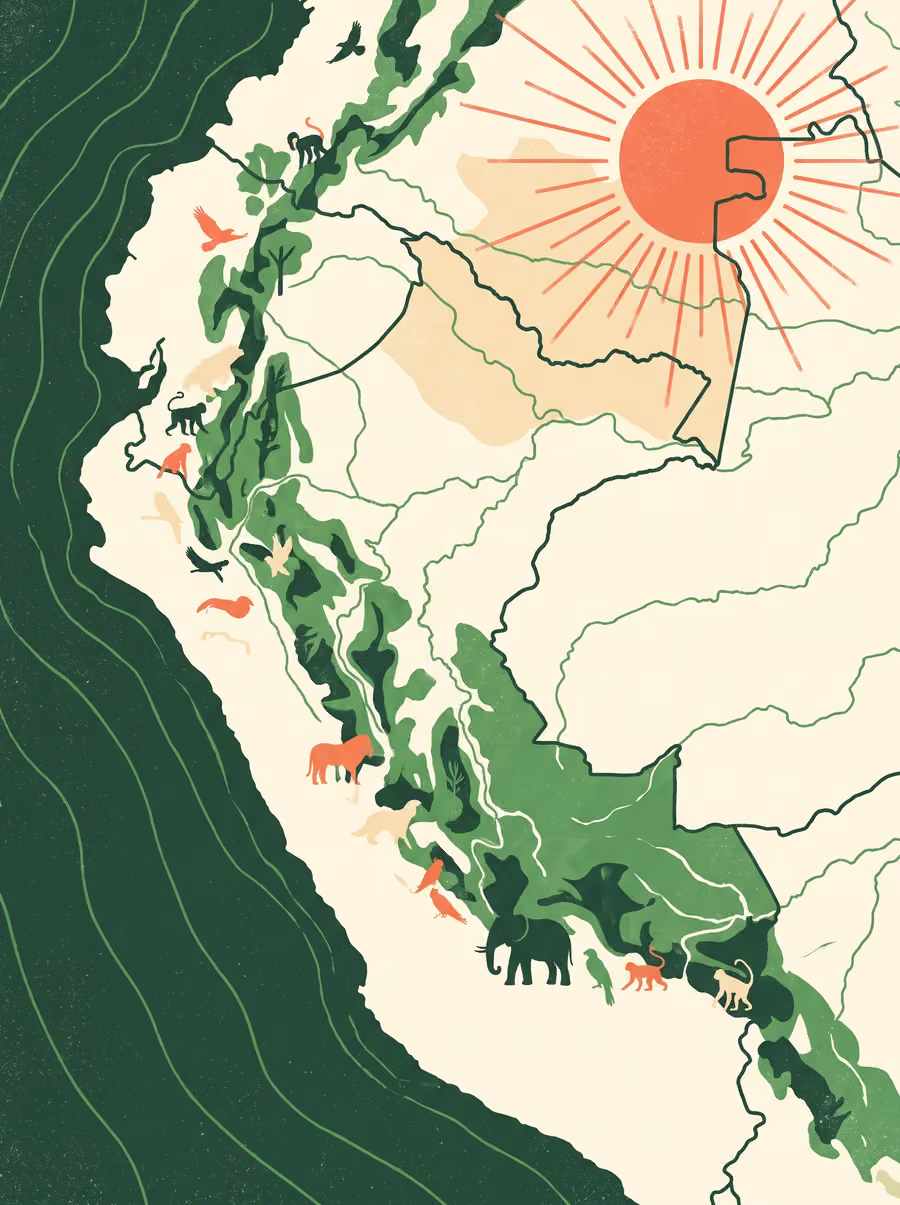
Hi, I'm Jenny Mason, your tour guide to feedback loops, a journey through food waste cycles and the solutions that curb climate change. In our ongoing series of good news-only stories, we landed on some huge headlines. Around the world, people are aggressively preserving and protecting lands for wildlife and nature. For instance, the Democratic Republic of Congo established the world's largest forest preserve in the Kivu Kinshasa green corridor. Covering an area the size of France, or 213,000 square miles, this conservancy will safeguard Earth's largest and healthiest intact expanse of tropical forest. In addition to providing habitat to 10,000 animal species, it also warehouses nearly 30 billion tons of carbon in a giant peat bog. On the other side of the globe, Mexico, Guatemala, and Belize co-created a tri-national preserve that protects nearly 14.8 million acres in the great Mayan jungle bio-cultural corridor. Across the Atlantic, Britain, Wales, and Northern Ireland have declared nature restoration to be their moonshot. Just as America spared no expense to send humans to the moon in the 1960s, parts of the UK are going all out to protect and restore a 30 percent of all lands and coastal seas by 2030. Under the plan, meadows, wetlands, woodlands, peatlands, and salt marshes will once again re-colonize England's wild landscapes. For peat's sake, there's no time for rest when we're gaining so much ground. Ordinary people also help the planet by converting household food waste to compost. Feedback loops is produced in collaboration with Table-to-Farm Compost and KDUR. For more information about curbing food waste, visit Table-to-FarmCompost.com.
 Loop70
Big Cats
For a change, only good news: tigers doubled in India, lions are roaring back, and Mexico's jaguars are up 30%. Big cats are clawing their way back from the brink.
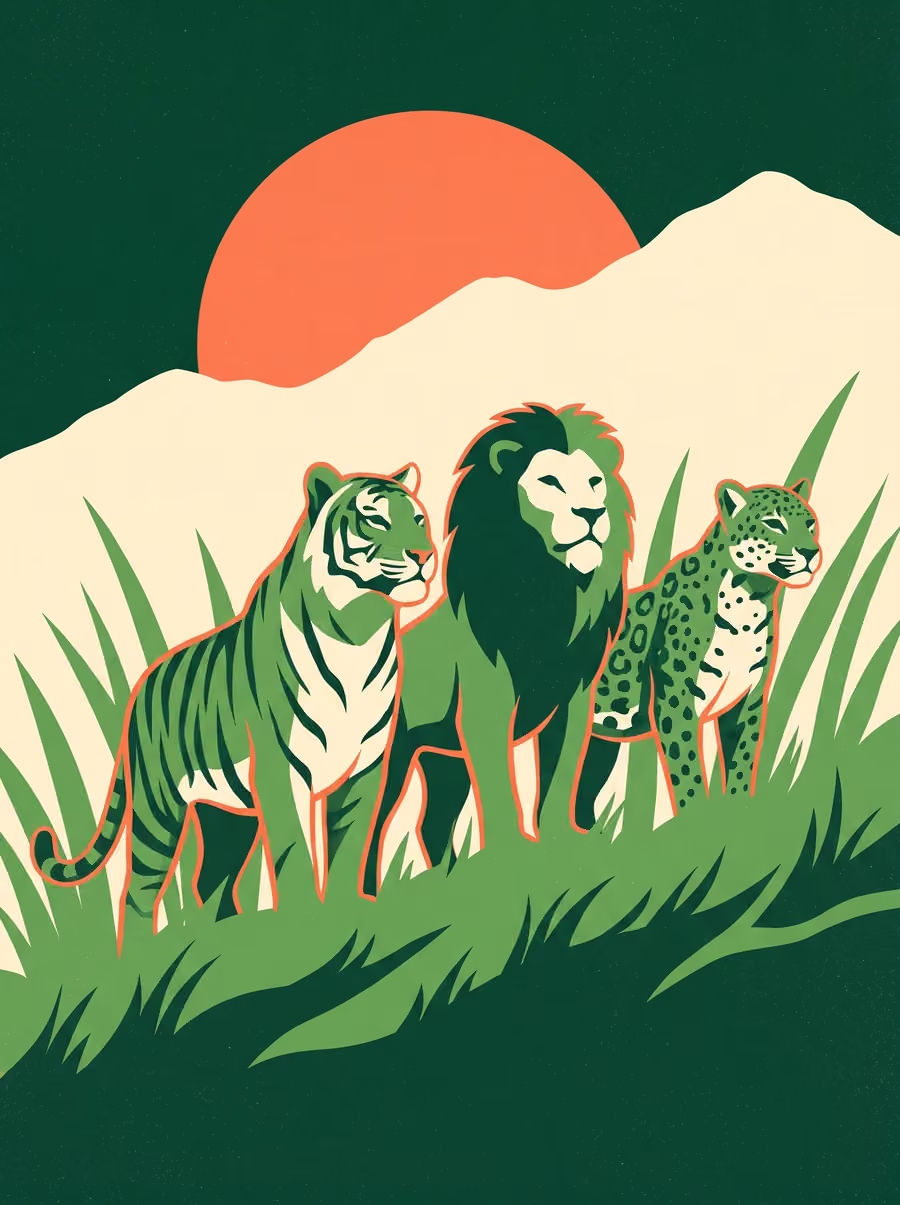
Hi, I'm Jenny Mason, your tour guide to Feedback Loops, a journey through food waste cycles and the solutions that curb climate change. Anyone who's ever adopted a new fitness routine knows that results feed discipline. The more you see change underway, the more you'll keep working out. The same is true for correcting Earth's runaway climate problems. Change is underway and to prove it, we're bringing you only good news for a change, or good news for a change. We begin with Earth's big cats clawing their way back from the brink of extinction. In India, tiger populations have doubled in a decade. Estimates place the numbers a little over 3,600 tigers, ordinary people strove to curb poaching, protect tiger habitats, and alter the human behaviors that lead to human tiger conflicts. India's Asian lion populations have also come roaring back over the last five years. Ecologists estimate 891 lions are thriving, and they've seen a steady upward growth trend for the past three decades. Across the planet in Mexico, Jaguar populations are also up 30% with some 5,300 counted in a scientific census. Just 15 years ago, Jaguar numbers were spotty, hovering at a thousand or fewer. Let this cat-a-log of feline success be a reminder that ordinary people can impact the planet in a big positive way, even if all they do is convert household scraps to compost. Feedback loops is produced in collaboration with Table-to-Farm Compost in KDUR. For more information about curbing food waste, visit Table-to-FarmCompost.com
 Loop69
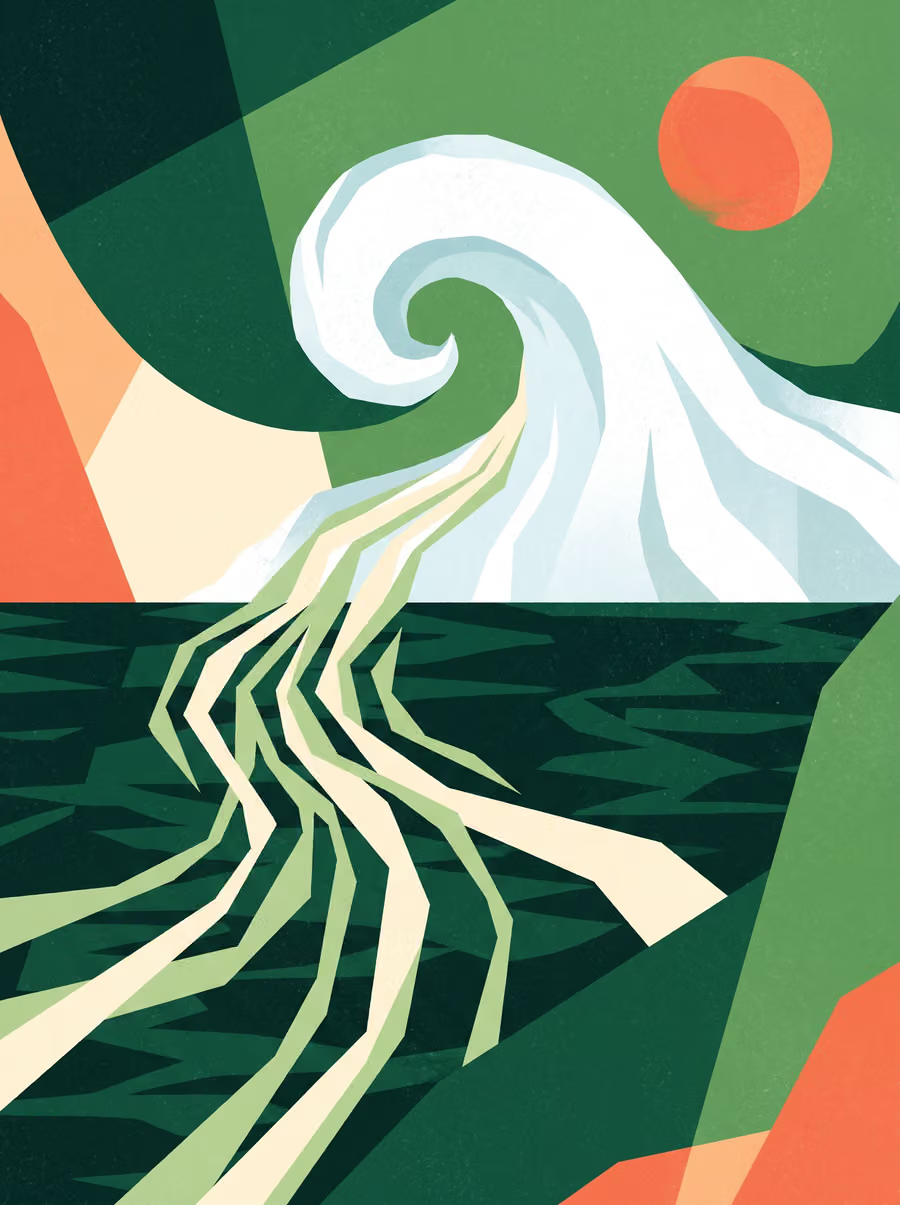
The Sea Stood Still
Once upon a time a glacial lake burst into the Atlantic and stopped the ocean's greatest current. The northern hemisphere froze for a thousand years.
Hi, I'm Jenny Mason, your tour guide to feedback loops, a journey through food waste cycles and the solutions that curb climate change. Once upon a time, the Atlantic Ocean stood still. About 13,000 years ago, something broke its biggest current. The planet had recently emerged from the ice age. Mega glaciers melted, leaving giant lake puddles across North America. One lake spanning most of what is now Canada's Manitoba province suddenly began leaking into the Atlantic Ocean. This freshwater flood disrupted the currents. With cold and salt making North Atlantic waters very dense and heavy, they tend to sink and slide south to the equator. When they warm up, these waters rise and glide back north. Diluted with freshwater, the northern waters held less salt. They were no longer heavy enough to sink. The hot cold exchange between north and south lurched to a stop. Without tropical warm air moving northward, much of the northern hemisphere plunged back into another mini ice age. A millennia passed before the ocean currents rebooted for reasons still unknown. Scientists are worried about another looming shutdown because 269 gigatons of freshwater melt off Greenland's ice sheet every year. Rather than wait and see if catastrophe happens, ordinary people can prevent climate collapse by simply converting food waste to compost. Feedback loops is produced in collaboration with Table to Farm Compost and KDUR. For more information about curbing food waste, visit tabletofarmcompost.com
 Loop68
Blooming Dryas
Thirteen thousand years ago a broken ocean current threw the warming planet back into a thousand-year freeze, and the white dryas flower carpeted the continents.
Hi, I'm Jenny Mason, your tour guide to feedback loops, a journey through food waste cycles and the solutions that curb climate change. In the year 11,000 BCE, the driest flowers or what we now call mountain avans grew like gangbusters. Their white petals and dark green leathery leaves carpeted much of North America and Europe. They flourished because the planet was locked in a sudden cold snap. Snow and ice stretched to the horizon across most land masses in the northern hemisphere. And driest flowers love snow and ice. But this wasn't the ice age. That climactic phase had ended, sending global temperatures soaring some 20 degrees, erasing the continental tundras. But something kicked the planet back into freezer mode for over 1000 years. Scientists now suspect what triggered this cold snap known as the little driest ice age was a breakdown in a major ocean current. Covering more than 70% of Earth's surface, the oceans create and influence weather far away from beaches and shorelines. Changes in the ocean ripple out and changes on land ripple back to sea. It's possible a giant freshwater lake leaked into the ocean and disrupted its currents, triggering the little driest. 13 centuries later, human life cycles that fuel planetary heating may be causing a similar crack in the currents. Composting food scraps is a sure way to stem the return of another ice age. Feedback loops is produced in collaboration with Table to Farm Compost and KDUR. For more information about curbing food waste, visit tabletofarmcompost.com.
 Loop67
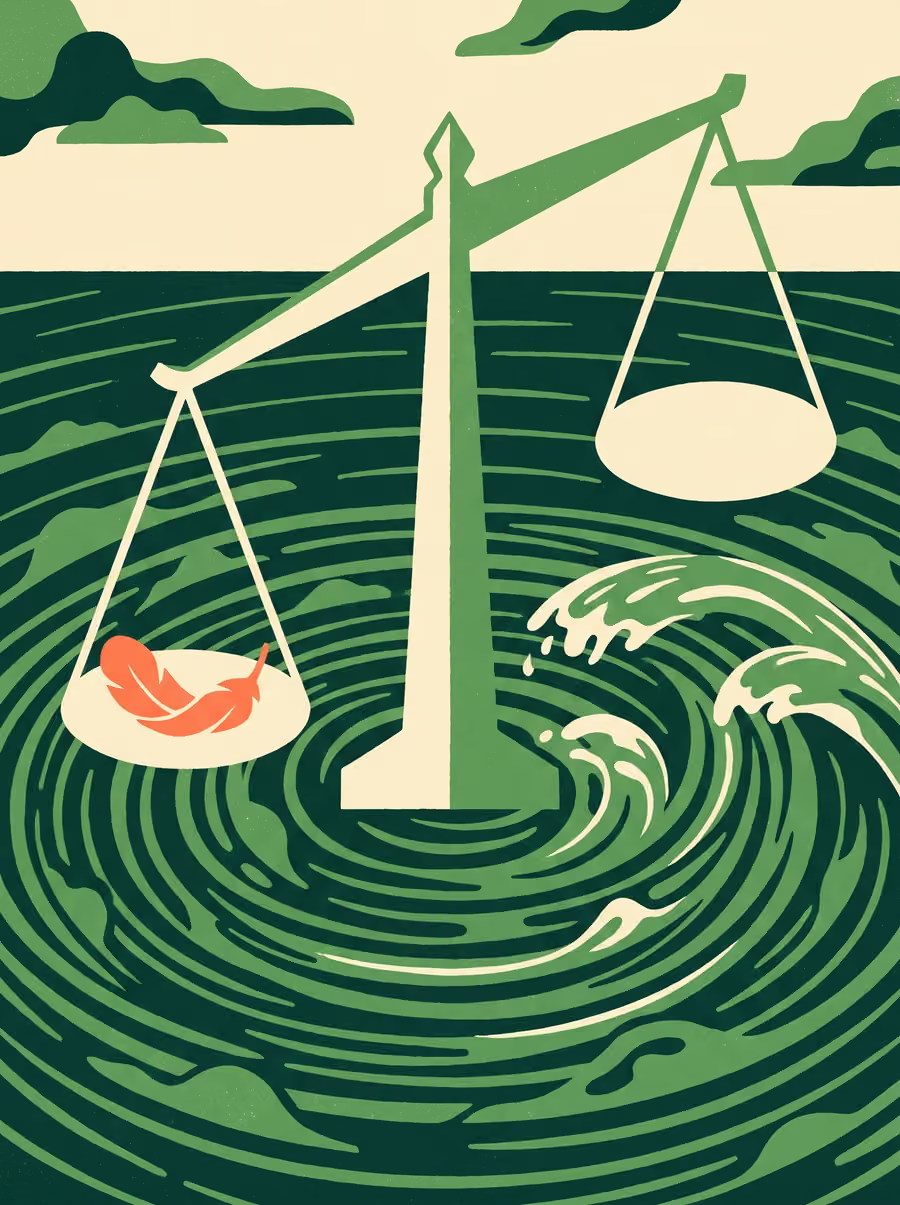
Tipping Point
A tipping point is the feather that drops the scale for good. Scientists are watching the ocean's currents wobble toward theirs.
Hi, I'm Jenny Mason, your tour guide to Feedback Loops, a journey through food waste cycles and the solutions that curb climate change. Spend any time scrolling through social media videos and you'll inevitably fall down the faceplant rabbit hole. In clip after clip, a person trips or stumbles or bends over just a little too far. Maybe they flail in a sad attempt to recover their balance before ultimately cheeks nuggling the concrete. What you're witnessing is not merely human, hubris, humorously humbled by happenstance. You're seeing the ecological concept of a tipping point in action. A tipping point is the feather that permanently drops the scales out of balance. It is the failed flail that doesn't prevent the faceplant. It is the point of no return before unstoppable and irreversible disaster. Experts are closely watching the ocean to see if its major currents are at a tipping point. The ongoing rise in global temperatures has the power to shut down the natural teeter totter of hot and cold water exchanged through ocean currents. If most of the ocean is simply warm or hot, the pressure equalizes and currents grind to a halt. It has happened before and it nearly triggered a never-ending ice age. Composting food scraps is a sure way for humanity to curb climate disasters and avoid a feat worse than death. Feedback loops is produced in collaboration with Table-to-Farm Compost and K-D-U-R. For more information about curbing food waste, visit Table-to-FarmCompost.com.
 Loop66
Rose vs. Jack
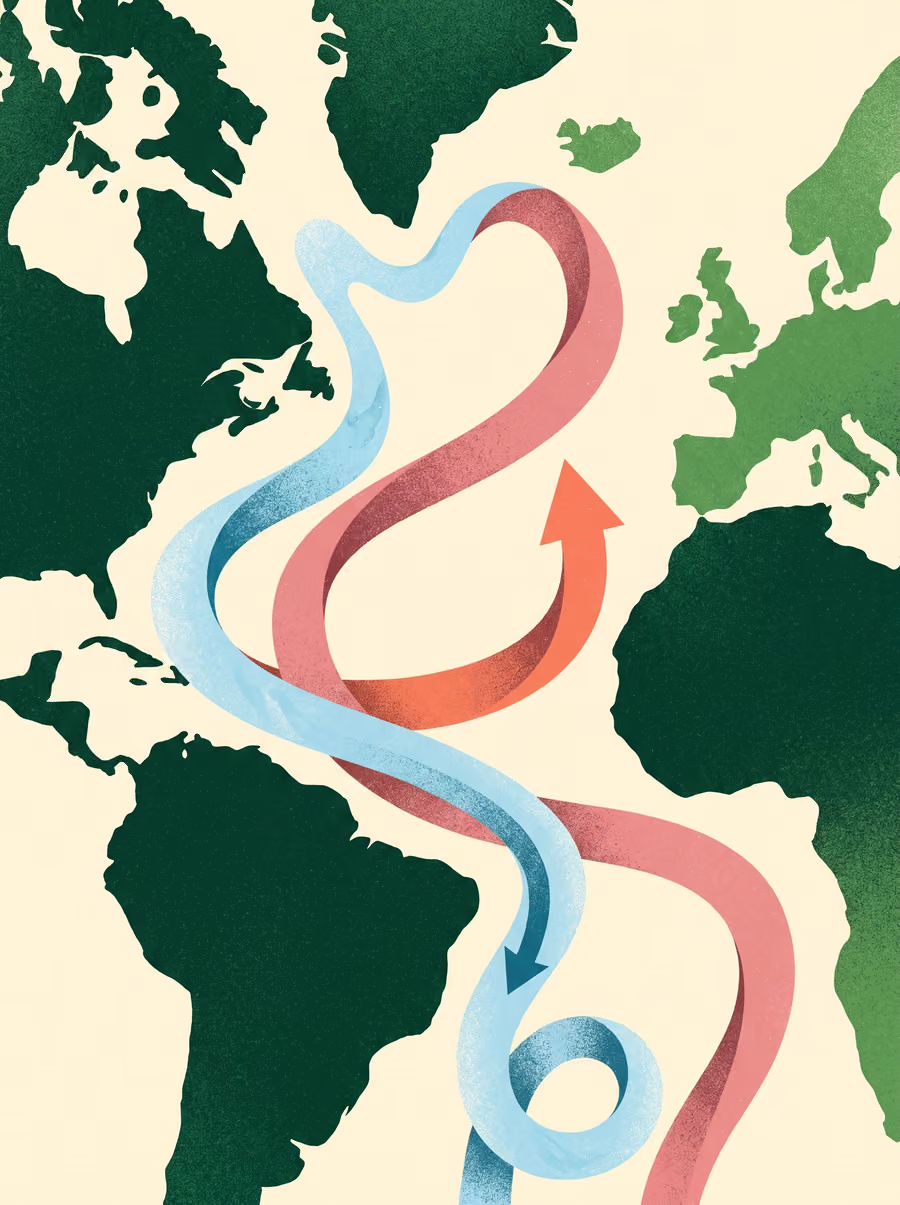
Cold water sinks, warm water rises, and the Atlantic runs on the romance between them. It is the Titanic physics that keeps Europe warm.
Hi, I'm Jenny Mason, your tour guide to feedback loops, a journey through food waste cycles and the solutions that curb climate change. What can think the unthinkable? An iceberg or movie fans will say it's Rose refusing to share her big door life wrapped with Jack once the Titanic slurps into the ocean. But the fact remains that cold sinks and warmth rises or floats. If we think of ocean waters like Jack and Rose from Titanic, we can better understand the natural forces that create major ocean currents like the AMOC or Atlantic meridiannel overturning circulation. Northern Atlantic waters or jack waters are cold and very dense because their particles possess less energy. They aren't moving much. Hot tropical equatorial waters or rose waters are packed with energy. Many kids spread across a playground, these particles jiggle, bounce, and ricochet. When cold, heavy Jack sinks, he creates a pressure vacuum that pulls warm rows out of the equator. As Rose travels north, she loses some volume to evaporation. This causes her to cool and get saltier. All that salt makes her heavier or denser. By the time she reaches the Northern Atlantic, Rose has transformed into Jack. Jack sinks and the AMOC cycle repeats. Recent data suggests that human lifestyles are disrupting the AMOC by spewing too much heat-trapping carbon dioxide and methane into the atmosphere. Converting food scraps to compost is how ordinary people can sap boat Taj, climate collapse. Feedback loops is produced in collaboration with Table-to-Farm Compost and KDUR. For more information about curbing food waste, visit Table-to-FarmCompost.com
 Loop65
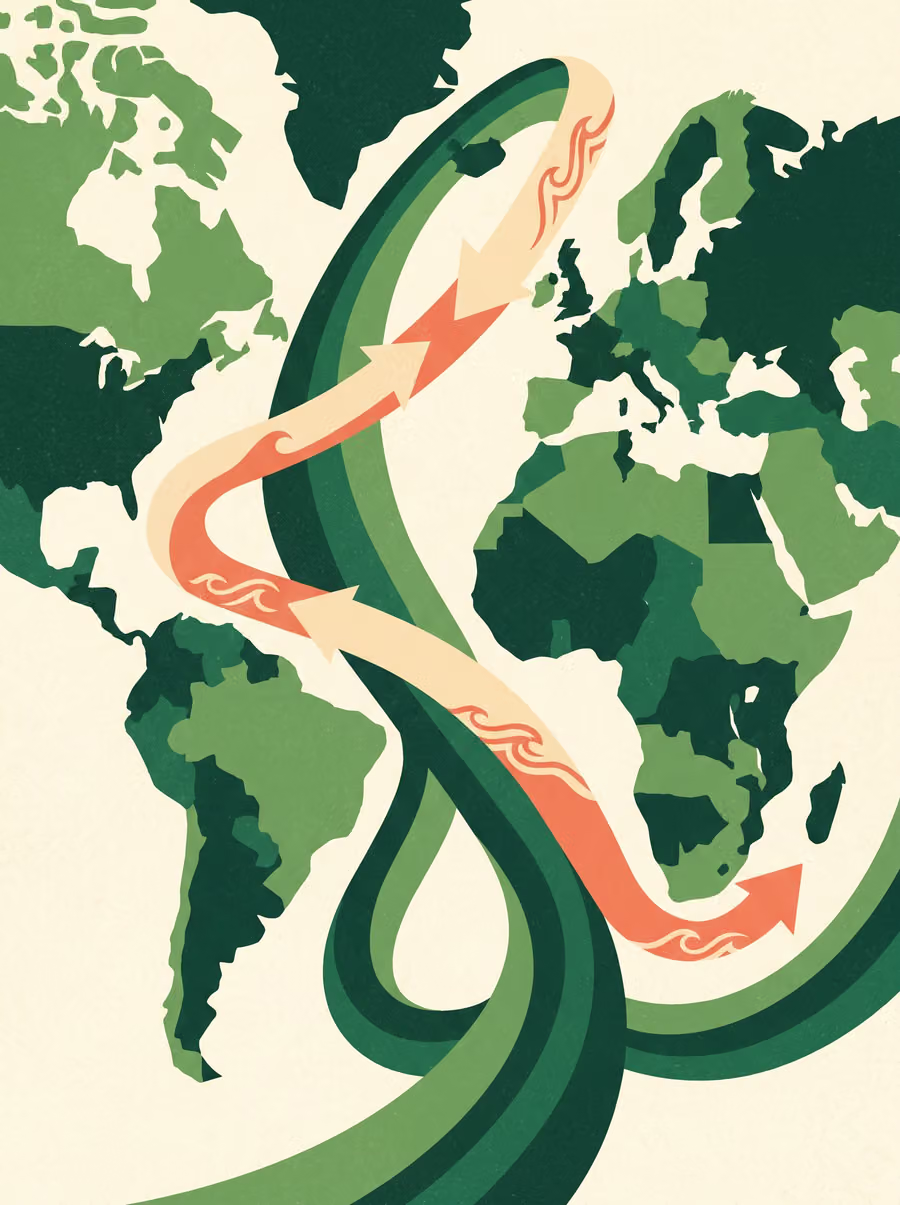
The Ocean Roller Coaster
There is a roller coaster in the ocean, thousands of miles long. The AMOC hauls heat between the poles, and without it, Ireland would feel like Siberia.
Hi, I'm Jenny Mason, your tour guide to feedback loops, a journey through food waste cycles and the solutions that curb climate change. Did you know there's a giant roller coaster in the ocean? Like cars on a track, streams of water plunge from the surface down to the depths and then soar back up to the surface again. This roller coaster ride can span thousands of miles between the north and the south poles. These currents also form liquid ribbons that connect the shorelines of distant continents. Ocean currents shuddle nutrients, organisms, and even temperatures around the planet. For instance, the Atlantic Meridianal overturning circulation or AMOC helps move heat from the sizzling hot tropical equator north into frigid regions, while also transferring chilly Arctic temperatures south to the tropics. It's a natural air conditioning system. Without the AMOC, northern Europe and Ireland would look and feel more like Siberia. The AMOC also plays a big role in regulating temperatures and determining typical seasonal rain patterns across North America and the United States eastern coast. Some scientists are seeing signs that Earth's rise in global heat is interfering with the AMOC. Converting food scraps to compost is currently the most impactful way for ordinary people to curb climate catastrophes. Feedback loops is produced in collaboration with Table to Farm Compost and KDUR. For more information about curbing food waste, visit TableToFarmCompost.com
 Loop64
Climate Stumped
Researchers flying over the melting Arctic found 55-million-year-old petrified stumps, proof the frozen north was once a steaming forest, and that Earth's story keeps turning.
Hi, I'm Jenny Mason, your tour guide to feedback loops, a journey through food waste cycles and the solutions that curb climate change. On a recent flyover survey of Arctic islands, researchers spotted something more astonishing than the rapidly vanishing snow. They discovered petrified tree stumps, roots, branches, leaves, and sap or amber. The hardened minerals preserved bark texture, growth rings, fungal infections, and pest infestations, all dating back some 55 million years. Following an intensive investigation, scientists determined that the snowy, lifeless Arctic had once been a hot, humid mix of deciduous and rainforests slathered in gigantic trees. The planet has cycled through many transformational heating and freezing cycles triggered by viral volcano eruptions, wobbles in earth's rotation, fluctuations in the sun's internal combustion, and many other natural phenomenon. Each event yanks on the planet's thermostat, which plunged 11 million years ago. The Arctic's mega-forests died and were then mummified under mud and ice. Today, the stony stumps are a reminder that not all changes bad. Perhaps a rapidly heating Arctic will regrow the old forests, providing refuge to wildlife and humans. The stone trees also indicate that although we have zero control over some climate triggers, humanity isn't entirely stumped because there are levers we can tug, such as converting food waste to compost. Feedback loops is produced in collaboration with Table to Farm Compost and KDUR. For more information about curbing food waste, visit tabletofarmcompost.com
 Loop63
Ag Arachnids
A mile down, newly discovered sea spiders farm bacteria gardens on their own bodies, and their microbe crops eat the methane seeping from the seafloor.
Hi, I'm Jenny Mason, your tour guide to Feedback Loops, a journey through food waste cycles and the solutions that curb climate change. Sometimes getting dressed and going to the grocery store is just too much, and forget apt-tapping some food delivery service. Wouldn't it be nice if you could just grow your own food? But not in an outdoor garden where you'd have to deal with bugs and weeds and weather. Or like a garden you grew on your own skin. That is exactly what three newly discovered sea spiders do. Uber Eats is not an option when you live over 6,500 feet down on the ocean floor. So these tiny spiders grow bacterial gardens on their exoskeletons. They then use their long noses or perbosses to harvest the yummy microbes. Most of these spiders gathered from California to Alaska reveal lawnmower tracks, clipped through the germ gardens. Why are researchers so jazzed about ag arachnids that munch their own skin gunk? Because the microbes they farm consume the methane gas that naturally seeps out of the sea floor. Methane in the atmosphere causes way more planetary heating than carbon dioxide. Together, the spiders and microbes act as a biofilter, locking methane deep underwater. People who convert their household food waste into compost also act as a biofilter that sequesters methane in the soil. So to all you spiders and composters, creep up the good work. Feedback loops is produced in collaboration with Table-to-Farm Compost and KDUR. For more information about curbing food waste, visit Table-to-FarmCompost.com.
 Loop62
Penguin Poo Clouds
Ammonia wafting off Antarctic penguin colonies seeds billowy clouds that bounce heat back to space. Forty million penguins, one colossal sunshade.
Hi, I'm Jenny Mason, your tour guide to feedback loops, a journey through food waste cycles and the solutions that curb climate change. Scientists based at Earth's north and south poles must tolerate several workplace quirks, such as bone-shattering cold or the stench of guano from humongous bird colonies. A University of Helsinki Research Expedition in Antarctica recently observed a strange workplace phenomenon. Gas emissions from penguin poo formed white, billowy clouds in the sky. After careful study, experts concluded the ammonia particles wafting off the dung heaps attract other air particles. These molecular lumps draw in water vapor and voila fluffy clouds form. Scientists in the Arctic have seen similar cloud seeding caused by seabird guano. Generating clouds on a hot planet is critical, especially around Earth's poles, where temperatures are rising faster than anywhere else. Melting the massive stores of snow and ice at the poles will cause ocean levels to rise. The devastation to coastal communities will be horrific, but clouds act like sunscreen, bouncing the sun's heat back into space. And with 40 million penguins in Antarctica alone, the potential to temper Earth's skyrocketing fever is colossal. Besides protecting bird and penguin habitats and food sources, ordinary people can stifle global heating by simply converting household food waste to compost. Feeding the crops that then feed us is really a penguin win. Feedback loops is produced in collaboration with Table to Farm Compost and KDUR. For more information about curbing food waste, visit tabletofarmcompost.com
 Loop61
Scrappy Solutions
New York discards a thousand blue whales of clothing a year. One Brooklyn warehouse has pulled two million pounds of it back from the brink.
Hi, I'm Jenny Mason, your tour guide to Feedback Loops, a journey through food waste cycles and the solutions that curb climate change. Every year, New Yorkers discard 200,000 tons of clothing, shoes, accessories and linens. That's equivalent to the weight of a thousand blue whales. But that's just residential waste. What about the waste produced by the fashion industry? Nobody really knows because no agency tracks the fabric waste trickling out from boutique designers or textile factories. That said, fab scrap may have a rough idea. Since the Brooklyn nonprofit formed in 2016, it has diverted over 2 million pounds of fashion fabrics from landfill waste streams. Half of its giant warehouse is consumed by floor to ceiling black garbage sacks, crammed with discarded materials and outfits. Every week, another 6,000 pounds of scraps are delivered. Volunteers sort through the contents and salvage reusable swatches or bolts of material before sending the rest onto a processing plant that converts the cloth into shoddy. Shoddy is lots and lots of shredded materials compressed into thick sheets that can then be used as insulation material. The need for fashion waste diversion solutions is mighty as the UN estimates 10% of global carbon dioxide pollution comes from trashed fashion. Ordinary people knock down even more CO2 pollution when they divert household food scraps to compost. Which goes to show that the best way to solve a waste problem is through expanded awareness. Feedback loops is produced in collaboration with Table to Farm Compost and K-D-U-R. For more information about curbing food waste, visit tabletofarmcompost.com
 Loop60
Sailing Boulders
In 2022, rain-on-snow floods raised the Yellowstone River fourteen feet and sent thousand-pound boulders sailing like ships.
Hi, I'm Jenny Mason, your tour guide to feedback loops, a journey through food waste cycles, and the solutions that curb climate change. Did you know Boulders can sail? In June 2022, giant boulders went sailing in and around Yellowstone National Park after an atmospheric river collided with a surprise heat spike. Around Memorial Day, a cold snap dumped epic proportions of snow on Montana's and Wyoming's mountains. In some places, 35 inches of snow piled up, which is 144% more than the 20-year average. But then, temperatures suddenly spiked well above historical averages, quickly melting all that snow. At the same time, an atmospheric river swept over California. It was so intense that it barreled over several major mountain ranges on a path towards Yellowstone. As much as five inches of rain fell in 24 hours, with more to come for several days, this rain on snow event quickly inundated riverways. The Yellowstone River alone rose over 14 feet. The flood waters scraped away roads and clawed trees off mountain slopes. Floods flatten nearby towns and transported 1,000-pound boulders like sailboats. Experts anticipate these rain on snow events will occur more often across the Rocky Mountain region as global heat ushers in earlier spring melt off and generates bigger atmospheric rivers that slither farther inland. But here's a fact worth sail abrating. When households convert food waste to compost, they sequester the carbon that heats the planet and sparks climate catastrophes. Feedback loops is produced in collaboration with Table-to-Farm Compost and KDUR. For more information about curbing food waste, visit Table-to-FarmCompost.com
 Loop59
Raining Toads
Atmospheric rivers are spreading into places that never needed umbrellas, dropping a third of Tennessee's annual rain in four days.
Hi, I'm Jenny Mason, your tour guide to feedback loops, a journey through food waste cycles and the solutions that curb climate change. Cloudy with a chance of showers, that's the daily monsoon forecast residents in the arid west yearn for while June slowly sizzles to a close. However, this year, that forecast might be cloudy with a chance of poisonous toads. Let me explain. In 1935, South America's cane toad was imported to Australia to gobble up the beetles damaging the nation's sugar cane crops. The toads largely ignored the beetles and wound up gobbling up everything else. And their toxic skin poisoned the critters that tried to eat them. This invasive species has devastated Australia's ecological habitats and continues to expand its territory. Similarly, atmospheric rivers are also proving to be something of an invasive weather species. As global temperatures rise, these soggy sky streams are spreading into new areas where residents are not necessarily equipped to deal with them. Ordinarily, states like Kentucky, Arkansas, and Tennessee experience some flooding following tornadoes. But in recent years, atmospheric rivers left behind catastrophic floods unlike anything locals had ever seen before. In April 2025, an atmospheric river hammered Tennessee with 15 inches of rain over four days. That's roughly one-third of the state's entire annual rainfall in less than a week. Fortunately, ordinary people totally have the power to check these climate calamities by simply converting household food scraps into compost. Backloops is produced in collaboration with Table-to-Farm Compost and K-D-U-R. For more information about curbing food waste, visit Table-to-FarmCompost.com
 Loop58
Surfin' USA
Atmospheric rivers left enough floodwater that surfers actually rode California's highways. Fifty-six sky rivers have slammed the West this year alone.
Hi, I'm Jenny Mason, your tour guide to feedback loops, a journey through food waste cycles and the solutions that curb climate change. If everybody had an ocean across the USA, then everybody'd be surfing, surfing USA. The Beach Boys 1963 fantasy turned reality when recent atmospheric rivers left enough flood water for actual surfers to ride their surfboards down California's highways and byways. In 2010, an atmospheric river dropped two feet of rain over the entire west coast in 12 days. It deposited 75% of the Sierra Nevada's entire annual snowpack in less than two weeks. More recently, a 2023 river day-luished California with 36 trillion gallons of water in a few days. To put that in perspective, that's the total daily flow of the Amazon River and to make matters worse, the frequency of atmospheric rivers is multiplying. From 1979 to 2019, a total of 24 rivers swept across the west coast. That figure nearly doubled over the winter months of 2023 to 2024 as 51 rivers slopped out of the Pacific. Already this year, 56 rivers have slammed the west. Current models predict an 84% uptick in winter's atmospheric rivers and a 113% rise in summertime sky floods. However, these dreary outcomes can be avoided if more households convert their food waste to compost, which sequesters the carbon that drives global heating and catastrophic weather. Suffice it to say, there's still hope. Feedback loops is produced in collaboration with Table to Farm Compost and KDUR. For more information about curbing food waste, visit tabletofarmcompost.com
 Loop57
Satellite Tracking
When meteorologists finally looked down from orbit, they discovered rivers in the sky, and evidence of a 43-day storm that once turned California's Central Valley into a sea.
Hi, I'm Jenny Mason, your tour guide to feedback loops, a journey through food waste cycles and the solutions that curb climate change. In the mid-1970s and early 80s, meteorologists stopped looking up at the skies and instead began looking down. Specifically, they looked down on planet Earth through the Geostationary Operational Environmental Satellites, or GOES. Built and launched by NASA and operated by the National Oceanic and Atmospheric Administration, or NOAA, these satellites proved to be game changers for weather scientists and forecasters who could fully observe the complete life cycles of common weather events. GOES helped experts spot all new weather phenomena, such as atmospheric rivers, which turned out to be culprits behind California, Oregon, and Washington states, famously rainy conditions. More than that atmospheric rivers seemed to cause 85% of all floods in that region. To save lives on property, forecasters hoping to predict destructive rivers in the future would need a better understanding of the damage they had already inflicted in the past. Coming back through historic weather data, scientists uncovered what may have been a watery behemoth that rained down on California for 43 days in 1861. It turned the central valley into a sea the size of lake Ontario. Are we on a crash course with a future disaster on this scale? Not necessarily. When ordinary people convert household food waste into compost, they significantly reduce heat trapping gases. And you know what they say, better lake than never. Feedback loops is produced in collaboration with Table to Farm Compost and KDUR. For more information about curbing food waste, visit tabletofarmcompost.com.
 Loop56
Giant Sponge
Picture a sponge twice the size of Sumatra crashing into the Sierra Nevada. That is the Pineapple Express, carrying twelve Mississippis of water through the sky.
Hi, I'm Jenny Mason, your tour guide to feedback loops, a journey through food waste cycles and the solutions that curb climate change. Imagine a sponge twice the size of Sumatra, rising out of the ocean and crashing into the cascade and Sierra Nevada mountains along the United States western coastline. Upon collision, the sponge buckles and releases all of its moisture as extreme rain or snow. Every winter, giant sponges really do attack the west coast when atmospheric rivers commonly referred to as the pineapple express transport muggy water vapor from Hawaiian seas to the western US. Some of these sky streams can carry 7 to 12 times more than all the water that flows out of the Mississippi into the Gulf of Mexico. That is about 4.5 million gallons or 166 semi-trucks of water every second. When delivered over several months, this water supply is vital to a largely arid region. Unfortunately, as Earth's global temperature spikes, oceans emit way more hot water vapor, the resulting atmospheric rivers morph into gargantuan sponges that bomb the landscape. The excessive rainfall uproots giant trees, cracks houses in half and scrapes away mountain sides. Luckily, ordinary households can prevent these sponge bomb square pants by converting their food scraps to compost, which curbs the heat trapping gases at the heart of catastrophic climate change. Feedback loops is produced in collaboration with Table to Farm Compost and KDUR. For more information about curbing food waste, visit tabletofarmcompost.com
 Loop55
Atmospheric Rivers
Rivers thousands of miles long flow above your head. They deliver half of California's rain, and a warming climate is making them burst their banks.
Hi, I'm Jenny Mason, your tour guide to feedback loops, a journey through food waste cycles and the solutions that curb climate change. What do jet streams and hot water have in common, with Romeo and Juliet? Both pairs represent matches made in heaven that lead to devastating consequences. In the Atlantic Ocean, hot equatorial water vapor caught on a jet stream generates hurricanes. But elsewhere, these same elements combine to form rainy, snowy fire hoses called atmospheric rivers. These rivers are huge, extending thousands of miles long and hundreds of miles across. Many of the world's arid regions from North America to South Africa rely on atmospheric rivers to deliver essential doses of precipitation. 40% of eastern Asia's precipitation comes from these sky rivers. They also bring half of California's annual rain. Without atmospheric rivers, the Western US would remain locked in a near permanent natural drought. But in more recent decades, shifting climate conditions are spurring atmospheric rivers to burst their banks, so to speak. And the more they run amuck, the more damage they cause. Floods and mudslides are two common catastrophes resulting from extreme atmospheric rivers. But soft, what light through yonder window breaks? Tis but the ordinary people converting food waste to compost to curb the pollution that dust spur these climate calamities. Feedback loops is produced in collaboration with Table-to-Farm Compost and KDUR. For more information about curbing food waste, visit Table-to-FarmCompost.com
 Loop54
Babcock Ranch
When Hurricane Ian leveled the Florida coast, one solar-powered town never lost its lights, its water, or its wifi. Babcock Ranch held the pass.
Hi, I'm Jenny Mason, your tour guide to feedback loops, a journey through food waste cycles and the solutions that curb climate change. In 480 BC, roughly 300 lackademonian soldiers or Spartans clashed with a Persian army some 1,000 times larger, trying to invade Greece through a narrow mountain pass known as Thermopoly or the Hot Gates. For three days the Spartans held the pass while inflicting major losses to the enemy's battalions. Although the Spartans were ultimately decimated, their courage in the face of unbeatable odds inspired Greece's other city-states to unite and fully route the Persian invasion. A similar battle may be taking place today in Florida's Babcock Ranch. This master-planned community was designed not only to be fully independent and sustainable but also to completely withstand hurricanes. The infrastructure of Babcock Ranch runs entirely on solar energy transmitted on underground power lines. Native plants and eco-conscious landscaping mitigate flooding, and every building, street lamp and park bench was constructed with wind-resistant materials. In 2022, Babcock Ranch took a direct hit from Hurricane Ian which wavered between categories 4 and 5 as it ripped across the state. While other communities were leveled and over 150 lives lost, Babcock Ranch never lost electricity, Wi-Fi or running water. Babcock Ranch is evidence that humanity can overcome the overwhelming onslaught of out-of-whack weather cycles. And while converting household waste to compost seems insignificant, it's spart-to-icularly effective at cutting down climate disasters. Feedback loops is produced in collaboration with Table-to-Farm Compost and K-D-U-R. For more information about curbing food waste, visit Table-to-FarmCompost.com
 Loop53
Hot to Trot
Tropical Storm Laura hit a patch of Gulf water ten degrees too hot and exploded into a category four in hours, the strongest storm to strike Louisiana since 1851.
Hi, I'm Jenny Mason, your tour guide to feedback loops, a journey through food waste cycles and the solutions that curb climate change. Imagine you're lounging on a beach in the shade of a giant umbrella, an ice cream vendor rolls along the boardwalk. Craving some sorbet, you grab your wallet and set off barefoot. The scorching sand turns your stroll into a goose stepping sprint. Something similar happens when a tropical storm steps on to a hot patch of ocean. In August 2020, tropical storm Laura blossomed off Africa's west coast, where 80 to 85% of all category three through five hurricanes are birthed. She claimed lives in Haiti, scraped over Costa Rica, and battered Cuba, causing the emergency evacuation of some 260,000 residents. But then Laura hit the Gulf of Mexico, where the waters were already 10 degrees hotter than historical averages. Within a few hours, Laura escalated to a category four hurricane, wind speeds averaged 150 miles per hour, and 18 foot storm surge crashed into coastal communities, a foot of rain flooded from the sky. Laura became the strongest storm to hit Louisiana since hurricane record keeping began in 1851. Ordinary people can directly help cool the earth's overheating oceans by converting food scraps into compost. It's a sand-tastic way to undercut the climate pollution that spurs catastrophic weather disasters. Feedback loops is produced in collaboration with Table to Farm Compost and KDUR. For more information about curbing food waste, visit tabletofarmcompost.com
 Loop52
Wind Waltzing
Off Africa's coast, hot desert wind waltzes with rainforest air, and their dance births the Atlantic's hurricanes. The music is speeding up.
Hi, I'm Jenny Mason, your tour guide to feedback loops, a journey through food waste cycles and the solutions that curb climate change. Tick-tock dance trends often take the world by storm, but none have gone so viral that we've needed to design all new buildings where they can be performed. The same cannot be said of the Waltz, which took the world by storm in the 18th and 19th centuries, so much so, that architects had to design and build the world's first public dance halls to accommodate the masses yearning to cut a rug. Today, Waltzing still takes the world by storm in the form of severe hurricanes. Just off Africa's western coast, hot dry winds from the Sahara Desert twirl together with wet air masses drifting off the continent's southern rainforests. These dance partners Waltz high into the atmosphere where they generate a powerful global air current known as the African Easterly Jet. Moving with a rhythmic pulse, the jet unulates the ocean below creating gargantuan waves that spark thunderstorms. When the thunderstorms combine, they form a tropical storm that can expand into a hurricane. For eons, this natural cycle produced a somewhat predictable hurricane season between July and October. Now however, Earth's hotter temperatures and rising sea levels are generating bigger, deadlier and more destructive hurricanes. Ordinary people can prevent the climate pollution that feeds megastorms by taking a minuet to compost household food waste. Feedback loops is produced in collaboration with Table to Farm Compost and K-D-U-R. For more information about curbing food waste, visit tabletofarmcompost.com
 Loop51
Hurricane How-To
A hurricane is a machine that feeds on hot ocean water, and our warming seas are serving bigger portions. Some storms now tower twice the height of Everest.
Hi, I'm Jenny Mason, your tour guide to feedback loops, a journey through food waste cycles and the solutions that curb climate change. What do you do with your dinner leftovers? Store them in the fridge? Take them to the office for lunch, or maybe you use them to spark the world's largest hurricanes. Typically, hurricanes, cyclones, or typhoons form when hot ocean water evaporates into the air. Strong winds, whoosh those steamy particles into the upper atmosphere, where they cool and condense into huge clouds. Wirling air currents twist the clouds into a spinning disc. So long as that disc can feed on warm water molecules, it will continue to grow and pick up speed. A standard hurricane churns at 74 mph. Unfortunately, modern human lifestyles produce atmospheric pollution that traps ever more solar heat. Oceans absorb much of this heat, which feeds bigger, better, hurricanes. Not only do hurricanes form earlier and more frequently, but they also swell to unthinkable scales. Some extend 10 miles high, or twice the height of Mount Everest, and a few have spanned nearly 1,000 miles across, which is half the length of the Mississippi River. Today's hurricanes are also faster with sustained winds creeping up on 200 miles per hour. For coastal denizens, effective solutions, hurricane, come fast enough. Converting household food waste to compost prevents the climate pollution that spurs destructive mega storms. Feedback loops is produced in collaboration with Table to Farm Compost and K-D-U-R. For more information about curbing food waste, visit TableToFarmCompost.com
 Loop50
Sleeping Giants
Sequoias survived the dinosaur-killing asteroid, but today's heat sends them into hibernation, and a sleeping giant absorbs no carbon.
Hi, I'm Jenny Mason, your tour guide to feedback loops, a journey through food waste cycles and the solutions that curb climate change. The birds are chirping, shrubs are budding, and the bears are safe cracking trash bins like De Niro in a heist film. Must be springtime in the mountain west. Weirdly, while some wildlife is stumbling out of hibernation, other organisms are settling in for a hot summer snooze. One prime example is Sequoias. These woodland jumbo giants are Earth's largest trees by volume. They soar to heights of 300 feet or more. They armor themselves in spongy two-foot thick bark, pumped with fire retardant substances, called tenons. And they can endure life spans exceeding 3,000 years. Despite having survived the asteroid blast that wiped out the dinosaurs, Sequoias are struggling with today's hotter climate. To cope, Sequoias hibernate. When a Sequoias siesta's, it neither ingest fuel, nor shares resources with its ecosystem. Sleeping Sequoias also don't respire, so they do not inhale carbon dioxide from the atmosphere. Given their capacity to hoover up 250 times the carbon quantities of average trees, their slumber only makes the planet hotter. A hotter planet induces hotter, more intensive wildfires, which slash through a Sequoias thick bark. In 2020, extra hot wildfires killed 10% of California's mature Sequoias. Ordinary people can exert Sequoia powers when they convert household food waste to compost, which sequesters billions of tons of carbon into Earth's crust. Although it seems inconsequential, it's virtually heroic. Feedback loops is produced in collaboration with Table to Farm Compost and KDUR. For more information about curbing food waste, visit tabletofarmcompost.com
 Loop49
Wildfire Tipping Point
2020 was the year wildfires outgrew every tool we had. Old fires killed one tree in ten; today's kill nine.
Hi, I'm Jenny Mason, your tour guide to feedback loops, a journey through food waste cycles and the solutions that curb climate change. In fire science circles, 2020 stands out for reasons other than a global pandemic. It marks a tipping point in fighting wildfires, the moment when humankind could no longer control wildfires using the once tried and true interventions developed in the early 1800s. Prior to the 1800s, forests experienced frequent burnings, typically triggered by lightning or indigenous land stewards clearing out dangerous fuel loads from the underbrush, while also returning nutrients to the soil. These fires were slow moving and less intense, killing only about 10% of a forest's trees. Today's fires are blazing beasts, so hot they scorch and kill 90% of all trees in a forest. Many factors contribute to this harsh reality. More than a century of fire suppression has jammed forests with tinder. Human development has also jammed more people into fire prone regions. As of 2020, some 16 million homes were nestled in forests, grasslands, and shrublands that not only experience but also need cyclical wildfires. Meanwhile, development has eliminated 90% of wetlands, habitats that serve as natural fire breaks. Luckily, modern mega fires are no match for human resourcefulness. Not only can ordinary people adopt fire-wise lifestyles, but also they can cut the global heat breeding these fires by simply converting food waste into compost. Feedback Loops is produced in collaboration with Table-to-Farm Compost and KDUR. For more information about curbing food waste, visit Table-to-FarmCompost.com
 Loop48
Gisborne's Lament
One man built the machinery that snuffed America's wildfires for a century, and the century of unburned fuel became today's infernos.
Hi, I'm Jenny Mason, your tour guide to feedback loops, a journey through food waste cycles and the solutions that curb climate change. Flames out by 10 a.m. This was the presidential mandate issued to Harry T. Gisborne in 1918. All wildfires had to be extinguished within a day. Gisborne was the U.S. Forest Service's first ever fire scientist. He devoted the next 38 years to taming Mother Nature to save the people and homes, flooding into the Western U.S. He assembled a nationwide team of 6,000 weather watchers to predict storms. He replaced volunteer firefighters with trained professionals. Realizing that fires could be controlled once they were sliced like cakes, Gisborne invented new jobs like hot shots and smoke jumpers. These brave souls infiltrate fires on foot or by parachute to cut control lines. Journalist Jonathan Vigliotti notes that without aircraft, satellites or radar, Gisborne effectively snuffed nature's wildfire cycles. Unfortunately, Gisborne's genius backfired. His methods upended ancient indigenous stewardship methods, creating dense forests choked with burnable fuel. Not surprisingly, fires today are measurably hotter, bigger and impossible to contain. Add to this predicament a chronic rise in regional temperatures, a severe drought and intensified winds, all stemming from human-induced climate disruptions. Ordinary people are hot shots when they convert household food waste into the compost that sequesters carbon and helps cool the planet. Feedback loops is produced in collaboration with Table to Farm Compost and KDUR. For more information about curbing food waste, visit tabletofarmcompost.com.
 Loop47
1910, Again
In 1910, three million acres burned in 48 hours and soot snowed on Greenland. What was once a doomsday outlier is becoming the pattern.
Hi, I'm Jenny Mason, your tour guide to feedback loops, a journey through food waste cycles and the solutions that curb climate change. The first gray coil of smoke rose out of the pine tops in April. By August, some 3,000 fires shimmered across forests from Montana to Washington State. Volunteer firefighters aided by the military seemed to have the situation under control until Hurricane Force winds blasted across the West. Smoldering ash piles reignited, and in 48 hours, 3 million acres of forest were consumed. Smoke choked out daylight from Western Canada to New York, and as far south as Denver, Colorado. Soot snowed down on Greenland. Nothing could tame the blaze until a mega-monsoon hit on August 23. It's easy to think this was a recent wildfire catastrophe, but in fact it occurred in 1910. The US's entire forest fire timeline is dotted with several doomsday blazes like that one. But in the last decade, those dots have formed more of a solid line. Wildfires are more frequent and so are the mega-fires. While 3 million wildfires blazed throughout the 1990s, that figure has more than doubled to 7 million in the last decade. Scientists warned that an atmosphere drenched in carbon dioxide and methane is ripe for breeding mega-fires. One smokin' hot way you can help is by converting household food waste into the compost that sequesters carbon and helps cool the planet. Feedback loops is produced in collaboration with Table-to-Farm Compost and K-D-U-R. For more information about curbing food waste, visit Table-to-FarmCompost.com
 Loop46
Party Fire
New Year's revels may have sparked the Palisades fire. From LA to Siberia, wildfire has gone global, off-season, overnight, and unstoppable.
Hi, I'm Jenny Mason, your tour guide to feedback loops, a journey through food waste cycles and the solutions that curb climate change. There's nothing like a good New Year's Eve party to usher in fresh hope and zesty possibilities. Unfortunately, for residents of Los Angeles, New Year's Rebels may have sparked the devastating palisades and eaten fires early in January 2025. Investigations into the cause of California's third most destructive fire ever are still underway, but the byproduct of its destruction is confirmed. Over 23,000 acres scorched, nearly 7,000 structures destroyed or damaged. Sadly, these most recent fire catastrophes are part of a global wildfire trend that has spread like a rash. The US and Canada, Mexico, Brazil, Greece, regions across Europe and Siberia are all experiencing more frequent and more intense wildfires. Off season, overnight, why are wildfires so unstoppable? Experts point to new climate realities, locking 45% of the US in a persistent drought. And although modern storms produce more lightning than before, people cause 85% of all wildfires, which is a problem because more people are residing in what firefighters call the Wildland Urban Interface, or WUI, or WUI. WUIs are areas where civilization and wilderness tangle together, and where fire danger always runs high. The palisades fire swept through a WUI. Converting food waste to compost is one surefire way people living anywhere can help snuff the destabilizing climate conditions feeding today's wildfire crisis. So don't WUI, be helpful. Feedback loops is produced in collaboration with Table-to-Farm Compost and KDUR. For more information about curbing food waste, visit Table-to-FarmCompost.com
 Loop45
Thunder
Mega-storms now hurl 200 lightning strikes every half hour, and the western fire season has grown by 84 days. Count the seconds between flashes while you still can.
Hi, I'm Jenny Mason, your tour guide to feedback loops, a journey through food waste cycles and the solutions that curb climate change. 1-1000, 2-1000, 3 What we're young, we're taught to count the pauses between thunder rumbles as a way to distract us from fear. Divide the number by 5 and you can roughly calculate the miles between your location and the booming lightning bolt. The exercise also reveals that storms aren't erratic monsters. They're systems with some predictable aspects. Even so, this calming method may be lost on today's young storm watchers. Rising global temperatures produce more atmospheric water vapor which in turn generates bigger, more forceful storm updrafts. This blustery tumbling shakes up particles building up a mighty static electric charge that blasts out as lightning. Since 2020 mega lightning storms have been known to produce 2500 bolts or about 200 strikes every 30 minutes. In some cases the flashes are so continuous they shine like daylight. In the western US this uptick in lightning strikes has driven up the frequency of wildfires. Hotter average temperatures have also extended the length of the fire season by 84 days. These correlations are not welcome news to families and businesses facing a potentially hazardous fire season in the west. Fortunately, communities can shrink future storms by simply converting food waste to compost which sequesters planet heating gases. 1,000, 2,000, let's get ready to rumble. Feedback loops is produced in collaboration with Table to Farm Compost and KDUR. For more information about curbing food waste visit tabletofarmcompost.com.
 Loop44
Meow
Every AI cat video has a carbon bill. Data centers guzzle electricity, the West heats up, trees die, and dead forests are powder kegs.
Hi, I'm Jenny Mason, your tour guide to feedback loops, a journey through food waste cycles and the solutions that curb climate change. It's fun to play with AI these days. It'll compose and perform death metal country ballads. It'll craft videos of cats strutting runways, dressed in star wars, hot kachir, in footage so rich. It can only be described as high for delity resolution. But every request we make of AI comes at a cost to Earth's climate. The data centers where AI's computerized brains operate demand huge electricity loads. Converting energy to electricity leaves behind carbon dioxide pollution that traps heat in Earth's atmosphere. The National Oceanic and Atmospheric Administration, or NOAA, estimates human lifestyle today boosts the atmosphere's CO2 levels 100 times faster than all other natural cycles and processes. Since the 1970s, summer temperatures in the west have gone up three degrees. Sounds small, but it's actually enough to kill millions of trees before they could adapt to hotter, drier conditions. Dead trees are powder kegs waiting to become infernos. Residents across the west and southwest are expanding their fire mitigation strategies. But besides creating defensible areas around a home, or restricting campfires, fireworks and other combustibles during peak fire conditions, people could cut back on high fashion catwalks. If, perhaps, that's too big a sacrifice, then simply diverting food waste from landfills is a powerful way to curb the gases that fuel a hotter planet. Feedback loops is produced in collaboration with Table to Farm Compost and KDUR. For more information about curbing food waste, visit tabletofarmcompost.com
 Loop43
Shrinking Goats
Italy's chamois goats have shrunk a quarter in size as their alps heat up, and Costa Rica's frogs are croaking in higher pitches. The heat is resizing the wild.
Hi, I'm Jenny Mason, your tour guide to feedback loops, a journey through food waste cycles and the solutions that curb climate change. As the planet spirals into hotter temperature cycles, car lovers are bracing for disaster. Not because of shifts from gas combustion to electric engines, but rather because they are losing the ability to lovingly polish their cars to a showroom shine. The Alpine Shamwa Goats of Italy, whose hides are turned into Shamwa leather cloths or shammies, are shrinking. A study in Frontier Zoology reported that this species of goat shrink a quarter in size between 1979 and 2010. Over that same period, the region of their habitat saw average temperatures rise by 5 to 7 degrees Fahrenheit. As the days grew hotter, the Shamwa goats spent more time bedded down and less time eating, which caused each successive generation to be a little smaller than their forebears. A similar predicament has been observed in Costa Rica's male koki frogs. Over two decades of warming, the frogs shrink and consequently their croaks rose to higher pitches. Hopefully female koki frogs aren't fans of berry whites baritone love songs. Ordinary people are goats, the greatest of all time, when they leapfrog their food from the landfill to compost, which sequesters the gases that contribute to catastrophic climate change. Feedback loops is produced in collaboration with Table to Farm Compost and KDUR. For more information about curbing food waste, visit TableToFarmCompost.com
 Loop42
Trouble Brewin'
Half the world's coffee belt could be too hot and dry to grow beans by 2050. Trouble is brewing, literally.
Hi, I'm Jenny Mason, your tour guide to feedback loops, a journey through food waste cycles and the solutions that curb climate change. The scientific community is buzzing because the wet, cool, humid and downright spongy tropical region around Earth's equator are heating up and drying out. To be fair, all of Earth's major boreal forests are also drying to a crisp on a steadily heating planet. But the reason why tropical forests are so concerning is that they are where the world's coffee supply is grown. On average, crops in Africa, Indonesia, Central and South America produce 11 million tons of beans. However, droughts in Vietnam and Brazil cut both nations' yields by 20% a piece. Climate models project that by 2050 about half of the world's bean belt will be too hot and too dry to support coffee crops. And while coffee plants do not like too much heat, infectious pests do. In the mid-2000s, a deadly fungus known as coffee leaf rust, decimated crops in Colombia, Honduras, Costa Rica, Nicaragua, El Salvador and Guatemala. Facing the loss of their most potent revenue source, the world's poorest nations are teetering on the brink of collapse. Clearly, trouble is brewing, but there's good reason to perk up. Converting your household food waste to compost sequesters the gases that contribute to catastrophic global heating. Feedback loops is produced in collaboration with Table to Farm Compost and KDUR. For more information about curbing food waste, visit tabletofarmcompost.com
 Loop41
Lotta Lava
Melting ice is uncorking the world's volcanoes. As the heavy frozen lids recede, magma is free to fizz, and eruptions are on the rise.
Hi, I'm Jenny Mason, your tour guide to feedback loops, a journey through food waste cycles and the solutions that curb climate change. On December 23rd, 2024, at 2.20am, the Earth's crust split like a busted eggshell. Lava fountains shot nearly 300 feet into the air. Hawaii's Mount Kilauea was erupting for the sixth time since 2020. GUI-Black sludge, crisscrossed with red fiery ribbons, covered 500 acres of the crater, pocking the mountaintop. Globally, more of Earth's volcanoes are erupting and they are doing so more frequently than in the past. Ancient geological data from Iceland shows that about 5,000 years ago volcanic eruptions were rare. The reason? A little ice age had piled Earth's surface under unusually large loads of snow. Planets volcanoes then and now are trapped under snow caps. Snow and ice are heavy and applied downward pressure on the magma inside volcanoes. Unable to slosh about, the magma loses heat and rests. As more of Earth's ice and snow layers recede due to global warming, magma is free to move. As the molten rock glushes under the surface, it fills with bubbles. Finally, like a shook-up soda bottle, the bubbling magma bursts free. Converting food scraps to compost is a rock-solid way to curb global heating and prevent volcanoes from destroying human homes and animal habitats. Feedback loops is produced in collaboration with Table to Farm Compost and KDUR. For more information about curbing food waste, visit tabletofarmcompost.com.
 Loop40
Dark Earth
Earth shines. Our clouds and snow reflect sunlight visible past Neptune, but the planet has measurably dimmed, and a dimmer Earth is a hotter Earth.
Hi, I'm Jenny Mason, your tour guide to Feedback Loops, a journey through food waste cycles and the solutions that curb climate change. The Sun gives us sunshine, but did you know the Earth gives other planets Earth Shine? The planet's vast fields of clouds and snowy areas act as mirrors, reflecting the light it receives from the Sun, back out into space. Earth Shine is bright enough to be seen with the naked eye well beyond Neptune's orbit, or at least it was bright enough, a 2021 study in geophysical research letters examined brightness levels of Earth's reflected light from 1998 to 2017, finding that the planet had dimmed significantly in the last three years of the study. A dimmer Earth is a sure sign of a planet heating itself into a chaotic and uncharted climate future. Hotter oceans produce fewer low-lying clouds, especially over the vast Pacific Ocean. With this giant flank left more exposed to the Sun, the Pacific's dark seas absorb even more solar radiation, which heats the ocean and prevents cloud creation, which means fewer reflecting mirrors and thus a dimmer planet that absorbs more heat and on and on the cycle goes, in an infinite and escalating feedback loop. Converting food scraps to compost is a bright way to reduce global heating by curbing the production of the greenhouse gases that trap excess solar heat. Feedback loops is produced in collaboration with Table-to-Farm Compost and K-D-U-R. For more information about curbing food waste, visit tabletofarmcompost.com
 Loop39
Lizard Love
Heat can flip the sex of developing reptile embryos, and the dating pool is tilting. A warming planet is leaving lizards, turtles and crocs swiping left.
Hi, I'm Jenny Mason, your tour guide to feedback loops, a journey through food waste cycles and the solutions that curb climate change. A good man is hard to find. Humans aren't the only critters on earth bemoaning the shortage of solid partners to match with. Several animal species are also swiping left thanks to rising global temperatures. All crocodiles, most turtles, some reptiles including lizards, frogs, and a few fish possess genes that enable temperatures to change the sex of developing embryos. Examining data as far back as 2015, scientists have seen a significant uptick in female hatchlings across these reptilian and amphibious species. In a clutch of eggs split evenly between male and female embryos, even a slight rise in temperatures will reverse the genetics of the males, transforming them into females. Experts speculate that these species evolved this ability as a way to outmaneuver unpredictable changes in climate. But many are concerned that the earth's current climate is getting too hot too rapidly for these species to adapt. If species cannot mate, their numbers dwindle until they go extinct. Looking at the evidence, I want to be honest, it's time ordinary people get going on serious climate action. By scaling up food waste diversion from landfills to compost, ordinary people contribute to a cooler planet and a hotter lizard dating scene. Feedback loops is produced in collaboration with Table to Farm Compost and KDUR. For more information about curbing food waste, visit tabletofarmcompost.com
 Loop38
Lightning Fires
Ninety-two million lightning bolts struck the US in a single year, and the long-burning ones are torching forests no firefighter can reach.
Hi, I'm Jenny Mason, your tour guide to feedback loops, a journey through food waste cycles and the solutions that curb climate change. The white-hot javelins and shimmering webs of lightning in a thunderstorm can be both beautiful and terrifying. Lightning in all its forms is the release of static electricity built up in the friction between particles, dust, moisture, and temperatures. But with a hotter planet, lightning acts weird. First off, it happens more often. In 2023, 92 million lightning needles stung the US, which is more than a 6% increase. Experts estimate a 40% rise in lightning strikes globally by the end of this century. Hotter air also produces longer lasting lightning. These long-continuing currents or LCCs pose a disastrous threat when they zap the remote boreal forests, rimming northern Canada and Siberia. Unreachable small fires quickly spiral out of control. In 2023, megafires caused by LCCs scorched 45 million acres of Canada's forests. That's eight times more than the average acres burned in the preceding 40 years. The world relies on these mighty forests for vital cooling effects and long-term carbon storage. But the more they burn, the more carbon enters the atmosphere, heating the planet, creating more LCC lightning, and more forest fires in an endless feedback loop. Converting food waste to compost is one of the most impactful actions ordinary people can adopt to tamp down the lightning fire crisis. Feedback loops is produced in collaboration with Table-to-Farm Compost and KDUR. For more information about curbing food waste, visit Table-to-FarmCompost.com.
 Loop37
Climate Bites
On hotter-than-normal days, dog bites jump 11%. Every degree of warming has teeth.
Hi, I'm Jenny Mason, your tour guide to feedback loops, a journey through food waste cycles and the solutions that curb climate change. In Frank Capra's 1947 holiday classic, it's a wonderful life. Clarence, the novitiate angel, tells the dispirited George Bailey that every time a bell rings, an angel is awarded his or her wings. In a similar fashion, scientific research finds that every time a person chucks food scraps in the trash, a dog bites an unsuspecting victim. According to a 2023 study published in the journal Scientific Reports, researchers found that instances of dog bites shoot up on hotter than normal days. The study's authors examined nearly 70,000 dog bite reports from eight major cities across the U.S., and in all of them they found an 11% uptick in canine nips on days with as little as a 4% rise in typical hot temperatures. No doubt we humans can relate to the heightened sense of tension and aggravation hot days so easily trigger. Police precincts and first responders have long observed more violent crimes over the summer months, especially in urban areas, and more scientific data is corroborating these observed trends. Converting food scraps and leftovers to compost is one of the simplest ways ordinary people can relieve earth's catastrophic fever and bring our doggies hackles down. Feedback loops is produced in collaboration with Table to Farm Compost and KDUR. For more information about curbing food waste, visit tabletofarmcompost.com
 Loop36
Sleep Loss
Hotter nights are stealing our sleep, 44 hours a year already, heading for 58. The thermostat and the alarm clock are on the same side now.
Hi, I'm Jenny Mason, your tour guide to feedback loops, a journey through food waste cycles and the solutions that curb climate change. Having trouble falling asleep or staying asleep? The Centers for Disease Control estimate 50 to 70 million people in the US have a sleep disorder. Experts often point to biochemical factors like anxiety or depression, or they link too much light exposure from our digital devices to throwing off the brain's ability to produce drowsy versus wakeful hormones. It may surprise you to learn that putting food in your trash can can result in poor sleep. Here's how. Scientists tracked the sleep patterns and sleep quality of 48,000 people in 68 countries using wearable fitness trackers. They found that as annual worldwide temperatures climbed, people continually slept less and worse. We've all probably known an unbearably hot night with the covers kicked off, fans on full blast, the AC cranked, all to no avail. Now with global heating on a rampage, rising temperatures appeared tied to rising sleep loss. By 2010, people had already collectively lost 44 hours of snores per year. Experts estimate that figure to hit 58 hours by 2100, converting household food scraps and leftovers into compost is one of the most significant ways ordinary people can turn down the earth's thermostat, making nights cooler and more comfortable for log-sawing slumber jacks. Feedback loops is produced in collaboration with Table-to-Farm Compost and K-D-U-R. For more information about curbing food waste, visit tabletofarmcompost.com
 Loop35
Hot Homers
Hotter air is thinner air, and thinner air means baseballs fly farther. Five hundred recent home runs are credited to climate change alone.
Hi, I'm Jenny Mason, your tour guide to Feedback Loops, a journey through food waste cycles and the solutions that curb climate change. Hearing about climate change might make you think of shrinking glaciers, cataclysmic hurricanes or apocalyptic storms. To be sure, those phenomena are all side effects of an overheating planet, but so is an uptick in home runs. A report in a recent American Meteorological Society bulletin determined that 1% or 500 home runs hit between 2010 to 2019 could be attributed to hotter temperatures. But how can that be? Hotter temperatures make air more slack and less dense. Heat allows air particles to drift further apart. As a result, projectiles like baseball's bulletin off a bat encounter less frictional resistance. They collide with fewer particles. And off they sail into the stands or out of the park. With annual temperatures trending ever up, researchers estimate homers to be as much as 10% more frequent by 2100. Leagues could offset this artificial homer inflation by scheduling more night games or by converting baseball to be a winter sport. Ordinary people can hit a grand slam and shield their beloved sports from climate impacts by converting their foods scraps to compost, which sequesters the elements that contribute to catastrophic planetary heating. Feedback loops is produced in collaboration with Table to Farm Compost and KDUR. For more information about curbing food waste, visit tabletofarmcompost.com
 Loop34
Bumpy Rides
Fasten your seat belts: flight turbulence is up 55% since 1979 and expected to double by 2050. The culprit is the same chaotic energy swirling in Van Gogh's Starry Night.
Hi, I'm Jenny Mason, your tour guide to feedback loops, a journey through food waste cycles and the solutions that curb climate change. Ladies and gentlemen, we're experiencing some turbulence. Please return to your seats and fasten your seat belts. Air travel passengers can expect to hear this script more often as global temperatures continue to swell. Analysis of flight data from 1979 to 2020 revealed a 55% rise in turbulence during air travel. And it wasn't just an uptick in single occurrences, the duration of turbulence had also increased from nearly 18 hours averaged across all flights to 27 hours. Researchers expect turbulence to more than double by 2050. Turbulence is a natural phenomenon that occurs in any system with moving fluids. Rivers, jet streams, clouds, ocean waves, the sun's plasma, blood in your body, even your coffee when you stir it will produce turbulence or circular worlds of energy. Giant worlds or eddies gradually fracture into ever smaller spirals. Picture the chaotic spin in Vincent Van Gogh's starry night painting. Hotter global temperatures result in more chaotic atmospheric wind currents. These streams collide and tangle more often, which creates more powerful and more erratic eddies that bounce airplanes like basketballs. Diverting household or restaurant food scraps to compost is an effective way for ordinary people to strap a seat belt over Earth's climate crisis. Feedback loops is produced in collaboration with Table to Farm Compost and KDUR. For more information about curbing food waste, visit tabletofarmcompost.com.
 Loop33
Depackaging Plants
Forty percent of American food is grown but never eaten. New depackaging plants unwrap wasted groceries by the ton, food to compost, packaging to recycling.
Hi, I'm Jenny Mason, your tour guide to Feedback Loops, a journey through food waste cycles and the solutions that curb climate change. Nearly 40% of all food produced in this country is considered surplus. That is, it's produced even though no one can or will ever eat it, much like holiday fruit cake. And also like fruit cake, our food surplus ends up trashed. Of the 77.6 million tons of food tossed into the trash in 2022, a whopping 4% consisted of unsolved or damaged shelf items at grocery stores. Half of all unsalable food at grocery stores will wind up in a landfill, even though it could all be recycled into compost. Add to that waste the foods packaging which was designed to be recycled. Factor in the water, labor and land needed to produce and package food and you're left with waste on an almost unfathomable scale. D-packaging facilities are springing up to combat this crisis. Operating much like recycling centers, these high-tech hubs use computerized machines to separate food from packaging so that both items can be sent on for recycling. The equipment can process 15 to 30 tons of material per hour per conveyor belt line. In a single partnership with 1400 Walmart locations, the Denali de-packaging plant expects to divert 200,000 pounds of food waste annually. Combatting food waste at home is a piece of cake when scraps are diverted to make compost. Feedback loops is produced in collaboration with Table-to-Farm Compost and KDUR. For more information about curbing food waste, visit Table-to-FarmCompost.com
 Loop32
Tipping Fees
Tipping fees are what trucks pay to tilt trash into a landfill, and with a quarter of US landfills maxing out, the price of dumping is hitting its own tipping point.
Hi, I'm Jenny Mason, your tour guide to feedback loops, a journey through food waste cycles and the solutions that curb climate change. 15.20.25% How much is a good tip? Sippers in 18th century coffee houses opted to kick in extra coins to ensure promptness or TIP tip. But today there's an inescapable tip that is also on the rise. Tipping fees are the payments waste management companies charge to hallway municipal waste, named for how the trash truck bed literally tips its contents into a landfill, tipping fees encompass a lot of overhead and infrastructure. Landfills invest major capital into environmental protections for ground and surface water, air quality and leachate treatment. Other factors are also spiking tipping fees. Many landfills are reaching capacity. Currently a quarter of all U.S. landfills were on track to max out in 2018. Acquiring real estate to build new landfills is equal parts complicated and expensive. Households and businesses are only making the problem worse by contributing to record-breaking quantities of trash. This historic upswell of garbage can be seen in the sky-rocketing stock values of waste management companies. The top two entities controlling 20% of all U.S. landfills have seen their stock prices double in the last five years. Here's a tip to stop tipping fees from hitting a tipping point. Divert recyclable food scraps from landfill waste streams. Feedback loops is produced in collaboration with Table-to-Farm Compost and KDUR. For more information about curbing food waste, visit Table-to-FarmCompost.com
 Loop31
Garbage Juice
America wastes 730 stadiums of food a year, and in a landfill it liquefies into leachate, up to 150,000 gallons of toxic garbage juice a day.
Hi, I'm Jenny Mason, your tour guide to feedback loops, a journey through food waste cycles and the solutions that curb climate change. If you happen to be watching football this weekend, imagine your team's entire stadium filled to the brim with wasted food. Now imagine 729 more stadiums all equally packed to the gills. Those stadiums represent one year of wasted food in the US. In a landfill, rotting food liquefies and contributes to leachate. Also lovingly called garbage juice, the leachate cocktail also contains toxic metals, cleaning chemicals, pharmaceuticals, pesticides, microplastics, and the forever chemicals known as PFAS. Experts estimate landfills produce between 70,000 to 150,000 gallons of juice per day. These toxic waste waterfalls are a landfill's most costly byproduct and most challenging problem. All landfills must be equipped with collection pipes that funnel the leachate away from the growing trash pile. Once collected, garbage juice may be sent off to a sewage and water treatment plant. Other landfills use settling ponds, evaporation, or biological treatment via microbes or plants. Food processing can cost around $24,000 a day. This expense and a menu of others are computed into the monthly service fee residents pay for their trash pickup service. Leachate can't score a touchdown when food waste from households and grocery stores is kept out of landfills and recycled into compost. Feedback loops is produced in collaboration with Table-to-Farm Compost and KDUR. For more information about curbing food waste, visit Table-to-FarmCompost.com.
 Loop30
Methane Candles
Every landfill has built-in party candles: gas flares burning off methane. An EPA review found hundreds of dumps leaking up to twenty times the legal limit.
Hi, I'm Jenny Mason, your tour guide to feedback loops, a journey through food waste cycles and the solutions that curb climate change. Happy Birthday to Methane! Every day is a celebration at a landfill, which has its own built-in party candles. Technically, the candles are gas flares burning off the methane venting out of the trash heap through pipework. Besides flares, landfills deploy a network of other defenses to capture decompositional gases. For example, at the end of each day, landfills use dirt, tarps or special sprays to seal the top crust of new garbage. This sealant not only helps deter scavenging wildlife, but also traps harmful gases. However, in 2024, a careful review of landfill inspection reports compiled by the Environmental Protection Agency revealed some shocking data. Hundreds of landfills across the country were spewing out way more methane than is legally allowed. Of the more than 700 excessively gassy landfills highlighted in the report, 73% were outfitted with methane capture technology. But sloppy or incorrect tool and tech implementation led to major leaks. As a result, some landfills outgassed as much as 10,000 parts per million of methane, or 20 times the legal limit. If these facts make you feel down in the dumps, consider barring food and other organic matter from landfill waste streams is an easy way to snuff out methane's party candles. Feedback loops is produced in collaboration with Table to Farm Compost and KDUR. For more information about curbing food waste, visit tabletofarmcompost.com.
 Loop29
Rubbish Roulette
Las Vegas feeds one of the largest landfills in North America, 1,400 football fields of chance. The house converts its methane into power for 11,000 homes.
Hi, I'm Jenny Mason, your tour guide to feedback loops, a journey through food waste cycles and the solutions that curb climate change. Viva Las Vegas If you've ever strolled the strip and discarded it to go cup, then you've contributed to the Apex landfill. It is one of North America's largest municipal waste facilities. It spans the length of 1400 football fields. It has climbed some 500 feet in the air as 250 trucks deliver trash daily. Each truck deposits 30 tons or a medium sized dinosaurs worth of garbage. Apex officials estimate they can add to this landfill for another 300 years. Even so, Las Vegas actively reduces its trash accumulation through aggressive recycling. Although casino buffet leftovers are recycled into livestock feed, household food waste is carted to Apex. As a result, a lot of rotting food spews climatically catastrophic methane into the atmosphere. Apex uses 260 gas wells drilled into its trash mountain to send the methane to a nearby power plant. There, the gas is burned to fuel the steam-powered turbines that produce electricity for 11,000 homes. And Apex is not alone in its efforts to convert methane. Nationally, about 1 million homes are powered from landfill methane. Ordinary people hit the jackpot when they divert household food waste to make compost. Feedback loops is produced in collaboration with Table-to-Farm Compost and KDUR. For more information about curbing food waste, visit Table-to-FarmCompost.com.
 Loop28
Sky Trash
Building a landfill is like building a pyramid, layered, lined, and engineered to climb hundreds of feet. Airspace is the product, and we are running out of it.
Hi, I'm Jenny Mason, your tour guide to Feedback Loops, a journey through food waste cycles and the solutions that curb climate change. Airspace. It's not just a highway to the danger zone for top gun pilots, airspace is crucial for landfills too. Constructing a modern landfill is a lot like erecting a pyramid. Engineers first dig a shallow wide pit. Impermeable layers of clay and plastic films line the pit. Operated pipes basket weave across the bottom of the cavity. They will collect the toxic garbage juice or leachate that oozes out of trash. Each day's rubbish delivery must be flattened into a compact layer by huge machines with spiky wheels. More pipes are used to vent out the hazardous, flammable gases produced as materials break down. Methane is the most abundant gassy byproduct of a landfill. Landing or flaring this earth-heating gas creates less harmful molecules. Landfills can grow hundreds of feet tall over a lifespan. When they max out their airspace, they are capped or sealed under more impermeable layers. The gargantuan mound or cell is seeded with grasses to hold the soil in place. Landfill operators monitor and maintain the capped cell for another 30 years. By diverting food scraps from the waste stream, ordinary people are mavericks who make landfills cheaper, cleaner, and safer to maintain. Feedback loops is produced in collaboration with Table-to-Farm Compost and KDUR. For more information about curbing food waste, visit Table-to-FarmCompost.com
 Loop27
RCRA
You live in a rare slice of history where you never think about your trash. The engineering marvel that made garbage invisible is also the third-largest source of methane on Earth.
Hi, I'm Jenny Mason, your tour guide to feedback loops, a journey through food waste cycles and the solutions that curb climate change. You live in a rare slice of history simply because you don't have to think about your trash, but all your predecessors had to. Historically, people managed their own waste, either burying, burning or piling it as they saw fit. As the first garbage pickup services emerged in the 1900s, trash went out of sight and out of mind. It was still burned, buried or piled, and it was contaminating the air and water sources. Amidst the environmental awakening of the 1970s, Congress passed the Resource Conservation and Recovery Act or RICRA, which gave the newly formed Environmental Protection Agency the power to oversee waste from cradle to grave. The EPA established new minimum standards for landfills. Their design and construction must encapsulate the waste from the surrounding environment, not just while the landfill operated, but also decades after it had closed. Despite these pressures, the waste management sector blossomed into a multi-billion-dollar industry. Today's landfills represent some of humankind's most stunning engineering feats. But they are also the third largest source of human-caused methane emissions due to all the rotting food we chuck in the trash. Ordinary people can make history and influence the future by diverting their household food scraps from the trash to make compost instead. Feedback Loops is produced in collaboration with Table to Farm Compost and KDUR. For more information about curbing food waste, visit tabletofarmcompost.com
 Loop26
Human Trash Habits
Medieval Paris piled its garbage into a mountain outside the city walls. We still do the same thing, except the average American now produces half a panda of trash a month.
Hi, I'm Jenny Mason, your tour guide to feedback loops, a journey through food waste cycles and the solutions that curb climate change. Hazel twigs for toothbrushes, olive oil for soap? By my troth, the medieval world was not exactly known for hygiene. However, medieval Paris had strict laws on trash collection. The city's garbage formed a mountain outside its defensive walls. According to some legends, invaders used the trash pile to hop over the wall and pillage the old metropolis. Alas and a lack, we modern humans haven't changed our trash habits all that much. We still gather trash into massive piles. However, people today produce way more trash than generations before. Between 1990 and 2018 alone, US waste generation soared by a third to a record breaking 292 million tons. The average American produces about 5 pounds of trash per day or 150 pounds per month. That's half a panda in garbage. 20 pounds of that trash panda is all food and the trends all point to more garbage to come with the World Bank projecting a 70% rise in global waste. Topping out at nearly three and a half billion tons by 2050. Diverting food waste from our trash piles to make compost a non is one of the most impactful actions ordinary people can adopt to combat the escalating trash crisis. Feedback loops is produced in collaboration with Table to Farm Compost and KDUR. For more information about curbing food waste, visit tabletofarmcompost.com
 Loop25
Ocean Respiration
The pea-sized terrapod stores fifty billion kilograms of carbon in its coiled shell, and the acidifying ocean is dissolving the vault.
Hi, I'm Jenny Mason, your tour guide to feedback loops, a journey through food waste cycles and the solutions that curb climate change. Take a breath, let it go. By simply breathing, you participate in one of the planet's oldest and most fundamental exchanges. People and animals inhale oxygen and exhale carbon dioxide, or CO2. Plants inhale that CO2 before exhaling oxygen. When I say plants, perhaps you picture trees, shrubs, and the potted ficus at the office. But the biggest, most significant CO2 and oxygen trades are actually brokered by rootless plants that float around. Indeed, dense forests of these plants drift and slush inside the world's oceans. Known generally as plankton, phytoplankton, and zooplankton are organisms that have photosynthesized CO2 for eons. Although most are small, like the pea-sized terrapod, they take a huge bite out of the atmosphere at carbon levels. Collectively, terrapods sequester 50 billion kilograms of carbon inside their coiled shells. Or they used to. After less than two centuries sponging up humankind's excessive CO2 emissions, the entire ocean is now overloaded. Its salty waters are turning into carbonic acid, which eats away seashells. Crabs, clams, oysters, terrapods, and entire coral reefs are suffering. Fortunately, converting household and restaurant food scraps into compost is a meaningful way to sequester excess carbon before it further acidifies the ocean. Now there's a good reason to breathe easier about planet Earth. Feedback loops is produced in collaboration with Table to Farm Compost and KDUR. For more information about curbing food waste, visit tabletofarmcompost.com
 Loop24
Shell Shocked
Scientists compared seashells gathered in 1875 with shells from today and found them 70% thinner. The ocean is turning to acid, one decimal point at a time.
Hi, I'm Jenny Mason, your tour guide to feedback loops, a journey through food waste cycles and the solutions that curb climate change. In the 1800s, hobby and professional scientists collected just about everything from the natural world. Butterflies, plant specimens, beetles. London's Natural History Museum contains a particularly large collection of shellfish from 1875. Some 145 years later, in 2020, researchers gathered a fresh shellfish collection and compared the two groups. They were shell-shocked to find modern shells were 70% thinner. Investigations revealed a much more acidic ocean to be the cause. To measure acidity levels, scientists employ a simple scale running from 0 to 14, with 0 being acid, 14 being alkaline, its opposite, and 7 being neutral. Currently, the ocean rests at 8 on the scale, but it used to measure in at 8.2. Such a shift seems minute until you multiply it across 352 quintillion gallons of ocean water, and then you're looking at a 40% boom. By 2100, levels are expected to reach 7.7 on the scale, or a 150% rise in acidity. Ocean acidification also choose into coral reefs, and it destroys the tiny Fido and Zuo plankton that underpin the entire ocean food web. Luckily, by collecting household and restaurant food scraps and converting them into compost, ordinary people can achieve a net positive change in the ocean's acidity. Compost reduces the greenhouse gas emissions that drive ocean acidity. Feedback loops is produced in collaboration with Table-to-Farm Compost and KDUR. For more information about curbing food waste, visit Table-to-FarmCompost.com
 Loop23
Ocean CO2
For eons the ocean sponged up our carbon. Now, overheated, it is venting its ancient stores back out, a feedback loop with no natural brake.
Hi, I'm Jenny Mason, your tour guide to Feedback Loops, a journey through food waste cycles and the solutions that curb climate change. Chuck a banana peel in the trash, or ask AI to generate an image of a kitten dragon. Your everyday activities impact Earth's oceans. Modern human lifestyles produce a lot of carbon dioxide or CO2. The power plants making electricity burn fossil fuels and emit CO2. Our waste streams also emit CO2. Humans contribute 9.5 billion tons of carbon to Earth's atmosphere where it prevents excess global heat from escaping into outer space. For eons, the oceans stopped global heating by sponging up extra CO2 in the air. Water molecules fuse with CO2 and hold it almost indefinitely. But now, instead of absorbing CO2, the ocean is venting out its ancient stores. The culprit behind this cycle reversal is heat. A hotter planet creates hotter oceans. Heat weakens water's ability to absorb CO2. It also weakens water's grip on carbon absorbed in the past. To restore chemical harmony, the deep ocean releases its stored carbon, but it too slips water's grip and is outgassed back into the atmosphere. The result is an endless feedback loop. More carbon, hotter planet, hotter oceans, more carbon. There's no denying we're in hot water, but ordinary people can make a huge difference by contributing food scraps to compost, which stores carbon in our soils on land. Feedback loops is produced in collaboration with Table to Farm Compost and KDUR. For more information about curbing food waste, visit tabletofarmcompost.com.
 Loop22
Ocean Layers
The ocean is stacked like Arizona's Painted Desert, in layers of temperature and salt. Global heating is cementing those layers apart and stalling the sea's natural air conditioner.
Hi, I'm Jenny Mason, your tour guide to feedback loops, a journey through food waste cycles and the solutions that curb climate change. Chalk white, dusky purple, tangerine pink, cinnamon brown. Arizona's painted desert national park displays these colorful sediment layers in neatly organized stacks. Ancient river floods, volcanic eruptions, blasting winds and intermittent lakes created this bizarre landscape. This layering or stratification can also be seen in Earth's oceans. Ocean strata result from different water temperatures, densities and salt concentrations. The coldest and saltiest layers sink heavily to the seabed. Warmer layers hold less salt and therefore float above the deep strata. Seasonal changes in weather and sun exposure across the planet periodically cause all the layers to tumble and mix. For example, extra heat in summer penetrates deep into the ocean like a shovel. It prides the cold layers up to the surface, creating a natural air conditioning system for the planet. Or at least, that's what used to happen. The relentless rise of global temperatures has overheated the surface of the ocean. The scorched surface layer resists mixing with other layers, which also causes those layers to resist more mixing. The more the layers cement and segregate, the more the ocean stagnates. Fortunately, this dismal future is not set in stone. Ordinary people can cut down the Earth's rise in temperatures by diverting food scraps to compost. Feedback loops is produced in collaboration with Table to Farm Compost and KDUR. For more information about curbing food waste, visit tabletofarmcompost.com
 Loop21
Carbon Sinks
You are made of recycled dinosaur. Earth's carbon just keeps moving, and the top three feet of soil could hold 250 years of our emissions if we feed it.
Hi, I'm Jenny Mason, your tour guide to feedback loops, a journey through food waste cycles and the solutions that curb climate change. Did you know you're made of recycled dinosaur? The carbon that forms your DNA and muscles was also used to make T-rexes and stony mountains. It passed through ancient oceans and the air. Carbon is the universe's fourth most abundant element. Its unique molecular shape is perfect for forming long repeating chains like DNA, crystals, or stalks. Planet Earth contains a fixed amount of carbon. The same carbon atoms are continually transferred between key sectors such as the oceans, the atmosphere, living organisms, and the rocks and sediment of Earth's crust. For the last 200 years, human actions and lifestyles have released too much carbon into the atmosphere, creating a heat cage around Earth. Luckily, we can draw carbon dioxide out of the air and sink it back into storage. Many experts see soil as an ideal sink. By some estimates, the top three feet of Earth's soil has the capacity to hold 2.5 trillion tons of carbon. That is 250 times more than what people produce annually. Making compost is a dynamite way for ordinary people to help sequester carbon and keep from being sore losers in the race to reduce climate change. Feedback loops is produced in collaboration with Table to Farm Compost and KDUR. For more information about curbing food waste, visit tabletofarmcompost.com.
 Loop20
Wood Wide Web
Beneath every forest runs a fungal internet brokering sugar, minerals and medicine between trees. The strands in four inches of soil would reach halfway across the galaxy.
Hi, I'm Jenny Mason, your tour guide to feedback loops, a journey through food waste cycles and the solutions that curb climate change. Ew, is what you might say at the site of fungi's blue-green fuzz, colonizing your day's old bread loaf. But fungi deserve a heartfelt, wow, given the essential role they play in making compost and forming healthy soils. Vast stores a fungi permeate the world's soils, not as mushrooms, which are only the fruits they produce. Rather, fungi form exploratory networks or webworks of tubular veins underground. Collectively, these webs are known as the micro-risal network, or what German forester Peter Voleben dubs the wood-wide web. Stretched into one thread, the micro-risal fungi from the top four inches of soil would reach halfway across the Milky Way galaxy. Fungi taps into plant and tree roots where they act not as bandits, thieving resources, but rather as brokers in a vital resource exchange. First off, fungi process elements like phosphorus and nitrogen into molecular structures that plants can absorb. In exchange, the fungi receive a third of the sugars plants produce through photosynthesis. Trees also use the fungi to share resources with each other, especially with young saplings. Mother trees or the oldest trees in forests will also send the equivalent of medicine to other ailing trees. Ordinary people can upload content to the wood-wide web by diverting household food scraps to compost. Feedback loops is produced in collaboration with Table to Farm Compost and KDUR. For more information about curbing food waste, visit tabletofarmcompost.com
 Loop19
Eco-Acoustics
Farmers are plugging headphones into their fields. Healthy soil crackles with the symphony of roots, worms and microbes, and the noisier, the better.
Hi, I'm Jenny Mason, your tour guide to feedback loops, a journey through food waste cycles and the solutions that curb climate change. Old MacDonald had a farm where he often stuck an earphone jack into the dirt. More of America's farms are taking up eco-acoustics as a way to measure the health of their soils. By inserting specialized microphones into the ground we can hear symphonies of life. Roots prodding through the earth, microbes munching on nutrients or producing the byproducts that feed plants. Earthworms slicking their way through the dark dirt, the noisier the soil, the healthier it is, say the researchers who pioneered this technique. Prior to eco-acoustics, assessing soil health involved the painstaking process of actually counting microscopic organisms in a sample. A process that must go something like squiggle blob 1, squiggle blob 2, squiggle blob 3. What really counts says Dr. Jake Robinson of Flinders University, Australia, is our reliance on soil, which produces 98% of our calories, with the planet on a trajectory to lose all but a tenth of its healthy soils by 2050. It's clear that all people need to pitch in. Pitching household food scraps into compost is one of the most meaningful ways ordinary people can combat climate change and soil degradation. Feedback loops is produced in collaboration with Table to Farm Compost and KDUR. For more information about curbing food waste, visit tabletofarmcompost.com.
 Loop18
Musicali-Tea
Soil microbes decompose tea bags faster when you play them music. Seventy decibels of ambient sound, and the underground orchestra digs in.
Hi, I'm Jenny Mason, your tour guide to feedback loops, a journey through food waste cycles and the solutions that curb climate change. Laboratories, august and austere centers of meticulous measurement and minuscule observations, and also places where tea bags get to listen to Spotify playlists. This academic action is not to suggest that roibos and green teas are swift teas, because they actually adore ambient soundscapes, played at about 70 to 90 decibels. Experts can tell these are the preferred tunes and frequencies because the tea bags decompose faster, which means the real music fans are actually the soil microbes and fungi around the tea bags. Scientists speculate that the microorganisms are able to convert the sound vibrations to electrical energy. This energy boost stimulates their ability to break down the tea bags. Experts are eager to find the fastest, easiest ways to maximize soils. Currently, 75% of the planet's soil is degraded. It lacks nutrients for agricultural crops or has been polluted or developed for other uses. This depletion of arable earth is likely to impact the well-being of 3.2 billion people. Luckily, there's already a solution and it doesn't take oolong to see the results. Contributing food scraps to compost production is one of the best ways ordinary people can preserve the planet's precious resources. Feedback loops is produced in collaboration with Table to Farm Compost and KDUR. For more information about curbing food waste, visit tabletofarmcompost.com
 Loop17
Hot & Dirty
A proper compost pile runs hot enough to cook pathogens, powered entirely by microbes throwing a feast. Gardeners call it trash; chemists call it a furnace.
Hi, I'm Jenny Mason, your tour guide to feedback loops, a journey through food waste cycles and the solutions that curb climate change. Should you happen to know, live with, or be married to an individual who deeply adores gardening, then you also know that gardeners tend to be trash stashers. Somewhere in or near the garden, they keep a mitten of scraps. Kitchens scraps and yard mulch combine to form the treasured compost pile. Dect with egg shells, crowned with banana peels, swarmed by an entourage of paparazzi gnats. The compost heap is to gardeners what the fully stocked larder is to a gourmet chef. Similar to a gardeners backyard mitten, many commercial compost companies adopt the thermophilic compost method whereby organic materials are heaped into a pile, regularly stirred. But otherwise left to rot. The right combination of carbon, nitrogen, air, and water in the heap activates bacteria and other microorganisms that feast on the heap. Their digestive gases produce an internally hot, thermophilic environment that kills pathogens. Compost also acts as a carbon sink. That means it returns to the soil the very compounds we drilled and used as fuel, which then overwhelmed the atmosphere as heat trapping gases. By sending household or restaurant scraps to backyard or commercial compost piles, ordinary people do more than stash trash. They meaningfully counteract catastrophic climate change. Feedback loops is produced in collaboration with Table to Farm Compost and K-D-U-R. For more information about curbing food waste, visit tabletofarmcompost.com
 Loop16
Heroic Humus
Skip the superhero movie: compost is the summer blockbuster. One ounce of good soil holds 54 miles of fungal strands and the strength to fight drought, wind and weeds.
Hi, I'm Jenny Mason, your tour guide to Feedback Loops, a journey through food waste cycles and the solutions that curb climate change. Pow! Cablam! Nothing screams summertime like an action-packed superhero movie. But if pricey tickets might pinch your wallet, maybe stop by your neighbor's backyard compost pile and behold the thrilling tablo that is soil amendment. Compost is the end result of decomposition, plant matter, animal matter, compounds produced by fungi and bacteria. It all mixes, and with the help of plenty of oxygen, it all reduces into a dark, velvety humus. Humus is an essential component of healthy soil. Sand spills, clay is thick as Christmas fudge. But good soil is crummy thanks to juices oozing out of trillions of microscopic bacteria acting as a glue. Plus, fungal strands called hyphae bundle minerals together. One ounce of soil can hold 54 miles of these fungal strands. Crummy soil acts like a sponge that holds water during dry times. Roots can better work between the crumbs. Adding compost can make loose sand stickier. It aerates and loosens up clay. Additionally, the nitrogen and phosphorus in compost feed plants. Used as a mulch cover, compost can suppress weeds, moisten soil during a drought and protect against damage inflicted by severe rain or winds. It may not wear a muscle-tight bodysuit, but humble compost is quite heroic. Feedback loops is produced in collaboration with Table to Farm Compost and KDUR. For more information about curbing food waste, visit tabletofarmcompost.com
 Loop15
Watching Grass Grow
For 130 years, English researchers literally watched grass grow. Chemical fertilizer made bigger crops and deader soil; compost grew life.
Hi, I'm Jenny Mason, your tour guide to feedback loops, a journey through food waste cycles and the solutions that curb climate change. The Summer Olympics are thrilling. Runners dash, swimmers torpedo, archers pierce bulls eyes. But in the early 1900s, competitive floating or distance plunging was anything but a spectacle. A diver bulleted into a pool and then floated. It's down and motionless for as long and as far as possible before needing to breathe. No wonder the sport was retired. Too many spectators found it about as boring as watching grass grow. However, researchers at the Rothmasted Estate in England might have thoroughly enjoyed watching the floaters. Their job from 1843 to 1975 was to literally watch the grass or cereal crops grow. Some crops were fed with compost, others with newly invented synthetic fertilizers. Over the decades, researchers found that crops certainly swelled in size and yield with chemical fertilizers. But the soil they grew from suffered as nutrients leached away and microorganisms died off. Meanwhile, soils treated with compost grew healthier. They were densely packed with complex microscopic communities. At a time when rising temperatures, threatened global food supplies, amending over fertilized industrial crop soils is as competitive and urgent as an Olympic race. Ordinary people can make a huge difference by diverting their food scraps from the trash and converting them to compost which suffuses more microbes into the soil. Feedback loops is produced in collaboration with Table to Farm Compost and KDUR. For more information about curbing food waste, visit tabletofarmcompost.com
 Loop14
Petrichor
That sweet earthy smell after rain is germ perfume. Humans can detect petrichor at five parts per trillion, because our noses evolved to sniff out healthy soil.
Hi, I'm Jenny Mason, your tour guide to feedback loops, a journey through food waste cycles and the solutions that curb climate change. Few things are as pleasing as the sound of soft summer rain, and few scents delight our noses more than petricore, that sweet, clean, earthy smell which lingers after rainfall. Surprisingly, that irresistible smell comes from bacteria. That's right, petricore is germ perfume. It arises when rain mixes with bacteria naturally present in the soil, and oils secreted from plants. The oils tell the plant seeds not to germinate during hot dry spells. Humans are especially adapted and evolved to detect petricore's aroma. We can parse it out of samples as small as five parts per trillion. Imagine detecting five pepper flecks concealed in a sandbox. It's no small wonder we omnivorous plant-munching people are drawn to petricore. It's an indicator of soil health and fertility. Soil packed with microorganisms can better transmit fuel into plants. It retains more moisture, and microbes even help cart away waste. When households and restaurants divert their food waste from the trash and convert it into compost, microbes are fed to the soils that feed us. Composting is also a meaningful way to combat climate change by curbing greenhouse gases. Who knows? Maybe humankind can avert disaster after all. Feedback loops is produced in collaboration with Table to Farm Compost and KDUR. For more information about curbing food waste, visit tabletofarmcompost.com
 Loop13
Macro Microbes
Half of all life on Earth lives in the planet's crust. Meet the 3.7-billion-year-old microbes that carved continents, invented photosynthesis, and make up 90% of you.
Hi, I'm Jenny Mason, your tour guide to feedback loops, a journey through food waste cycles and the solutions that curb climate change. Where would you guess the most life on Earth exists? Perhaps in the oceans, or the mighty Amazonian jungles? The winner is Earth's crust, which contains one half of all life on the planet. Besides ants, worms, and gophers, the rocky soil deposits of the planet are packed with tiny organisms called microbes. You may also know them as germs or bacteria, but these terms sell short the wonderful work microbes perform. On a four and a half billion-year-old planet, microbes date back 3.7 billion years. They do everything, from carve continents to shape caves. They regulate chemical exchanges in the ocean and drive the global energy shifts that trigger animal migratory patterns. They make up 90% of the matter that is you and your body. Microbes are also responsible for the fruits, nuts, and veggies you buy at the grocery store. The photosynthesis that all plants use to grow was a process first pioneered in ancient bacteria. And microbes in fungi act as invisible brokers exchanging minerals and nutrients between dirt and plant roots. When food waste is diverted from the trash and converted into compost, we feed the microbes that in turn feed us. And we take a big bite out of the greenhouse gases threatening to snuff out all life on the planet. Feedback loops is produced in collaboration with Table-to-Farm Compost and KTUR. For more information about curbing food waste, visit Table-to-FarmCompost.com
 Loop12
Earth's Sunscreen
The white poles are the planet's sunscreen, bouncing away up to 90% of incoming solar rays. That shield has lost 60% of its volume since the 1970s.
Hi, I'm Jenny Mason, your tour guide to feedback loops, a journey through food waste cycles and the solutions that curb climate change. Yowch! The sting of a bad sunburn is tough to soothe. Applying sunscreen is one way to prevent turning into a lobster. Natural sunscreen lotions contain inert minerals like titanium dioxide and zinc oxide that leave a white residue on the skin. This pale shield both scatters and reflects the sun's light. In a similar fashion, Earth's white regions at the north and south poles, plus all of its many snowy glaciers, act as sunscreen for the planet. In the winter, when these regions are broadest and densely packed with fresh snow, they block anywhere from 80 to 90% of incoming solar radiation. Unfortunately, Earth's sunscreen is disappearing. Thick ice sheets that have crowned Antarctica and Greenland for millions of years, plus the ice sheet flowing over the Arctic Ocean are all shrinking and thinning. They have lost roughly 60% of their total volume since the 1970s. Without this sunscreen, the immense dark ocean absorbs more heat. Hotter seas make for larger storms. Winds and waves bust apart already weakened ice sheets, feeding a seemingly unstoppable loop. Before you suffer bad news of burnout, remember people can subtract huge quantities of greenhouse gases from the atmosphere by dedicating their food waste to clean disposable methods like composting. Feedback loops is produced in collaboration with Table-to-Farm Compost and KDUR. For more information about curbing food waste, visit Table-to-FarmCompost.com.
 Loop11
Icebergs
The world's largest iceberg is the size of Oahu and has been cruising the ocean since 2023. Antarctica lost 400,000 square miles of ice in a single year.
Hi, I'm Jenny Mason, your tour guide to feedback loops, a journey through food waste cycles and the solutions that curb climate change. Iceberg right ahead! Frederick Fleet shouted this warning after spotting the iceberg that would ultimately sink the RMS Titanic in 1912. In recent decades, the oceans many sailing vessels have had to dodge more icebergs caved or broken off from melting glaciers. The A23A iceberg has been on a pleasure cruise of the ocean since it fled from Antarctica in December 2023. This bird is the world's largest at about the size of the Hawaiian island of Oahu. It holds about a trillion tons of ice that will melt and merge with the sea. The gigantic ice sheets covering Antarctica and much of its surrounding waters are shrinking year to year. The continent lost some 400,000 square miles of ice in 2023. That is an area slightly smaller than the size of Bolivia and it was a new record. Greenland's ice sheets and the Arctic sea ice are also disappearing. More ice means more water in a hotter ocean, which contributes more water vapor to the atmosphere. Water vapor is a greenhouse gas. These facts need not sink your spirits. Ordinary people can eliminate powerful greenhouse gases like methane by simply diverting their household food waste into sustainable streams such as compost. Feedback loops is produced in collaboration with Table to Farm Compost and KDUR. For more information about curbing food waste, visit tabletofarmcompost.com
 Loop10
Glacier Cork
The Thwaites Glacier is a cork plugging back an ice sheet the size of Florida. If it pops, sea levels rise ten feet, and the Texas coast goes under.
Hi, I'm Jenny Mason, your tour guide to feedback loops, a journey through food waste cycles and the solutions that curb climate change. Papa Kork and celebrate summertime, graduations, weddings, and vacation getaways. Kork is a remarkable renewable material harvested from Kork Oak. These trees store more carbon dioxide than other trees of similar size. And the more their bark is harvested, the more carbon dioxide they absorb while regenerating new bark. Kork is now replacing leather and other synthetic materials used in fashion, airplanes, buses, and cars. Elsewhere in the world, a different kind of Kork keeps much of the Texas coastline from dipping deep under the ocean. The Thweights Glacier in Antarctica plugs a narrow passageway that, if unblocked, could release into the sea a melting ice sheet, the size of Florida. Prevailing ocean currents funnel Antarctic waters to the Gulf of Mexico. Should the Thweights Glacier give way, the ice sheet would raise global sea level by 10 feet, such a substantial rise would swallow much of the low-lying Texas coast. Luckily, ordinary households can curb the carbon dioxide and methane emissions driving these major melt-offs by simply diverting their household food scraps to a renewable carbon-sinking use, like composting, which is another reason to Papa Kork and celebrate. Feedback loops is produced in collaboration with Table to Farm Compost and KDUR. For more information about curbing food waste, visit TableToFarmCompost.com.
 Loop9
Loop9Glacier Melt
Glaciers do not melt like ice cubes; they collapse like a house of cards with one card plucked out. County-sized sheets can shatter in an instant.
Hi, I'm Jenny Mason, your tour guide to feedback loops, a journey through food waste cycles and the solutions that curb climate change. There's nothing like iced tea on a hot summer day. Melting ice cubes are what most people imagine when they hear about the global retreat of glaciers. However, the analogy couldn't be more wrong. Ice possesses a unique molecular structure that stacks little pyramids of oxygen and hydrogen molecules. Picture a house of cards. Out in the wild, the centuries old ice shaping glaciers and giant ice sheets does not melt evenly, slowly and steadily like a newborn cube from your freezer. Once heat forms a hole or a crack, the entire sheet behaves like a house of cards with one card plucked out. Ice sheets the size of whole counties can buckle and shatter in an instant. Glaciers are ice cubes that implode. Experts agree that human-driven carbon dioxide and methane emissions are fueling the global inferno currently blasting the world's glaciers to smithereens. Luckily, our penchant for tea could offer a solution, such as when ordinary households divert their food waste from conventional waste streams and opt to compost instead. These small steps amount to a big serving of ingenuity. Feedback loops is produced in collaboration with Table to Farm Compost and KDUR. For more information about curbing food waste, visit tabletofarmcompost.com
 Loop8
Loop8The Meat Grinder
General Electric once put a meat grinder in the kitchen sink to solve America's trash crisis. One Indiana town made it mandatory. The sewers had opinions.
Hi, I'm Jenny Mason, your tour guide to feedback loops, a journey through food waste cycles and the solutions that curb climate change. Why did the engineer put the Coke bottle through a meat grinder? That's no joke being set up. General electric inventors churned glass bottles into dust, hoping to solve America's out-of-control garbage problem. In the early 1900s, Americans produced record-setting rotting piles of food waste, with haphazard trash pickup services struggling to keep pace with the waste, GE proposed a solution. Install a meat grinder in the kitchen sink to mulch food waste and send it on to the local waste water plant. The GE garbage disposal disposed all waste. In 1950, the town of Jasper, Indiana, mandated disposers in all homes and banned all organic waste from the landfill. Other towns and cities followed suit. However, the glut of food waste quickly choked up pipes and overwhelmed sewage plants. With entire sewage and sanitation infrastructures on the brink of collapse, disposers were banned from many places. Nearly 100 years after GE's first disposer prototype, the data is clear. Sending food waste down the drain is a catalyst for climate catastrophes. It sparks algal blooms and waterways and injects greenhouse gases into the atmosphere. By reducing food waste and recycling all scraps and leftovers into compost, ordinary people can curb catastrophes, and that's no joke. Feedback loops is produced in collaboration with Table-to-Farm Compost and KDUR. For more information about curbing food waste, visit Table-to-FarmCompost.com.
 Loop7
Loop7Down the Drain
Before garbage trucks, cities drowned in flies. We invented our way out, straight into a methane problem, and the sink drain turned out to be no escape either.
Hi, I'm Jenny Mason, your tour guide to feedback loops, a journey through food waste cycles and the solutions that curb climate change. Shoe fly shoe, buzzing, biting black flies bug everybody. Before the 1950s, many U.S. towns and cities dealt with plagues of flies and rats and diseases. These pests were the price of a new way of life. Instead of growing food at home, people shopped at newly invented grocery stores continually stocked by new industrial farms. Newly invented TV and radio commercials coaxed shoppers to buy more than they could ever eat. People tossed old unwanted food into the streets, rivers or ocean. Municipal trash pickup service didn't exist. Why would it when people traditionally repaired, recycled and reused everything? Mired in flies and infections, society quickly invented garbage cans, trash bags and garbage trucks to haul away the rancid waste. However, rotting organic waste in landfills releases the heat trapping gases that lead to climate catastrophes. Garbage disposers were originally invented to keep food waste out of landfills. But the EPA has found that food sewage emits the same net value of greenhouse gas emissions as landfill food. Luckily, you don't have to be a fly on the wall to discover a solution. By shopping sustainably and then composting all scraps and leftovers, ordinary people can curb the worst impacts of food waste. Feedback loops is produced in collaboration with Table to Farm Compost and KDUR. For more information about curbing food waste, visit tabletofarmcompost.com.
 Loop6
Loop6Zombie Mush
The rotten leftovers you grind down the drain rise again at the wastewater plant. America's fridge zombies deserve a better afterlife.
Hi, I'm Jenny Mason, your tour guide to feedback loops, a journey through food waste cycles and the solutions that curb climate change. Honey, there's a zombie trapped in the fridge. We've all been there. You open the fridge to forage for a snack when BAM! You're ambushed by the stench of a rotten zombie. In many households, people choose to pulp the zombie through the garbage disposer. The average American discards about a pound of food a day or two bowling balls of waste every month. Over half of all US households have garbage disposers. Combine these facts and you wind up with a lot of zombie mush swirling into local waste water treatment facilities. But just like in every horror movie, the undead return with a vengeance. Waste water plants combine food waste with toilet solids, making a treated slurry or sludge that emits methane and carbon dioxide gases. Only 8% of sewage centers in the US use anaerobic digester domes to convert the methane gas to electricity. About 2.5 million homes could be powered for a whole year if just half of all food waste filtered into these domes. Unluckily, the bulk of our zombie slush is shipped to landfills or slupped into waterways where it feeds toxic algal blooms. Composting food waste is a great way to end America's zombie food apocalypse. Feedback loops is produced in collaboration with Table to Farm Compost and KDUR. For more information about curbing food waste, visit tabletofarmcompost.com.
 Loop5
Loop5Algal Blooms
Vomit-green slime now blooms in all fifty states, and the Gulf's dead zone is the size of Massachusetts. Your garbage disposal is feeding it.
Hi, I'm Jenny Mason, your tour guide to feedback loops, a journey through food waste cycles and the solutions that curb climate change. It's not easy being green. Over the last 20 years, vomit green slimes have been spreading across US lakes, ponds, rivers, estuaries and coastlines. These blooms of algae now impact all 50 states. They occur when too much nitrogen and phosphorus wind up in water sources. Natural bacteria and algae feed and breed until they choke the water with toxic overgrowth. Eventually, all that algal growth dies and decays. The death spiral choose up all the available oxygen in the water, suffocating other organisms. The result is a soggy dead zone. Dead zones have killed millions of birds and fish. They poison the water sources that 30 to 40 million Americans rely on. Of the 166 dead zones recorded, the largest is in the Gulf of Mexico. It measures 8,500 square miles or the size of Massachusetts. Initially, experts thought runoff from industrial agricultural fertilizers caused algal blooms. However, recent evidence now points to treated wastewater as a secondary culprit. The pulverized food waste from garbage disposers creates tons of nitrogen and phosphorus. Ordinary people can prevent algal blooms by composting their food scraps. Proof that being green is easy if you're willing to make the permitment. Feedback loops is produced in collaboration with Table to Farm Compost and KDUR. For more information about curbing food waste, visit tabletofarmcompost.com.
 Loop4
Loop4SB 23-191
Colorado dumps two million tons of food scraps a year, and a bipartisan bill is charting the path to put them to work as compost instead.
Hi, I'm Jenny Mason, your tour guide to feedback loops, a journey through food waste cycles and the solutions that curb climate change. Nothing stinks like getting dumped. Dump sites or landfills wreak because organic matter decomposes with little or no access to oxygen. Sealed off in plastic bags or other containers, the anaerobic microbes breaking down the food waste produce smelly acids and alcohols. This decomposition process also produces methane, a greenhouse gas that is 80 times more powerful at trapping the sun's heat than carbon dioxide. Statewide, Coloradans dump some 2 million tons of food scraps. That figure is likely to change thanks to Senate Bill 23191, which tasks Colorado's health and environmental departments to map out feasible organic waste diversion methods by August 2024. Backed with bipartisan support, SB 23191 seeks to put food waste to better use, such as making compost. When making compost, aerobic microbes metabolize food waste into soft, velvety soil amendment that smells a lot like a healthy forest. Diverting organic matter like food scraps from our landfills would actually make a huge dent in combating rising global temperatures due to climate change. Ultimately, dumping our dump at all habits doesn't stink. It smacks of common sense. Feedback loops is produced in collaboration with Table to Farm Compost and KDUR. For more information about curbing food waste, visit tabletofarmcompost.com
 Loop3
Loop3MethaneSAT
A new satellite can spot which single pump jack is leaking methane from orbit. Plugging the leaks it finds would equal closing a third of the world's coal plants.
Hi, I'm Jenny Mason, your tour guide to Feedback Loops, a journey through food waste cycles and the solutions that curb climate change. Marsha, Marsha, Marsha. This famous gripe comes from the Brady Bunch sitcom middle sibling, Jan Brady, who always played second fiddle to her older sister. Until very recently, methane could have made a similar complaint, having long been overshadowed by its greenhouse gas sibling, carbon dioxide. Today methane is fully in the spotlight for two reasons. First, new data published in 2018 revealed 60 percent more methane was in Earth's atmosphere than had been previously estimated. Second, methane has a way of jerking the dial on Earth's thermostat to inferno levels, while carbon dioxide slowly nudges the needle over centuries. On Monday, March 5, 2024, the methane-sat satellite entered orbit around Earth with a mission to find methane leaks. Methane-sat can pinpoint which pump jack at a natural gas production site is leaking. The satellite will concentrate on oil and gas facilities for now, because methane leaking machinery and pipes are easy to plug. If successful in its mission, the satellite's methane reductions would not only snuff a toxic sibling rivalry, but also amount to shuddering one-third of the world's coal plants. Ordinary people can have a similar impact simply by diverting household food scraps from their trash cans. Feedback loops is produced in collaboration with Table to Farm Compost and KDUR. For more information about curbing food waste, visit tabletofarmcompost.com
 Loop2
Loop2Methane Seeps
Lakes across Alaska and Siberia are bubbling like cauldrons as the permafrost thaws, releasing gas frozen since before civilization.
Hi, I'm Jenny Mason, your tour guide to feedback loops, a journey through food waste cycles and the solutions that curb climate change. Double, double, toil and trouble, fire burn and cauldron bubble. Likes across Alaska and Siberia are bubbling. Some look like jacuzzi's, or cauldrons. The bubbles come from methane seeps, escaping the melting permafrost buried deep underground. Most of the world's permafrost, or permanently frozen ground, exists in the northern latitudes. It holds vast quantities of organic matter, ancient plants and animals that froze before it could decompose. Our currently warming climate causes this matter to thaw and rot. The rotting releases greenhouse gases that trigger more warming, which thaws more permafrost. Scientists refer to this process as a feedback loop, or a cycle that not only repeats but amplifies with every repetition. Experts estimate permafrost holds 1400 billion metric tons of carbon dioxide, twice our current atmospheric levels. Add to that some 1.3 trillion tons of methane, or 250 times current levels. Methane seeps are a powerful reminder that ordinary people must shrink their carbon and methane footprints, however possible. And diverting food scraps from landfills is one magic potion antidote to a bubbling cauldron curse. Feedback loops is produced in collaboration with Table to Farm Compost and KDUR. For more information about curbing food waste, visit tabletofarmcompost.com.
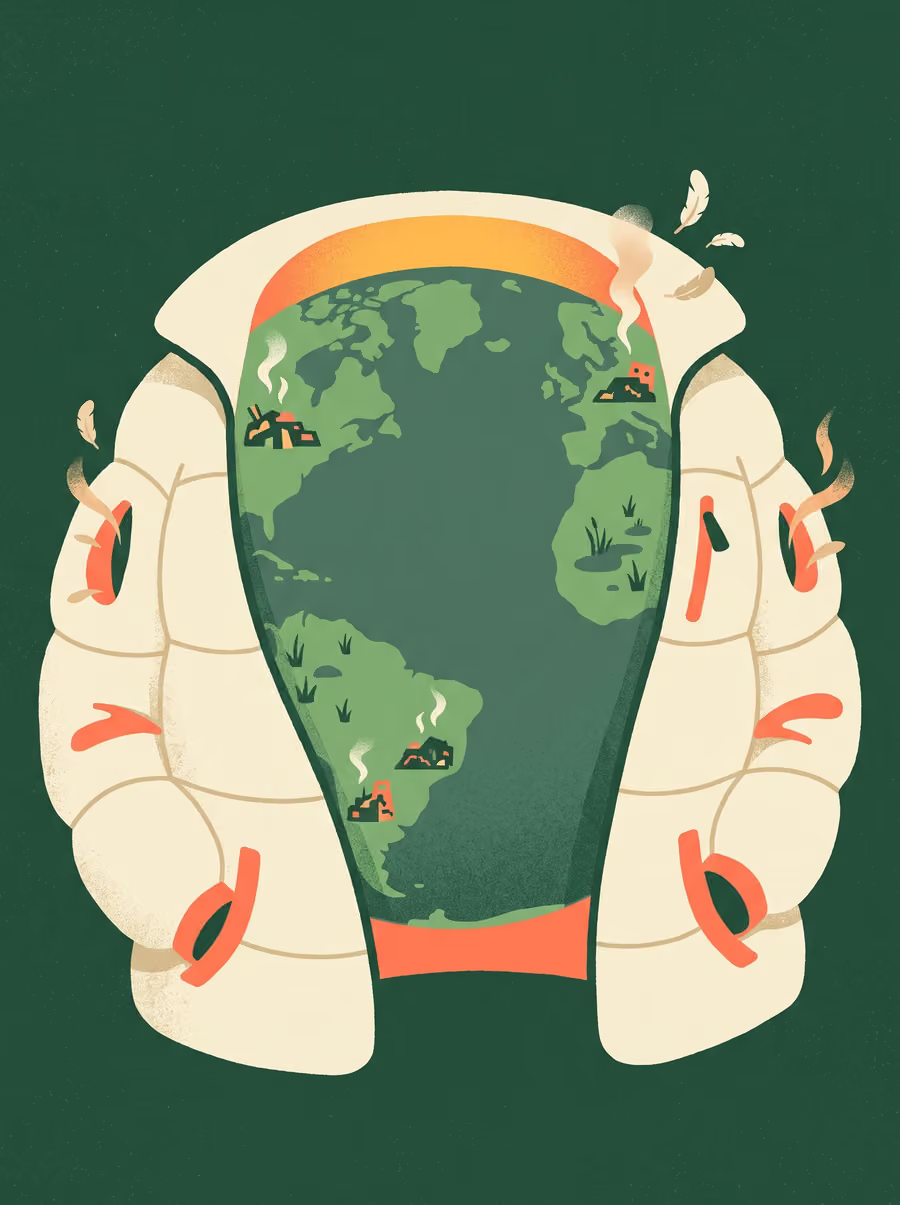 Loop1
Loop1Methane Facts
Methane is the down jacket of the atmosphere, eighty times better than CO2 at trapping heat, and we have doubled it.
Hi, I'm Jenny Mason, your tour guide to Feedback Loops, a journey through food waste cycles and the solutions that curb climate change. Spring is creeping in, and many people in the southwest Rocky Mountain region are creeping out to enjoy warmer desert landscapes, where the days are warm and so are the nights. As long as you pack that down jacket and sleeping bag. Down or the softest layer of feather fluff found on waterfowl is nature's most powerful insulator. The cloud-like fluff traps the heat radiating off your body. In many ways, your puffy gear is your atmosphere. Earth's atmosphere is a mixture of gases including oxygen, carbon dioxide, ozone, and more. Some of these gases block radiation streaming in from the sun. Others like carbon dioxide and methane trap it just like down. Methane can be up to 80 times more heat-absorbent than carbon dioxide. Methane seeps out of diverse sources including natural gas wells, bogs, livestock, and landfills. And although its historic levels averaged 700 to 800 parts per billion, modern human lifestyles have more than doubled methane concentrations to roughly 1800 parts per billion. Don't let the data get you down. Diverting organic matter like food scraps from our landfills is one of the most impactful ways ordinary people can fight climate change. Feedback loops is produced in collaboration with Table to Farm Compost and KDUR. For more information about curbing food waste, visit tabletofarmcompost.com